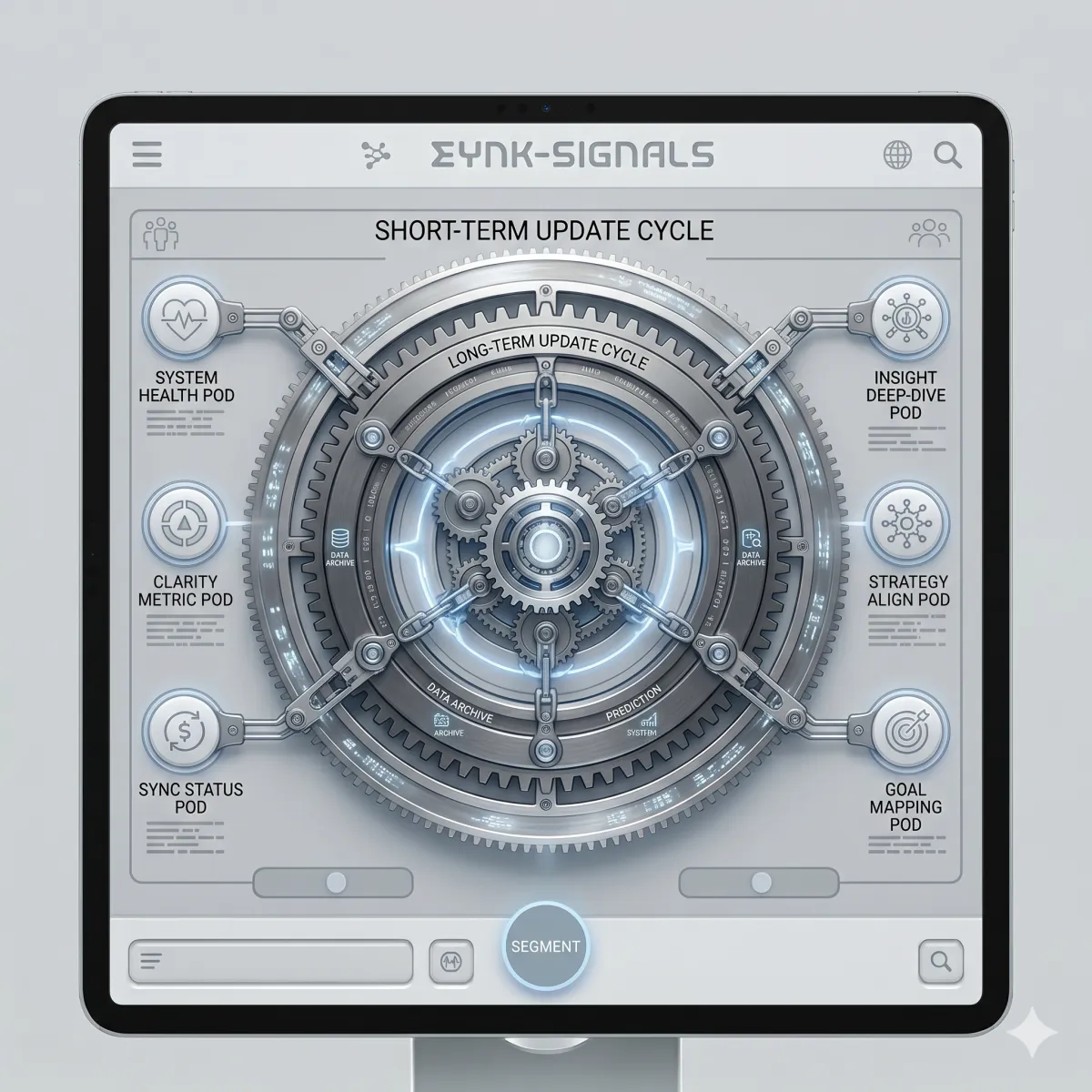
🔄 When to Update Your Target Audience and Buyer Persona (Cadence & Signals)
🔄 When to Update Your Target Audience and Buyer Persona (Cadence & Signals)
Marketing feels safe when it feels clear.
But the market moves.
People change what they want.
They change what they fear.
They change where they hang out.
They change how fast they buy.
If we keep the same target audience and the same buyer persona forever, our message gets stale.
And stale shows up in consumer behavior:
clicks drop
bounce goes up
emails get quiet
calls get weaker
sales slow down
That is not “bad luck.”
That is drift.
This post shows a simple cadence to stay sharp:
a 90-day light check
a 6–12 month deep dive
a change log
a re-test plan
No fancy tools. No guesswork. Just clear moves inside The Buyer Clarity System™.
We do a light refresh every 90 days and a deeper refresh every 6–12 months. We refresh sooner if signals change (CTR, bounce, time, replies, close rate, refunds). We keep a change log and re-test the core message.
🧠 Why target audience and buyer persona drift happens
Even great businesses drift.
Here are common drift causes:
competitors change their offer
prices and budgets change
new fears show up (risk changes)
new channels pop up
your offer changes
your best buyers change
If we don’t update our target audience and buyer persona, we keep talking like it’s last year.
And buyers can feel that.
🎯 Quick definitions (so we update the right thing)
🧭 Target audience (the group)
Our target audience is the group we aim at.
It answers:
Who are we trying to reach?
Example: “Busy parents who want short workouts.”
🧩 Buyer persona (the one person inside the group)
Our buyer persona is the “one person” story inside that group.
It answers:
Why do they buy or not buy?
It includes: pain, dream, doubt, trigger, proof needed.
Target audience = the lake.
Buyer persona = the fish.
We update both, but not the same way.
🔥 The big warning signs (drift signals we can’t ignore)
If we see two or more of these, it’s time to refresh.
📉 Signal: CTR drops
People stop clicking.
Meaning: the hook no longer fits the buyer persona or the target audience moved.
🚪 Signal: Bounce rate spikes
People click, then leave fast.
Meaning: promise mismatch. Our page is not what they expected.
⏱️ Signal: Time on page drops
People don’t stay.
Meaning: the message feels off or confusing.
🖱️ Signal: CTA clicks drop
People read but don’t act.
Meaning: fear is high at the click. Proof and FAQ are not calming them.
💬 Signal: New questions show up
Support and DMs change.
Meaning: doubts shifted. The buyer persona changed.
📞 Signal: Close rate drops
Leads come in but don’t buy.
Meaning: our target audience might be too broad or wrong.
💸 Signal: Refunds or churn rises
People buy, then leave.
Meaning: expectations changed or our promise is unclear.
🧭 Signal: Channel mix changes
Traffic moves from search to social, or desktop to mobile.
Meaning: consumer behavior changed. Our “where” might be wrong.
These are drift signals. They are helpful, not scary.
🗓️ The simple cadence (what to do and when)
We keep it easy:
✅ Every 90 days: Light check (quick tune)
✅ Every 6–12 months: Deep dive (full refresh)
✅ Anytime drift hits: Fast refresh (right away)
This keeps us clear without overworking.
🧩 The 90-day light check (fast and simple)
This is a tune-up, not a rebuild.
🧾 Step 1: Check the main numbers (consumer behavior)
Look at the last 90 days for your main page and offer:
CTR (ad/email/search)
bounce rate
time on page
CTA clicks
conversion rate
close rate (if calls)
refunds/churn (if relevant)
velocity (time to yes)
We don’t need perfect. We need direction.
🗣️ Step 2: Pull 20 fresh buyer words
Grab 20 real lines from:
emails
DMs
support chats
call notes
reviews (yours + competitors)
site search terms
We are looking for repeats.
🧠 Step 3: Ask 5 light-check questions
Did the main pain change?
Did the dream change?
Did the top doubt change?
Did the proof needed change?
Did the best CTA step change?
If one answer is yes, update the persona card.
🛠️ Step 4: Update one thing only
Pick one improvement:
headline angle (pain vs proof)
proof placement (by CTA)
micro-FAQ under CTA
“For…” line (target audience)
CTA step size (guide vs trial vs call)
Then test for one week.
This is how we stay sharp without chaos.
🧭 The 6–12 month deep dive (bigger reset)
Do this when:
you changed your offer
your market got crowded
you enter a new channel
sales slowed for months
you are ready to scale
🧱 Deep dive step 1: Re-check the target audience (the lake)
We ask:
Are we still aiming at the right group?
Is this group still reachable?
Is the pain still strong?
Do they still have budget?
Are we still a strong fit?
If not, we tighten or shift the target audience.
🧠 Deep dive step 2: Rebuild the buyer persona (the fish)
We refresh these fields:
target audience line (“For…”)
pain (in buyer words)
dream (in buyer words)
trigger (why now)
past tries
top doubts
proof needed
first safe step (CTA)
48-hour win
week-one win
words they use (10–15 phrases)
This makes the persona usable again.
🧾 Deep dive step 3: Update your proof stack
Proof drift is real.
Old proof stops working if:
it’s not “like us” proof anymore
the buyer fears changed
the market got noisier
So we update:
3 short review lines for the hero area
1 like-me case story (simple timeline)
4–6 micro-FAQ answers under CTA
🧪 Deep dive step 4: Re-test the core message
We run clean tests:
headline A vs B (pain vs proof)
CTA A vs B (guide vs demo vs trial)
proof placement (by CTA vs lower)
FAQ order (top doubt first vs last)
We change one thing per week.
🧯 When to do a “fast refresh” (right now, not later)
Sometimes we don’t wait 90 days.
Do a fast refresh if:
CTR drops hard in 7–14 days
bounce jumps suddenly
a new objection repeats daily
a new competitor becomes loud
a channel starts failing quickly
⚡ Fast refresh steps (30 minutes)
Update the “For…” line (tighten the group)
Update the top doubt line under CTA
Move proof next to the CTA
Add one micro-FAQ for the new objection
Re-test for one week
Fast refresh keeps the boat steady.
📌 What usually changes first (and what that means)
Most drift happens in these places:
🗣️ Words change first
New phrases show up.
Example: buyers stop saying “more leads” and start saying “more booked calls.”
That is a buyer persona refresh.
💬 Doubts change second
New fears show up.
Example: “Will this work?” becomes “Will this waste money?”
That is a proof + FAQ refresh.
🧭 Channels change third
People move where they search.
Example: less search, more social.
That is a target audience channel refresh.
We watch behavior. We adjust in order.
🧾 The change log (so we don’t forget what worked)
A change log is your memory.
Without it, we repeat mistakes.
✅ Change log template (copy/paste)
date
what we changed (target audience or buyer persona)
why we changed it (which signal)
what we edited (headline, CTA, proof, FAQ)
result after 7 days
winner or loser
next test idea
This makes growth calmer.
🧠 The re-test plan (so we don’t scale a stale message)
Before we scale ads or content, we check:
Is our “For…” line still sharp?
Is our buyer persona message still true?
Do we have “like-me” proof by the CTA?
Do our top 5 FAQs match real questions?
Is our CTA step safe for stage?
Then we run one small test.
Scale comes after clarity.
🧩 How to tell what to update (target audience vs buyer persona)
Here’s the simple diagnosis.
🎯 If these are weak, update target audience
CTR low across all messages
leads are wrong people
sales calls start with “I’m not sure this is for me”
channels feel expensive everywhere
That means aim is off.
👤 If these are weak, update buyer persona
bounce high after click
time on page low
CTA clicks low
objections repeat
conversions drop but targeting is the same
That means message is off.
Aim first. Message second.
🧰 A simple 90-day checklist (print this)
✅ 90-day target audience check
Our “For…” line is specific
Our ads are not broad
We can name one primary group
Our channels match how they behave
Lead quality is mostly right
✅ 90-day buyer persona check
Pain words still match real buyer words
Top doubt still matches real questions
Proof needed still matches buyer fears
CTA step still fits stage
Our FAQs match real objections
If 2+ boxes fail, refresh.
📈 Why this helps us rank for “buyer persona”
Search engines love pages that:
define terms clearly
answer real questions
have clean structure
repeat the keyword naturally
This post uses buyer persona in:
title and definitions
headings and explanations
FAQs and examples
That supports our ranking plan across search engines and answer engines.
❓ FAQ — Update Target Audience and Buyer Persona
1) How often should we update our buyer persona?
We do a light check every 90 days and a deeper refresh every 6–12 months. Update sooner if consumer behavior signals drop fast.
2) How often should we update our target audience?
We review target audience focus every 90 days. We re-check deeply every 6–12 months or anytime lead quality shifts.
3) What consumer behavior signals tell us a refresh is needed?
CTR drops, bounce rises, time on page falls, CTA clicks drop, new objections repeat, close rate drops, or refunds rise.
4) What is the difference between updating target audience and buyer persona?
Target audience updates change who we aim at and where we show up. Buyer persona updates change the pain, doubt, proof, and CTA message.
5) What is a 90-day light check?
A 90-day light check is a quick tune-up: look at KPIs, pull new buyer words, update one line, and run one small test.
6) What is a 6–12 month deep dive?
A deep dive is a bigger reset: re-check the target audience, rebuild the buyer persona fields, refresh proof, and re-test core messages.
7) What should we update first when performance drops?
Start with the “For…” line and the top doubt under the CTA. Then move proof by the button. These are fast wins.
8) How do we avoid persona drift?
We pull fresh buyer words weekly, keep a change log, and update the buyer persona every 90 days so it stays real.
9) How do we avoid target audience drift?
We stop mixing audiences in the same campaigns and track lead quality by slice so we know who is really responding.
10) How do we know our refresh worked?
Consumer behavior improves: CTR up, bounce down, more CTA clicks, higher conversion, better close rate, and faster time-to-yes.
11) Should we refresh FAQs when we refresh personas?
Yes. FAQs should mirror real objections from emails, chats, and calls. Old FAQs often stop calming fear.
12) What is the biggest mistake when updating a buyer persona?
Changing too many things at once. Use one-change-one-week tests so learning stays clean.
📌 Key Takeaways
Update buyer persona and target audience on a rhythm: 90-day light check, 6–12 month deep dive
Watch consumer behavior signals: CTR, bounce, time, CTA clicks, conversions, close rate, refunds, velocity
Use a change log so you don’t forget what worked
Refresh “For…” line + top doubt + proof-by-CTA first for fast wins
Re-test core messages before scaling
Clear buyer persona language supports SEO and AEO
This is buyer clarity inside The Buyer Clarity System™
🎁 Complimentary Ebook
Want the 90-day checklist, the change log template, and the re-test plan in one place?
Grab our COMPLIMENTARY Buyer Clarity Guide here:
👉 Download your complimentary ebook now
🧭 Final Word
Markets move. We move with them.
We keep our target audience clear.
We keep our buyer persona real.
We watch consumer behavior.
We tune on rhythm.
That’s how we stay sharp and keep converting—inside The Buyer Clarity System™.
