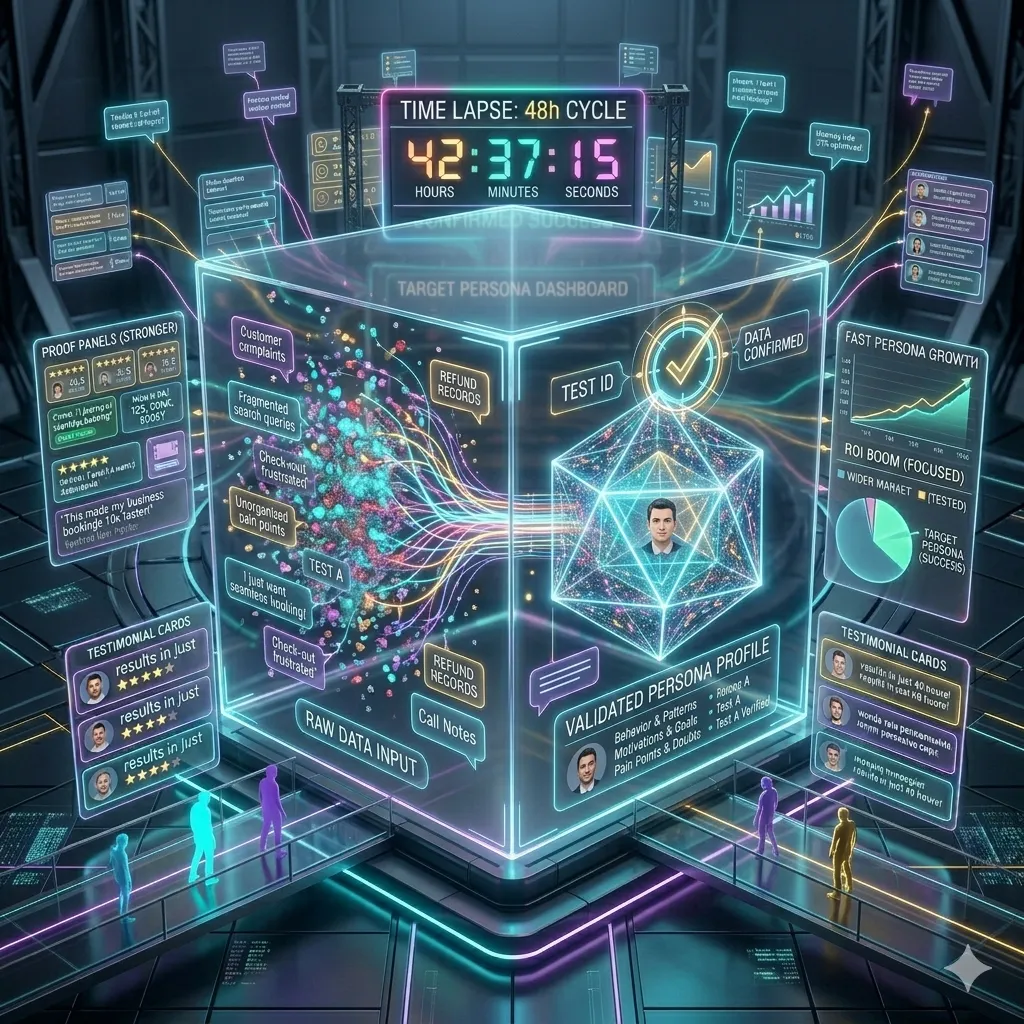
✅ Validate Your Buyer Persona With Consumer Behavior (No Guessing)
✅ Validate Your Buyer Persona With Consumer Behavior (No Guessing)
A buyer persona is not “true” because it looks nice.
It’s true when it performs.
When the buyer persona is right, your target audience feels seen. Pages get clicks. Emails get replies. Calls get booked. Sales happen with less pushing.
When it’s wrong, you feel it fast:
low CTR
high bounce
weak replies
“not a fit” calls
slow sales
refunds
That is consumer behavior talking.
So instead of guessing, we validate the persona like a simple test. This is a core habit inside The Buyer Clarity System™.
Write your buyer persona as a hypothesis, run a small test plan (one page + one offer + one channel), track behavior signals (CTR, time, bounce, opt-ins, close rate), and iterate weekly until the persona is clearly winning.
💡 Buyer persona: What “validation” means (simple definition)
Validating a buyer persona means:
We prove that our persona matches real buyers by measuring what they do.
Not what we think.
Not what we hope.
What they do.
That’s consumer behavior.
🧠 Consumer behavior: The difference between a “made-up persona” and a “validated persona”
🚫 Made-up buyer persona
built on opinions
heavy on demographics
light on fears and triggers
not tested on a page
not tied to KPIs
✅ Validated buyer persona
built from real words
clear pain + dream + doubt
tested with a real page and offer
confirmed by behavior signals
updated weekly
Validation makes your persona useful.
🧭 Step 1: Turn your buyer persona into a clear hypothesis
A test needs a hypothesis.
Here’s the easiest one:
🧩 Buyer persona hypothesis template
“If we write a page for [buyer persona], they will:
click at a higher rate
stay longer
take the next step more often
because the message matches their pain and proof needs.”
Now we test it.
🧱 Step 2: Build the one-page persona test (one slice, one CTA)
We don’t test a persona with 10 pages.
We test it with one clean page.
✅ Persona test page must include
hero headline in buyer words
one clear CTA
proof near the CTA
3-step path with time tags
micro-FAQ under the CTA
one “48-hour win” line
This page is the “persona mirror.”
🎯 Step 3: Pick one offer that matches the stage
Stage matters.
cold persona → guide/checklist/quiz
warm persona → trial/audit/demo
hot persona → book/buy
If we mismatch stage, we get fake “no’s.”
So pick the safest step for the stage.
🧪 Step 4: Run the test plan (small, clean, fast)
Keep the test simple:
one buyer persona
one page
one offer
one channel
one week
That’s it.
✅ Simple channel choices
search traffic (SEO or small paid search)
a small social test ($10/day)
a warm email segment (if you have a list)
The goal is not huge data.
The goal is a clear signal.
📊 Step 5: Track the validation metrics (consumer behavior signals)
Here are the core persona validation signals.
🎯 CTR (buyer persona signal)
CTR answers: “Does this feel like me?”
low CTR = wrong hook or wrong persona
higher CTR = message match
⏱️ Time on page (buyer persona signal)
Time answers: “Do they care enough to read?”
low time = confusion or mismatch
higher time = interest and trust
🚪 Bounce rate (buyer persona signal)
Bounce answers: “Did they leave fast?”
high bounce = broken promise match
lower bounce = page feels right
🖱️ CTA clicks (buyer persona signal)
CTA clicks answer: “Does the next step feel safe?”
low clicks = fear at the button
higher clicks = trust rising
🧾 Opt-ins / conversions (buyer persona signal)
Conversion answers: “Did they take the step?”
low conversion = offer too big, form too hard, wrong stage
higher conversion = persona + offer fit
📞 Close rate (buyer persona signal)
Close answers: “Is this the right buyer?”
low close = wrong persona fit
higher close = persona is real
⏳ Velocity (buyer persona signal)
Velocity answers: “Do they move fast?”
slow velocity = lingering doubts
faster velocity = clarity and trust
These are all consumer behavior signals.
🎨 A simple “green/yellow/red” persona scorecard
You don’t need fancy math.
Use colors.
🟩 Green signals (persona likely right)
CTR up
time on page up
CTA clicks up
conversions up
close rate stable or rising
refunds low
🟨 Yellow signals (persona needs tuning)
good CTR but low conversion
good time but low clicks
conversions but low close
🟥 Red signals (persona likely wrong)
low CTR + high bounce
low time on page
weak leads
high refunds
Color makes the decision easy.
🧠 What to change based on results (the iteration map)
When the test is not green, we don’t panic. We fix the first broken link.
🧯 If CTR is low (persona hook problem)
Fix:
change headline angle (pain vs proof vs dream)
use exact buyer words from reviews/emails
tighten the “For…” line
🧯 If bounce is high (promise match problem)
Fix:
match ad promise to page headline
remove extra offers
add micro proof under headline
🧯 If time is low (clarity problem)
Fix:
shorten hero
add 3-step path with time tags
add “For/Not-for” box
🧯 If CTA clicks are low (trust problem)
Fix:
put proof next to CTA
add micro-FAQ under CTA
make CTA smaller (guide first)
🧯 If conversions are low (friction problem)
Fix:
reduce form fields
improve mobile button size
explain “what happens next” clearly
🧯 If close rate is low (fit problem)
Fix:
tighten target audience slice
add “not for you if…”
align pricing and expectations
One change. One week. One winner.
🗓️ The 7-day persona validation plan (simple schedule)
Day 1: Build the persona test page
Hero + proof + steps + FAQ + CTA
Day 2: Launch one traffic source
Email or $10/day social or small search
Day 3–6: Let it run
Don’t change anything mid-test.
Day 7: Review metrics
CTR → time → bounce → clicks → conversions → close quality
Pick one fix for next week.
Repeat.
🧪 Mini examples of validation signals (what they mean)
Example: CTR high, conversion low
Meaning: message is good, step is too big.
Fix: smaller CTA, shorter form, proof by button.
Example: time high, CTA clicks low
Meaning: they’re interested but scared.
Fix: add micro-FAQ under CTA + like-me proof.
Example: conversion high, close low
Meaning: leads aren’t the right fit.
Fix: tighten persona slice, add “not for you” filter.
Example: bounce high
Meaning: mismatch between click promise and page promise.
Fix: mirror headline and offer.
These patterns help you tune without guessing.
❓ FAQ — validate buyer persona with consumer behavior
How do we validate a buyer persona?
Validate a buyer persona by running a small test: one persona page, one offer, one channel, one week. Track consumer behavior KPIs like CTR, time, bounce, CTA clicks, conversions, and close rate.
What is the best KPI to validate a buyer persona first?
CTR is a strong first signal because it shows message match. Then check conversion and close rate to confirm buyer fit.
How long should a buyer persona validation test run?
Run for one week or until you have enough traffic to see stable patterns. Keep the test clean with one change at a time.
What if we have low traffic—can we still validate a buyer persona?
Yes. Use email, small paid tests, or direct outreach to get initial signals. Look for patterns, not perfect stats.
What does high bounce mean for buyer persona validation?
High bounce usually means promise mismatch or wrong persona targeting. Mirror the headline and tighten the target audience slice.
What does “CTR high but conversion low” mean?
It usually means the hook is right but the next step is too big. Make the CTA smaller and reduce friction.
What does “conversion high but close low” mean?
It means leads are not the right fit. Tighten your persona and add “not for you if…” filters.
How often should we update a buyer persona after validation?
Update weekly with new buyer words and KPI signals. Do a deeper refresh every 90 days.
Should we validate buyer persona by segment?
Yes. Validate a buyer persona per target audience slice. Blending hides the truth.
What is the biggest mistake in buyer persona validation?
Changing too many things at once. Keep it one change, one week, one winner.
📌 Key Takeaways
A validated buyer persona is proven by consumer behavior, not opinions
Write a persona hypothesis, then test one page + one offer + one channel
Track CTR, time, bounce, CTA clicks, conversion, close rate, and velocity
Use a simple green/yellow/red scorecard
Fix the first broken link (hook → match → trust → friction → fit)
Iterate weekly with one change at a time
This builds buyer clarity inside The Buyer Clarity System™
🎁 Complimentary Ebook
Want the persona validation scorecard and test plan worksheet?
Grab our COMPLIMENTARY Buyer Clarity Guide here:
👉 Download your complimentary ebook now
🧭 Final Word
A buyer persona is not a belief.
It’s a bet.
Place the bet small. Measure consumer behavior. Keep winners. Fix weak links. Then scale with confidence—inside The Buyer Clarity System™.
