🔄 When and How to Update Your Market Segments (Signals and Timing)
🔄 When and How to Update Your Market Segments (Signals and Timing)
Markets change. Buyers change.
But most businesses keep the same segments for years.
Then the ads stop working.
The page feels “off.”
The calls get quieter.
And it feels like a mystery.
It’s not a mystery.
It’s usually one thing:
Your market segmentation is stale.
When we refresh our market segmentation, we realign our target audience with real consumer behavior. We update our buyer persona using fresh buyer words. We get back to buyer clarity—the calm feeling of “we know what to do next”—inside The Buyer Clarity System™.
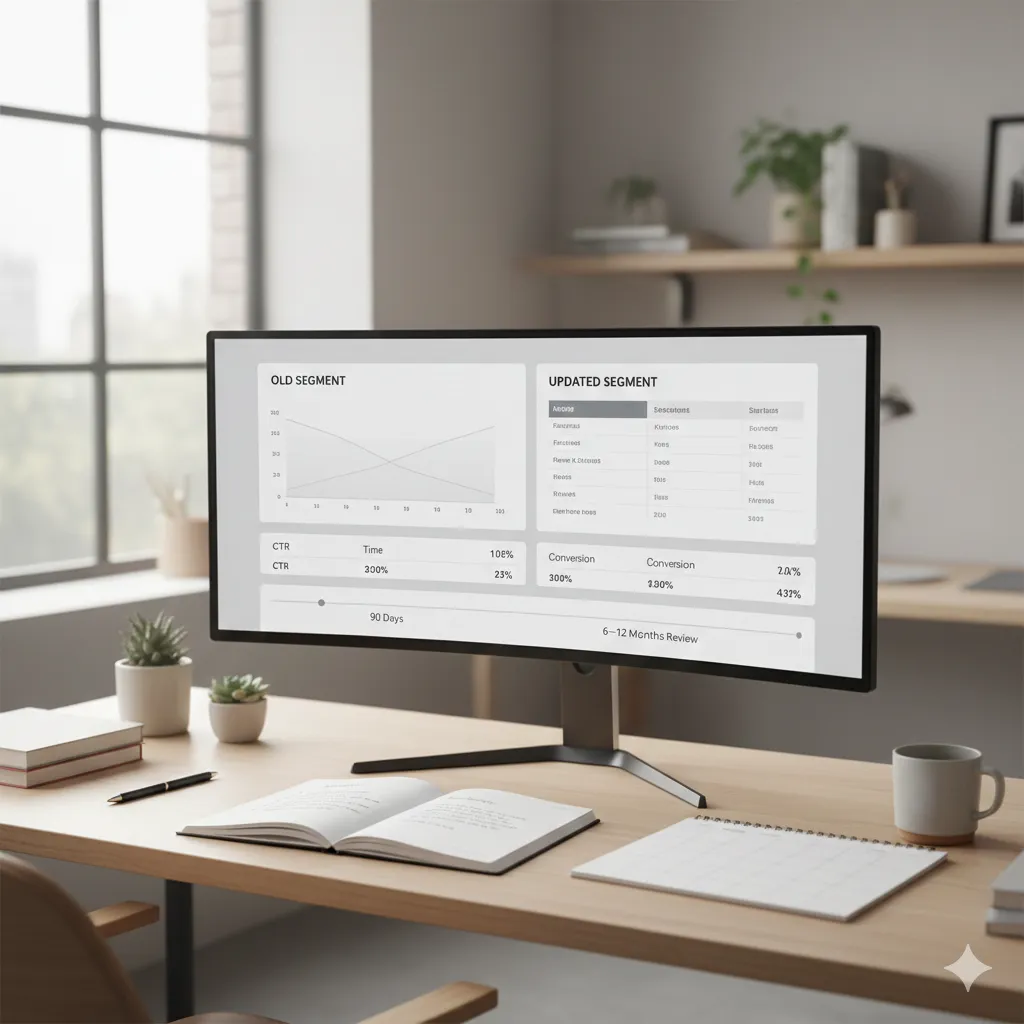
Do a light market segmentation check every 90 days and a deeper refresh every 6–12 months. Update sooner if behavior signals drop (CTR, time, conversion) or buyer questions change.
💡 Why updating market segmentation keeps small businesses alive
Small businesses can’t afford stale aim.
Updating market segmentation helps because it:
keeps your message matching the current target audience
lowers wasted spend on wrong clicks
protects your close rate and LTV
prevents “we tried everything” burnout
makes your buyer persona stay real
follows real consumer behavior instead of opinions
If your message used to work and now it doesn’t, don’t blame yourself.
Blame the drift.
Then fix it.
🔎 What it means to “update market segments” in plain words
Updating market segmentation means we:
re-check our slices
re-score our slices
re-pick our main target audience
re-write the core message using fresh buyer words
re-align offers to stage (cold/warm/hot)
We don’t rebuild everything.
We tune the system.
Small tuning beats big panic.
🚨 Update triggers for market segmentation (signals that your segments are off)
If you see two or more of these, refresh your market segmentation now.
📉 CTR drops for a market segmentation slice
Your hook doesn’t match the slice anymore.
⏱️ Time on page drops for a market segmentation slice
Your message feels less “for us.”
🚪 Bounce rate spikes for a market segmentation slice
The ad promise and page promise don’t match, or the slice changed.
🖱️ CTA clicks stall for a market segmentation slice
The next step feels risky or unclear for that slice.
🧾 Conversion drops for a market segmentation slice
The offer is too big, too small, or wrong for the slice’s stage.
💬 New questions show up for a market segmentation slice
Buyers start asking new “what if” questions. That means needs shifted.
📍 Channel shifts happen for a market segmentation slice
Traffic moves: more mobile, more search, more social, different times of day.
🔁 Refunds/churn rise for a market segmentation slice
Promises and expectations are no longer aligned for that slice.
These are consumer behavior alarms.
Listen early. Fix fast.
🧭 The 90-day light check for market segmentation (fast, simple, repeatable)
Every 90 days, do this light check. It’s quick and calm.
📊 Pull the simple numbers for market segmentation slices
For each market segmentation slice, track:
CTR
time on page
bounce rate
CTA clicks
conversion rate
cost per lead (if paid)
lead-to-call / close rate (if relevant)
You’re not looking for perfect.
You’re looking for dips.
🗣️ Pull fresh buyer words for market segmentation slices
Collect:
10–20 reviews (yours + competitors)
10 inbox lines (sales + support)
10 chat lines (objections and “why now”)
10 comments (questions and fears)
top site searches (and zero-result terms)
This is raw consumer behavior in words.
🔍 Spot drift in market segmentation slices
Ask:
What pain shows up more now?
What “why now” triggers are new?
What fear is louder?
What proof do they demand?
✍️ Make one market segmentation change
Pick one:
new headline angle (pain vs proof vs dream)
move proof next to CTA
reorder FAQs by slice fears
swap offer size (guide → trial → call)
tighten “For/Not-for” list
One change. One week. One winner.
🧭 The 6–12 month deep dive for market segmentation (realignment, not chaos)
This is the bigger refresh. Do it twice a year or once a year.
🧩 Rebuild the market segmentation slice list
Write your 5–8 possible slices again.
Use real inputs:
buyer questions
buying triggers
past tries
urgency levels
budgets
roles
behavior patterns
🧮 Re-score market segmentation slices (urgency, budget, reach, fit)
Score each slice 1–5:
urgency
budget
reach
fit
Add the score.
Pick the top 3–5 slices to keep.
Pick the #1 slice as your main target audience for the next quarter.
🪪 Refresh the buyer persona inside the market segmentation slice
Update the buyer persona card using new buyer words:
pain
dream
trigger
past tries
fears
proof needed
first step
week-one win
If the words changed, your page must change too.
🧱 Re-align pages and offers to market segmentation slices
one page per slice
one promise per page
one main CTA per page
proof by the button
FAQs by slice
This is buyer clarity made visible.
🧾 The change log for market segmentation (how to stop repeating mistakes)
Most teams forget what they changed.
Then they repeat the same tests again and again.
A change log fixes that.
📝 Simple market segmentation change log (copy this)
For each change, record:
date
slice name
what changed (headline, CTA, offer, proof, FAQ)
why we changed it (which signal dipped)
result after 7 days
what we learned (1 sentence)
next test idea
This turns marketing into learning, not guessing.
🧠 How to update market segmentation without breaking everything (safe process)
People fear updates because they fear loss.
So we update the safe way:
keep the old slice page live
build the new slice page as a variant
split traffic
let consumer behavior choose
keep the winner
No panic. No massive rebuild. Just calm tests.
🔁 What to change first when market segmentation shifts (order of impact)
If segments drift, start here:
headline/hook (CTR)
promise match (bounce)
proof placement (CTA clicks)
offer size (conversion)
fit filters (close rate + refunds)
Fix the first broken link.
Then move down.
🧩 Mini examples: market segmentation updates in real life
🛠️ Service business market segmentation update
Signal: CTR down + new question: “Do you guarantee results?”
Update: Add a proof-seeker slice, tighten “For/Not-for,” add clearer deliverables and timeline.
Result: CTA clicks rise because trust increases.
💻 SaaS market segmentation update
Signal: same traffic, lower trials, more “Does it work with ___?” questions
Update: Create an integration-focused slice page and put proof next to CTA.
Result: conversion improves for that slice.
📍 Local market segmentation update
Signal: more late-night mobile traffic + more “class times” searches
Update: shift slice priority to busy parents, add schedule-first hero and sticky CTA.
Result: bookings rise.
🛒 Ecommerce market segmentation update
Signal: higher refunds + reviews mention “too strong”
Update: build sensitive-skin slice with sample kit and clear ingredients “For/Not-for” box.
Result: refunds fall, repeat buyers rise.
These are segment shifts, not product problems.
🧠 What most people miss when updating market segmentation (the hidden truth)
They update the segment name…
but keep the same offer.
That fails.
When a slice shifts, these often shift too:
what they fear
what proof they need
how fast they want results
what they tried before
what first step feels safe
That’s why market segmentation updates must touch: message, proof, and next step.
❓ FAQ (AEO-Ready) for market segmentation updates
When should we update market segmentation?
Update market segmentation every 90 days lightly and every 6–12 months deeply. Update sooner if consumer behavior signals drop.
What are the clearest signals that a market segment is stale?
CTR drops, time on page drops, bounce spikes, CTA clicks stall, conversion drops, new questions appear, or refunds rise.
How often should we change our target audience slice?
Your main target audience can change quarterly if data shows another slice is stronger.
What should we update first when market segmentation shifts?
Start with headline and promise match, then proof placement, then offer size, then fit filters.
How do we avoid breaking our funnel when updating segments?
Create a new version, split traffic, and let consumer behavior pick the winner.
What is a market segmentation change log?
It’s a simple record of what you changed, why, what happened, and what you learned—so you don’t repeat mistakes.
Do we need new landing pages when market segments change?
Often yes. One page per market segmentation slice keeps the message and CTA clean.
How do we find new segment ideas?
Look at buyer questions, on-site searches, reviews, inbox messages, and channel shifts. These are real consumer behavior clues.
What if we have low traffic—can we still update segmentation?
Yes. Use buyer words and patterns. You don’t need big numbers to see repeat pains and fears.
How does market segmentation affect the buyer persona?
Segments shape the buyer persona. When segments change, the persona’s pain, trigger, and proof needs often change too.
📌 Key Takeaways for market segmentation updates
Refresh market segmentation before performance collapses
Use behavior triggers: CTR, time, bounce, conversion, new questions, channel shifts
Do a 90-day light check and 6–12 month deep dive
Keep a change log to learn faster
Update safely with split tests, not big rebuilds
Fix the first broken link (hook → match → proof → offer → fit)
Let consumer behavior guide every change
This creates buyer clarity inside The Buyer Clarity System™
🎁 Complimentary Ebook
Want the 90-day checklist, deep dive worksheet, and change log template?
Grab our COMPLIMENTARY Buyer Clarity Guide here:
👉Download your complimentary ebook now
🧭 Final Word
Markets move. That’s normal.
The win is not “never change.”
The win is “change with confidence.”
Update market segmentation on a rhythm. Watch consumer behavior. Keep a log. Run tiny tests. Stack wins.
That’s how we stay clear and grow steady—inside The Buyer Clarity System™.
