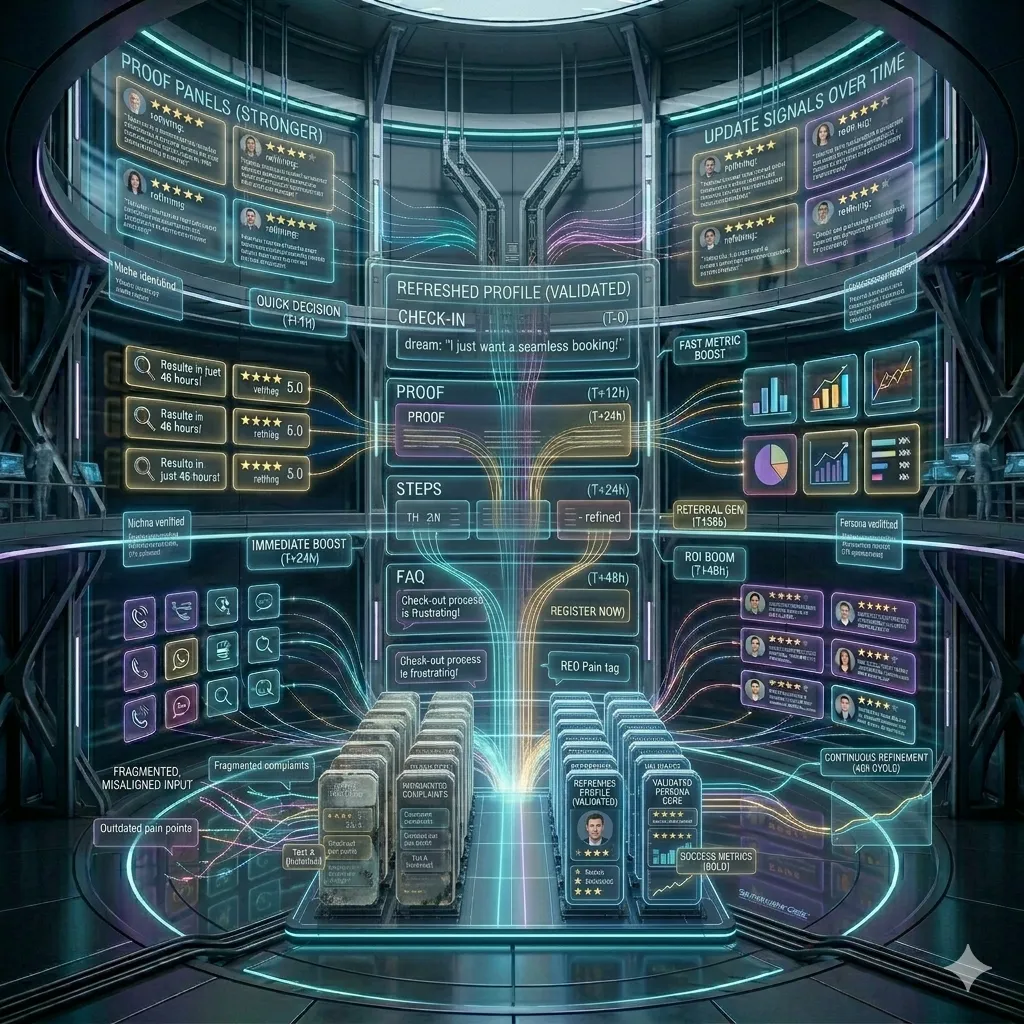
🔄 When to Update Your Buyer Persona (Signals, Cadence, Checklist)
🔄 When to Update Your Buyer Persona (Signals, Cadence, Checklist)
A buyer persona is not a tattoo.
It’s a tool.
Markets move. Competitors change. Your offer changes. Your buyers change.
And when your buyer persona gets stale, you feel it:
ads stop clicking
pages feel “off”
emails get quiet
sales slow down
refunds creep up
That’s not “bad luck.”
That’s consumer behavior telling you the persona drifted.
This post shows how often to refresh personas, what triggers a refresh, and how to do it without rebuilding everything. This is how we keep buyer clarity inside The Buyer Clarity System™.
Do a light buyer persona review every 90 days and a deeper refresh every 6–12 months. Refresh sooner if behavior signals drop (CTR, time, conversion) or buyer questions change.
💡 Buyer persona: Why personas go stale
Most personas go stale for simple reasons:
buyers learn new options (competition)
prices and budgets change
new fears pop up (risk shifts)
language changes (new phrases, new slang)
channels change (more mobile, more social, more AI search)
your offer changes (new package, new promise)
If the persona stays frozen while the world moves, your message stops fitting.
🚨 Consumer behavior triggers that scream “update the buyer persona”
If you see two or more of these, refresh now.
📉 CTR drops (buyer persona hook mismatch)
Your promise no longer grabs the right target audience.
🚪 Bounce rate spikes (buyer persona promise mismatch)
They click… then leave fast.
Your page is not matching what they expected.
⏱️ Time on page falls (buyer persona clarity problem)
They’re not staying long enough to trust you.
🖱️ CTA clicks stall (buyer persona trust problem)
Fear spikes at the button. Proof and FAQ aren’t answering the doubt.
🧾 Conversion drops (buyer persona offer-stage mismatch)
The step is too big or too small for the buyer’s stage.
💬 New questions show up (buyer persona doubt shift)
Support, DMs, and sales calls start repeating new objections.
🔁 Refunds/churn rise (buyer persona expectation shift)
Your promise doesn’t match what they thought they bought.
📍 Channel shift happens (buyer persona behavior shift)
Traffic patterns change: device, time of day, or source changes.
These are behavior alarms. Don’t ignore them.
🧭 The 90-day light review (buyer persona tune-up)
This is the fast check. It’s not a full rebuild.
✅ Step: Pull the simple behavior numbers
For your main persona page and offer, look at:
CTR (ads/email/search)
bounce rate
time on page
CTA clicks
conversion rate
lead quality (if calls)
time-to-yes (velocity)
Circle any big drops.
✅ Step: Pull 20 fresh buyer words
Collect 20 lines from:
reviews
emails/chats
call notes
site search terms
ad comments
You want fresh language, not old assumptions.
✅ Step: Compare old persona words vs new words
Ask:
did the main pain change?
did the main “why now” trigger change?
did the main doubt change?
did the proof needed change?
did the best first step change?
If yes, update the persona card.
✅ Step: Make one page adjustment
Pick one change to test this week:
headline angle (pain vs proof vs dream)
proof placement (by CTA)
micro-FAQ under CTA
“for/not-for” box
smaller CTA for cold traffic
One change. One week. One winner.
🧭 The 6–12 month deep dive (buyer persona refresh)
This is the bigger reset.
Do this if:
you changed your offer
your market shifted
you launched into new channels
you added new segments
✅ Deep dive: Rebuild the buyer persona from five sources
call notes
support inbox
refunds/cancels
reviews (yours + competitors)
search terms (including zero-result queries)
✅ Deep dive: Update the persona card (one page)
Update these fields:
target audience line (role + situation)
pain (in buyer words)
dream (in buyer words)
trigger (why now)
past tries
top doubts
proof needed
first safe step
48-hour win
week-one win
words they use (10 real phrases)
✅ Deep dive: Re-test the core messages
Run small tests:
headline A/B (pain vs proof)
CTA A/B (guide vs trial)
proof placement A/B (near CTA vs lower)
FAQ order A/B (top doubt first)
This confirms the refreshed persona is real.
🧾 The buyer persona change log (don’t lose the learning)
Most teams forget what they changed.
Then they repeat the same mistakes.
A change log fixes that.
✅ Buyer persona change log template
date
what changed (pain/doubt/proof/CTA)
why it changed (which behavior signal)
what we updated on the page/email
result after 7 days
what we learned (one sentence)
This turns persona work into progress.
🧠 What to refresh first (order of impact)
If you’re overwhelmed, refresh in this order:
buyer words in the headline
top doubt and its answer (micro-FAQ)
proof needed (move proof by CTA)
first safe step (CTA size and offer)
trigger language (why now)
Fix the first broken link first.
🧪 What a persona refresh looks like (simple examples)
Example: CTR down, bounce up
Meaning: hook and promise mismatch.
Refresh: update headline using new buyer pain words.
Example: time on page down, CTA clicks down
Meaning: trust is missing.
Refresh: update proof type and move it by CTA.
Example: conversions down, leads low quality
Meaning: offer-step mismatch.
Refresh: change CTA (guide first) or tighten “for/not-for.”
Example: refunds up
Meaning: expectations are off.
Refresh: update “not for you if” and “what happens next.”
This is how behavior tells you what to change.
🔁 Simple schedule (so you actually do it)
✅ 90-day light review
quick KPI check
pull 20 new buyer words
update 1 persona line
test 1 page change
✅ 6–12 month deep dive
refresh all persona fields
update pages and emails
re-test core messages
This keeps your persona alive.
❓ FAQ — update buyer persona
How often should we update a buyer persona?
Do a light update every 90 days and a deeper refresh every 6–12 months, using consumer behavior signals.
What triggers a buyer persona refresh?
CTR drops, bounce spikes, time on page falls, CTA clicks stall, conversions drop, new objections show up, refunds rise, or channel behavior shifts.
Do we need to rebuild the whole buyer persona each time?
No. Most updates are small. Start by refreshing the headline words, top doubts, and proof placement.
What data should we use to update a buyer persona?
Use calls, emails, support chats, refunds, reviews, and search terms. These show real consumer behavior.
How do we re-test a refreshed buyer persona?
Run small A/B tests: headline angle, CTA size, proof placement, and FAQ order. Let behavior choose winners.
What is a buyer persona change log?
It’s a record of what changed, why it changed, and what result you saw. It stops repeated mistakes and speeds learning.
How do we know if our buyer persona is stale?
Your numbers and buyer questions change. If behavior drops or new doubts appear, the persona needs a refresh.
What should we update first in a buyer persona?
Update buyer words in the headline, then top objections, then proof needed, then CTA step size.
Can we update buyer personas per segment?
Yes. Each target audience slice may shift differently. Track persona signals by slice when possible.
What is the biggest mistake when updating buyer personas?
Changing too many things at once. Keep it one change per week so you can learn clearly.
📌 Key Takeaways
Update your buyer persona every 90 days lightly and every 6–12 months deeply
Use consumer behavior triggers: CTR, bounce, time, clicks, conversions, refunds, new questions
Pull fresh buyer words from calls, emails, reviews, refunds, and search terms
Keep a change log so learning stacks
Re-test core messages with small A/B tests
Fix the first broken link (hook → trust → friction → fit)
This keeps buyer clarity alive inside The Buyer Clarity System™
🎁 Complimentary Ebook
Want the 90-day checklist and persona change log template?
Grab our COMPLIMENTARY Buyer Clarity Guide here:
👉 Download your complimentary ebook now
🧭 Final Word
Personas don’t fail because you built them “wrong.”
They fail because you stop feeding them truth.
Watch consumer behavior. Refresh on rhythm. Test small. Keep winners.
That’s how we stay clear and keep converting—inside The Buyer Clarity System™.
