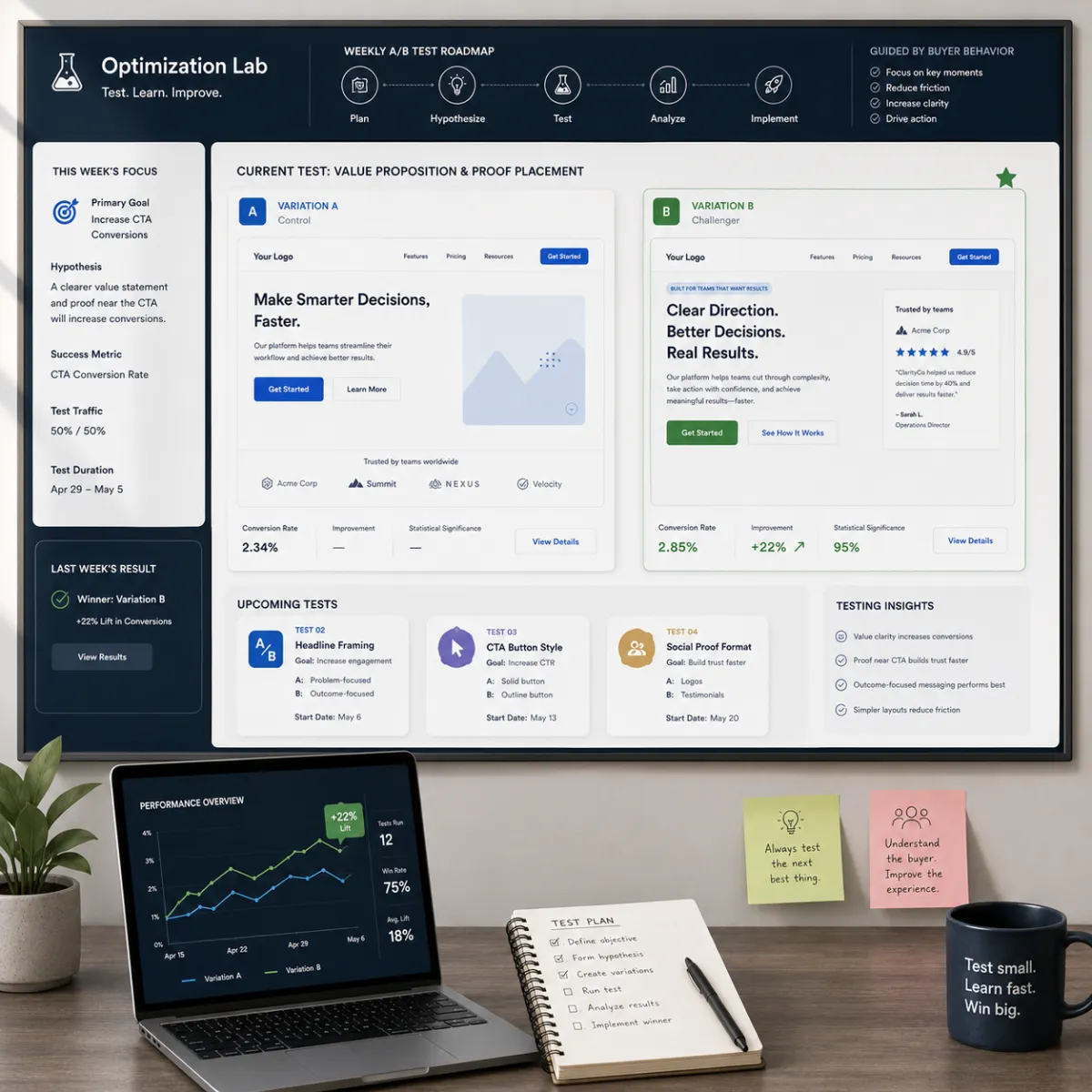
🧪 Weekly Tiny Tests: A/B Plan That Uses Your Buyer Persona
🧪 Weekly Tiny Tests: A/B Plan That Uses Your Buyer Persona
Big changes feel productive.
New homepage. New funnel. New offer. New ads.
All at once.
But big changes create one big problem:
We don’t know what worked.
So we do the opposite.
We run tiny tests each week—small, clean A/B tests guided by one thing:
Your buyer persona.
Because the buyer persona tells us what matters:
what hurts
what they want
what they fear
what proof they need
what step feels safe
Tiny tests let us improve without panic.
They turn guesswork into steady wins. That’s how we attract ideal clients inside The Buyer Clarity System™.
Run one tiny test per week. Change one variable only. Test in order: hook → promise match → proof placement → objections → CTA step size. Use consumer behavior metrics (CTR, bounce, time, CTA clicks, conversions, lead quality) to pick winners.
🧠 What a “tiny test” is (simple definition)
A tiny test is a small A/B test that changes:
one line
one block
one button
one placement
Not the whole page.
Tiny tests are great because they:
cost less
teach faster
reduce risk
stack into big growth
🎯 Why buyer persona should guide every test
Without a buyer persona, tests become random.
We test things because we saw someone else do it.
That wastes time.
A buyer persona helps us test what truly moves the brain:
pain vs dream
proof type
proof placement
objections
CTA size and safety
That’s how tests become meaningful.
🧩 The non-negotiable rules (so tests don’t lie)
✅ Rule 1: One change only
If you change two things, you don’t know what caused the result.
✅ Rule 2: One week per test
Behavior changes by weekdays vs weekends.
One week smooths the noise.
✅ Rule 3: Same audience, same budget
Don’t change targeting mid-test.
✅ Rule 4: Pick a “win metric” before you start
Know what you’re trying to improve.
✅ Rule 5: Log the test
If you don’t log, you repeat mistakes.
🧭 The best test order (what to test first)
We test in this order because it matches consumer behavior:
Hook (headline angle)
Promise match (ad → page)
Proof placement (near CTA)
Objections (micro-FAQ)
CTA step size (guide vs call)
Friction (form fields, speed)
Fix the first broken link first.
📊 The tiny test KPI map (what numbers mean what)
❄️ Cold stage metrics (first impression)
CTR
bounce
time on page
🌤️ Warm stage metrics (trust)
CTA clicks
scroll depth
email clicks/replies
🔥 Hot stage metrics (action)
conversion rate
booking starts
close rate
velocity (time to yes)
These are your truth signals.
🧪 Tiny Test #1: Pain vs Dream headline (hook test)
This is the best first test for most brands.
🧠 Why it works
Buyer personas respond differently:
some move away from pain
some move toward the dream
✅ Variant templates
A (Pain): “Stop [pain] without [fear].”
B (Dream): “Get [dream] in [time] with simple steps.”
📍 Where to place it
Hero headline.
📊 What to measure
CTR + bounce + time on page.
✅ How to pick a winner
Winner improves at least 2 of the 3 metrics.
🧪 Tiny Test #2: Proof near CTA vs proof lower (trust test)
Proof placement is huge.
Fear spikes at the click.
✅ Variant templates
A: proof block right next to CTA
B: proof block below the fold
📍 Proof block options
1–3 review lines (real)
mini-case (short)
“what happens next” bullets
📊 What to measure
CTA clicks + conversions.
🧪 Tiny Test #3: Add micro-FAQ under CTA vs none (objection test)
If buyers hesitate, it’s usually an unanswered question.
✅ Variant templates
A: micro-FAQ (4–6 Qs) under CTA
B: no micro-FAQ
✅ Best micro-FAQ questions (buyer persona)
“Will this work for someone like us?”
“What happens first?”
“How fast is the first win?”
“How much time does this take?”
“What if we tried ___ before?”
“What if we get stuck?”
📊 What to measure
CTA clicks + conversions + velocity.
🧪 Tiny Test #4: CTA wording (safe step test)
Buttons matter because they signal risk.
✅ Variant templates
A: “Get the complimentary guide” (small step)
B: “Book a quick call” (bigger step)
C: “Start the trial” (medium step)
(Run A vs B first. Then test the winner vs C later.)
📊 What to measure
Conversion + lead quality + close rate.
🧪 Tiny Test #5: “For…” line tighter vs broader (fit test)
A buyer persona page needs a sharp target.
✅ Variant templates
A (Tight): “For [role] who want [result] without [pain] in [time].”
B (Broad): “For businesses who want [result].”
📊 What to measure
Bounce + lead quality.
Tighter often wins because it filters wrong clicks.
🧪 Tiny Test #6: 48-hour win block vs no win block (certainty test)
A fast win reduces fear.
✅ Variant templates
A: add “48-hour win” block near CTA
B: no win block
✅ 48-hour win block template
“In 48 hours, you will:
___________________________________________________________
___________________________________________________________
____”
📊 What to measure
CTA clicks + conversions + refunds (if relevant).
🧪 Tiny Test #7: Steps with time tags vs steps without (effort test)
This is great for Time-Poor personas.
✅ Variant templates
A: Step 1 (5 min), Step 2 (10 min), Step 3 (15 min)
B: steps without time tags
📊 What to measure
Time on page + scroll + CTA clicks.
🧪 Tiny Test #8: “Not for you if…” box vs none (lead quality test)
This is underrated.
It filters bad leads.
✅ Variant templates
A: add a small “not for you if” box
B: no box
📊 What to measure
Lead quality + close rate.
🗓️ The weekly tiny test calendar (12-week plan)
Here is a simple plan you can run:
Week 1: pain vs dream headline
Week 2: proof near CTA
Week 3: micro-FAQ under CTA
Week 4: CTA wording (guide vs call)
Week 5: add 48-hour win block
Week 6: “For…” line tight vs broad
Week 7: time-tag steps
Week 8: “not for you” box
Week 9: proof type (review vs mini-case)
Week 10: FAQ order (top doubt first)
Week 11: CTA placement (top vs mid)
Week 12: repeat the biggest winner
That’s one win a week.
🧠 How to read results (don’t get tricked)
A real winner usually improves more than one metric.
✅ Real win examples
CTR up and bounce down
CTA clicks up and conversions up
lead quality up and close rate up
⚠️ Fake win examples
CTR up but bounce way up (wrong clicks)
conversions up but refunds also up (wrong expectations)
We want clean wins.
🧾 The test log (copy/paste)
Use this log every week:
Week of: ____
Test name: ____
Buyer persona slice: ____
Change made (one line): ____
Why we tested it: ____
Metrics before: ____
Metrics after: ____
Winner: A or B
Next test: ____
This turns testing into a machine.
🧭 Next-step playbook (what to do after a win)
When a test wins:
lock it in (make it the new baseline)
document it
run the next test in order
scale slowly after 2–3 wins
When a test loses:
revert
log the learning
test the next hypothesis
No drama. Just progress.
🧠 Why this supports ranking for “buyer persona”
This post supports ranking for buyer persona because it:
uses buyer persona as the core test driver
defines buyer persona and connects it to conversion
answers buyer persona testing questions in FAQs
uses clear, snippet-ready sections for AI search engines
This builds topical authority.
❓ FAQ — Weekly Tiny Tests and Buyer Persona
1) What is a tiny A/B test?
A tiny A/B test changes one small thing (headline, proof placement, CTA) to learn what improves consumer behavior and conversions.
2) Why should buyer persona guide our tests?
Because buyer persona tells us what buyers fear, want, and need to see. That makes tests focused and meaningful.
3) What should we test first?
Test the headline hook first (pain vs dream) because it affects CTR, bounce, and time on page.
4) What is the one-change-one-week rule?
Change one thing only and run the test for one week. This keeps results clean and easy to trust.
5) Which metrics matter most for cold traffic tests?
CTR, bounce, and time on page. These show if the message fits the buyer persona.
6) Which metrics matter most for warm traffic tests?
CTA clicks, conversions, and email clicks/replies. These show trust and safety.
7) Which tests boost conversions fastest?
Proof near CTA, micro-FAQ under CTA, and CTA step-size tests often give fast wins.
8) How do we know a winner is real?
A real winner improves at least two key metrics and does not hurt lead quality or refunds.
9) How many tests should we run at once?
Start with one test per page at a time. Too many tests create noise.
10) What if we don’t have much traffic?
Run tiny tests on emails, DMs, or small ad budgets. You can still learn from behavior trends.
11) How do we log tests?
Write what changed, why, and what happened. Keep a weekly test log so learning stacks.
12) How does this attract ideal clients?
Tiny tests sharpen your buyer persona message and target audience fit, so the right people click and the wrong people self-filter.
📌 Key Takeaways
Run one tiny A/B test per week guided by your buyer persona
Follow rules: one change, one week, same audience, log results
Test order: headline → proof placement → objections → CTA step size → friction
Use consumer behavior metrics to choose winners
Stack weekly wins into big growth
This is buyer clarity inside The Buyer Clarity System™
🎁 Complimentary Ebook
Want the 12-week tiny test calendar, test log, and buyer persona copy blocks?
Grab our COMPLIMENTARY Buyer Clarity Guide here:
👉 Download your complimentary ebook now
🧭 Final Word
Most businesses don’t need a new funnel.
They need a new habit.
One tiny test. One week. One win.
Let your buyer persona guide the tests, and ideal clients start showing up faster—inside The Buyer Clarity System™.
