🧭 Target Audience or Buyer Persona First? The Right Order for Fast Wins
🧭 Target Audience or Buyer Persona First? The Right Order for Fast Wins
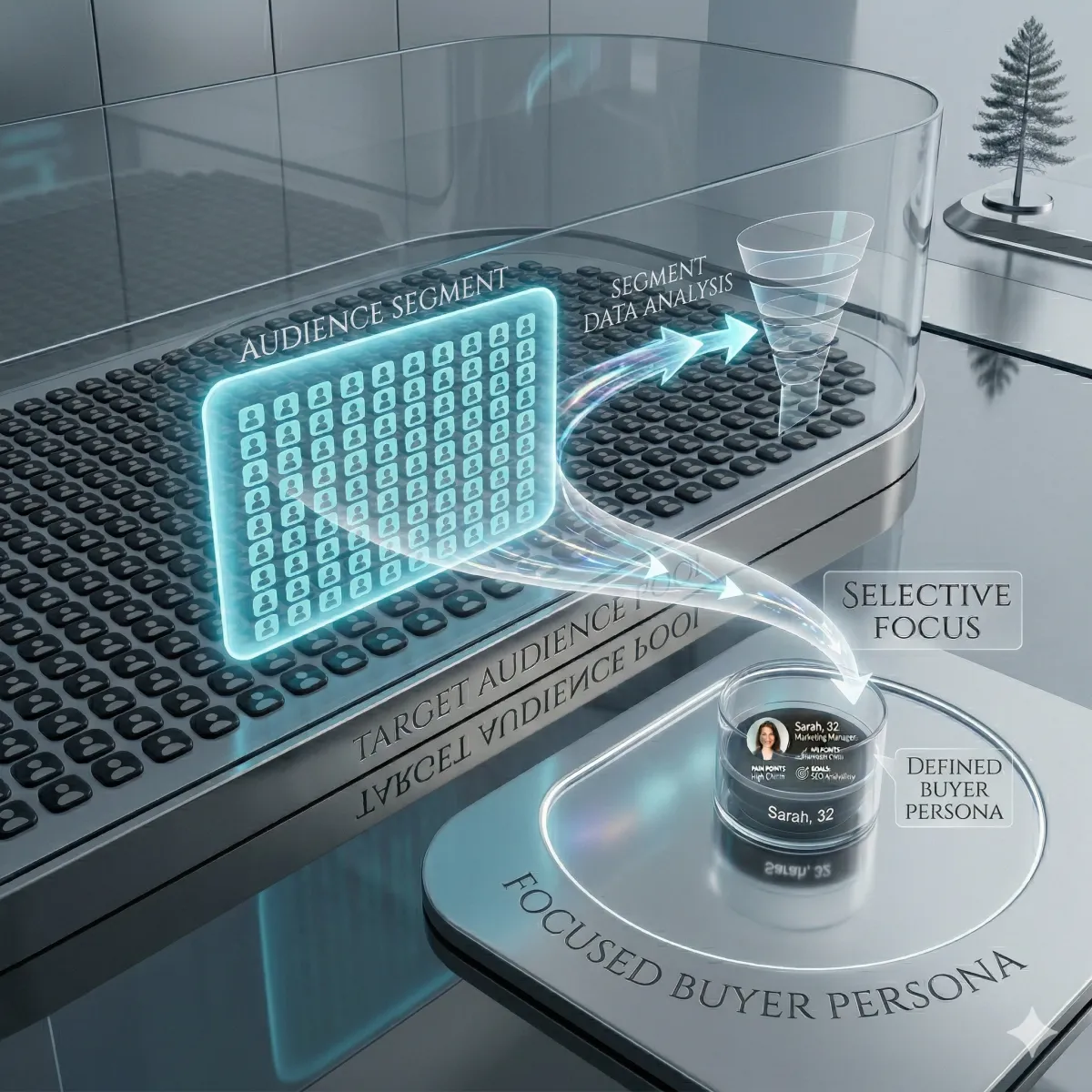
If we build the buyer persona first, we might build it for the wrong crowd.
If we pick the target audience first, we might still need a “real person” to talk to.
So which comes first?
Here’s the calm answer:
Target audience first. Buyer persona second.
Why? Because the target audience is the lake.
The buyer persona is the fish.
Pick the wrong lake… and it doesn’t matter how good your bait is.
Choose your target audience first using a simple 3×3 “Audience Radar.” Then build your buyer persona using a “Persona Canvas Lite.” Do it in one week.
💡 Why the order matters (safety, speed, certainty)
When you get the order wrong, you waste:
time writing copy that doesn’t fit
money running ads to the wrong people
energy building offers nobody wants
confidence (because it feels random)
When you get the order right, you get:
clearer messaging
cleaner tests
better conversions
faster learning
real buyer clarity
That’s the goal.
🧠 Simple definitions (so we don’t mix them up)
🎯 Target audience (the lake)
Your target audience is a group you choose to focus on.
It’s broader. It’s a slice of the market.
Example: “Busy parents in our city who want short workouts.”
👤 Buyer persona (the fish)
Your buyer persona is a “one person” story inside that target audience.
It’s more specific. It includes fears, triggers, and proof needs.
Example: “A busy mom who wants 30-minute workouts, feels guilty, and fears failing again.”
Target audience comes first because it sets the boundaries.
🧭 The right order for fast wins
Here’s the best order:
Pick the target audience (lake)
Build the buyer persona (fish)
Build one page for that persona
Run one tiny test
Improve weekly using consumer behavior
This prevents “persona fantasy land.”
🛰️ Audience Radar 3×3 (pick the lake first)
Audience Radar is a simple 3×3 grid.
We score audience options on three things:
Pain strength (how badly they need help)
Reach (how easy they are to find)
Pay power (how likely they can pay)
Each gets a 1–3 score.
✅ Audience Radar 3×3 grid
For each possible target audience, score:
Pain strength:
1 = mild
2 = annoying
3 = urgent
Reach:
1 = hard to reach
2 = reachable
3 = easy to reach
Pay power:
1 = low budget
2 = medium budget
3 = strong budget
Add the score (3–9).
Pick the highest score first.
That’s your lake.
🧩 Audience Radar examples (target audience options)
Example: local gym
Audience A: busy parents nearby
Pain: 3 (low time hurts daily)
Reach: 3 (local + social + search)
Pay: 2 (moderate)
Score: 8
Audience B: college students
Pain: 2
Reach: 3
Pay: 1
Score: 6
Busy parents win first.
Example: B2B SaaS
Audience A: ops leads at small agencies
Pain: 3 (monthly chaos)
Reach: 2 (LinkedIn + search)
Pay: 2
Score: 7
Audience B: freelancers
Pain: 2
Reach: 3
Pay: 1
Score: 6
Ops leads win first if the offer fits.
✅ What if two target audiences tie?
If two audiences score the same, pick the one with:
higher urgency
faster path to proof
easier “first win” in 48 hours
Speed matters when you’re testing.
🎣 Persona Canvas Lite (pick the fish second)
Once the target audience is chosen, we build a simple persona.
Persona Canvas Lite has 8 fields. Keep it one page.
🪪 Persona Canvas Lite template
Target audience line: who are we talking to?
Main pain: “I’m stuck with ___.”
Main dream: “I want ___.”
Trigger: “I started looking because ___.”
Past tries: “I tried ___.”
Top doubt: “Will this work if ___?”
Proof needed: reviews / case / steps / demo
First safe step: guide / trial / call
48-hour win: the first small result
That’s enough to write converting page copy.
🧠 Where do we get persona answers? (consumer behavior sources)
We don’t guess. We borrow words from:
reviews (yours + competitors)
emails and DMs
support chats
on-site search terms
call notes
refund reasons
This is consumer behavior in language form.
🧱 Turn persona into one page (one slice, one CTA)
Now we build one page for that persona.
The page should include:
hero headline in buyer words
proof by the CTA
3-step path with time tags
micro-FAQ under CTA
one clear CTA that matches stage
“what happens next” line
One persona. One page. One job.
🗓️ One-week setup plan (fast, safe, real)
Here’s the simple week plan.
Day 1: list 3–5 target audiences
Run Audience Radar 3×3. Pick one.
Day 2: collect buyer words
Mine 20 lines from reviews/emails/comments.
Day 3: fill Persona Canvas Lite
Use real words. Keep it short.
Day 4: write the page
Hero + proof + steps + FAQ + CTA.
Day 5: run a tiny test
$10/day ads, or send to your list.
Day 6–7: measure behavior
CTR, time, bounce, CTA clicks, conversions.
Pick one improvement for next week.
That’s how you move fast without panic.
🧯 Common mistakes (and the fix)
Mistake: building personas before choosing a target audience
Fix: pick the lake first with Audience Radar.
Mistake: picking a target audience too broad
Fix: tighten by pain + urgency + reach.
Mistake: creating 5 personas at once
Fix: build one persona for one audience first.
Mistake: ignoring behavior signals
Fix: use CTR, time, bounce, CTA clicks to learn.
❓ FAQ — Target Audience vs. Buyer Persona Mix-Up
Which comes first: target audience or buyer persona?
Pick the target audience first. Then build the buyer persona inside that audience. The audience sets boundaries; the persona makes the message personal.
Why should target audience come first?
Because if you pick the wrong audience, even perfect persona copy won’t convert. You’ll be fishing in the wrong lake.
What is Audience Radar 3×3?
It’s a simple scoring tool that ranks target audiences by pain strength, reach, and pay power so you can choose the best audience first.
What is Persona Canvas Lite?
It’s a one-page persona template: pain, dream, trigger, doubts, proof needed, first safe step, and a 48-hour win.
How many target audiences should we score?
Start with 3–5. Pick the top one to focus on for 30 days.
How many buyer personas should we start with?
Start with one persona for your chosen target audience. Add more only after you have a stable winner.
What if we have no data yet?
Use competitor reviews, inbox questions, and lookalike interviews. That’s still real language and behavior clues.
How do we know the target audience choice is right?
You’ll see better CTR, longer time on page, more CTA clicks, and higher conversions. That’s consumer behavior validation.
How fast can we do this process?
You can set up Audience Radar and Persona Canvas Lite in one week and start testing right away.
What’s the biggest mistake?
Skipping the target audience step and building personas in a vacuum.
📌 Key Takeaways
Target audience first (lake), buyer persona second (fish)
Use Audience Radar 3×3: pain, reach, pay
Use Persona Canvas Lite: pain, dream, trigger, doubt, proof, step, 48-hour win
Build one page for one persona with one CTA
Test in one week and learn from consumer behavior signals
This creates buyer clarity inside The Buyer Clarity System™
🎁 Complimentary Ebook
Want the persona card template and the tagging worksheet in one place?
Grab our COMPLIMENTARY Buyer Clarity Guide here:
👉 Download your complimentary ebook now
🧭 Final Word
Pick the lake. Then pick the fish.
Start with the target audience. Then build the buyer persona that speaks to them like a mirror.
That’s how we get fast wins without guessing—inside The Buyer Clarity System™.
