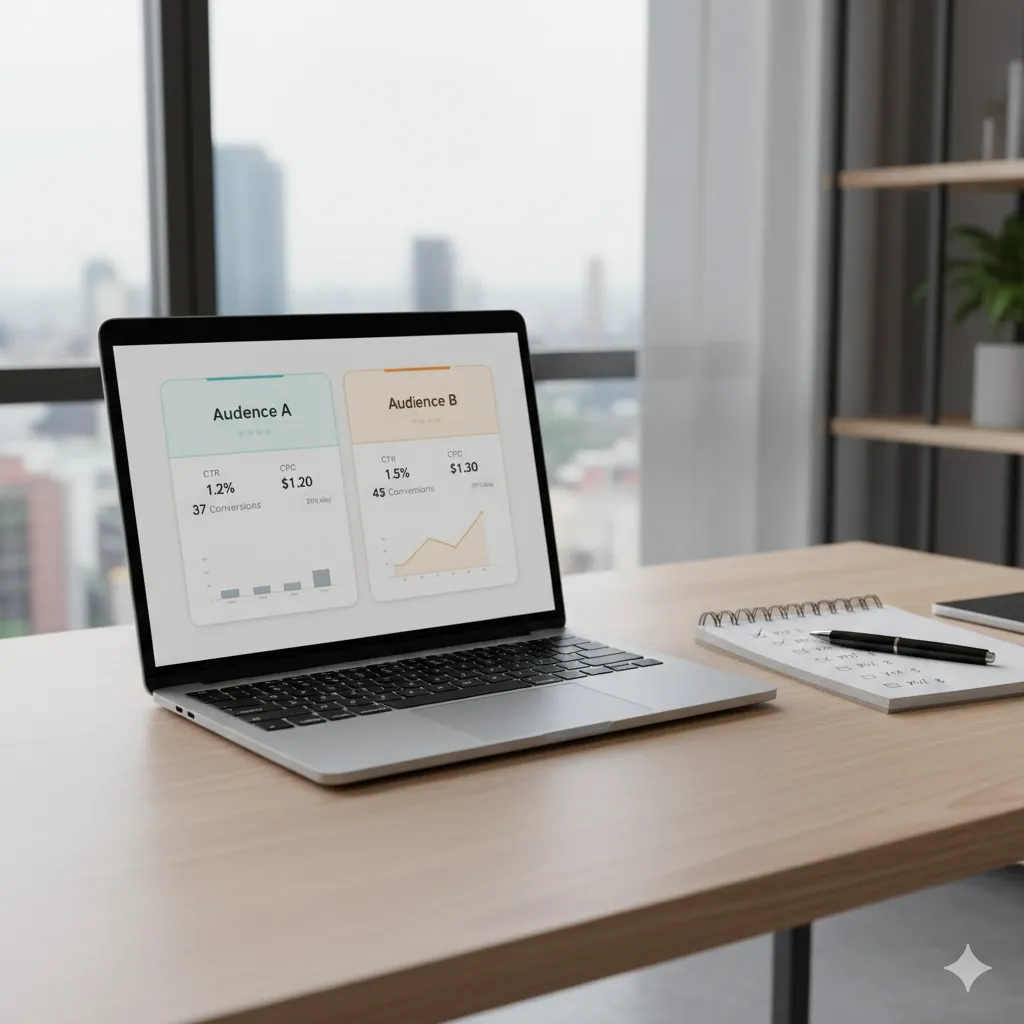
📣 Run Segment-Based Ads on a Small Budget (Tiny Tests, Big Wins)
📣 Run Segment-Based Ads on a Small Budget (Tiny Tests, Big Wins)
Small budgets can feel scary.
Because every dollar feels like a vote.
A vote for “this will work”… or a vote for “we just wasted money.”
That fear is real. And it’s why most small businesses either stop ads… or spray money everywhere and hope.
But there’s a calmer way.
We use market segmentation. We aim at one target audience slice at a time. We write ads that match real consumer behavior. We run tiny tests. We keep the winners. We cut the losers. That’s how we grow without panic inside The Buyer Clarity System™.
Pick 1–2 slices, pick the right channel for the stage, run a $10/day test, track 5 simple KPIs, and improve one thing per week.
💡 Why market segmentation makes small-budget ads work
A small budget cannot survive “everyone targeting.”
Market segmentation helps because it:
lowers waste (fewer wrong clicks)
raises relevance (better CTR)
makes the message feel personal to the target audience
shows clearer patterns in consumer behavior
keeps testing simple so we don’t freeze
builds buyer clarity fast (we know what to do next)
When ads feel like a mirror, people stop scrolling.
🧭 The “one slice, one ad set” rule for market segmentation
Here’s the simplest ad rule we use:
One market segmentation slice = one ad set.
That means:
one slice
one promise
one landing page
one main CTA
If we mix slices, results get muddy.
If results are muddy, we can’t learn.
Clear slice = clear learning.
🧩 How to choose slices for market segmentation ads (start with 2)
Don’t start with 10 slices.
Start with 2 slices max.
Good first slices are:
high urgency slice (“need it now”)
high fit slice (“we solve this well”)
easy reach slice (“we can find them today”)
Use a quick score for each market segmentation slice:
urgency
budget
reach
fit
Pick the top 2.
Then pick one as your main target audience for 7 days.
🔎 How consumer behavior tells us what to say in ads
We don’t guess ad copy.
We steal real words from:
reviews
inbox questions
support chats
comments
site search terms
Those words become:
hooks
headlines
objections
offers
That’s consumer behavior turned into conversion.
🧊 Channel picks by stage for market segmentation ads
Different stages need different channels.
🔍 Search ads for cold target audience slices (high intent)
Search is for “I’m looking right now.”
Use search when your target audience is typing:
“how to…”
“best…”
“near me”
“pricing”
“fix…”
Search works great for:
urgent pain
local services
buyers ready to compare
📱 Social ads for cold-to-warm target audience slices (scroll intent)
Social is for “I didn’t plan to buy, but I might.”
Use social when your target audience is:
bored
curious
scared but not ready
looking for quick tips
Social works best when:
the hook is strong
the offer is small
the proof is clear
✉️ Email for warm target audience slices (trust intent)
Email is where trust grows.
Ads alone don’t always close.
Email helps you:
teach
reassure
answer doubts
guide next steps
So we often run ads to:
a complimentary guide
a short checklist
a mini training
Then email does the warming.
This is market segmentation across the whole path.
🪧 Ad angles by slice for market segmentation (copy templates)
Different slices respond to different angles.
Below are simple angles for market segmentation.
💥 Pain angle (market segmentation)
“Stop [pain] and get [result] in [time]—without [hated thing].”
🌈 Dream angle (market segmentation)
“Get [result] in [time]—even if [fear].”
📣 Proof angle (market segmentation)
“People like you got [result]. Here’s the 3-step path.”
🧠 “Burned before” angle (market segmentation)
“Tried [past try] and it didn’t work? Here’s the simple fix.”
⚡ Urgent angle (market segmentation)
“Need [result] this week? Start here.”
Each angle maps to a slice and a stage.
🔘 Landing page rule for market segmentation ads (match the promise)
If an ad says: “Calm skin in 7 nights…”
The landing page must say that too.
Same promise. Same words. Same slice.
That’s how the target audience feels safe.
That’s also how you lower bounce rate and raise conversion.
🧰 The $10/day test plan for market segmentation ads (simple and real)
Here’s a calm plan small businesses can follow.
✅ Setup (market segmentation)
Choose 1 slice (one target audience)
Create 2 ad angles (pain vs proof)
Use 1 landing page (same CTA)
Run $10/day for 7 days
That’s it.
✅ Example budget (market segmentation)
Ad A: $5/day
Ad B: $5/day
After 7 days, keep the winner.
Then test something else.
🧪 What to test first in market segmentation ads (order of impact)
Start in this order:
Hook/headline (pain vs dream vs proof)
Creative (image vs video vs text)
Offer (guide vs trial vs call)
CTA (“See how it works” vs “Start now”)
Landing page proof placement (by button vs lower)
One test at a time.
One week at a time.
This keeps results clear.
📊 KPI tracker for market segmentation ads (simple numbers)
Track per slice. Not blended.
📌 Top KPIs for market segmentation
CTR (do they care?)
CPC (how expensive is attention?)
Landing page time (do they trust?)
CTA clicks (do they act?)
Conversion (opt-in, trial, call)
Cost per lead (can we afford this?)
Lead quality (do they buy later?)
These show real consumer behavior.
🧾 A simple KPI scorecard (copy/paste)
For each market segmentation slice, track:
Slice name: ______
Channel: ______
Hook angle: pain / dream / proof
CTR: ______
CPC: ______
Landing page conversion: ______
Cost per lead: ______
Notes (what people asked): ______
Keep this in a spreadsheet. Review weekly.
🧩 Examples: segment-based ads by business type (market segmentation)
🛠️ Service business segment ads (market segmentation)
Slice: burned-before buyers
Angle A: “Stop wasting money on marketing that doesn’t work.”
Angle B: “Here’s the 3-step plan to get clear and convert.”
Offer: complimentary guide
CTA: get the guide
💻 SaaS segment ads (market segmentation)
Slice: month-end chaos
Angle A: “Stop month-end chaos.”
Angle B: “Ops teams cut chasing time fast.”
Offer: trial or demo
CTA: start the trial
📍 Local business segment ads (market segmentation)
Slice: busy parents nearby
Angle A: “Get strong in 30 minutes.”
Angle B: “See class times near you.”
Offer: tour or intro week
CTA: book tour
🛒 Ecommerce segment ads (market segmentation)
Slice: sensitive skin fear
Angle A: “Calm skin in 7 nights—without harsh stuff.”
Angle B: “See what’s inside our gentle routine.”
Offer: sample kit
CTA: try sample kit
Each ad matches one slice and one page.
⚠️ Common mistakes in market segmentation ads (and quick fixes)
Mistake: targeting everyone
Fix: one slice per ad set
Mistake: changing 5 things at once
Fix: one change, one week
Mistake: ad promise doesn’t match landing page
Fix: mirror the headline
Mistake: no proof near the CTA
Fix: move proof by the button
Mistake: selling big to cold traffic
Fix: small first step (guide, checklist)
These fixes save money fast.
🔁 Weekly routine for segment-based ads (market segmentation)
🧩 Weekly routine (market segmentation)
Monday: check KPIs per slice
Tuesday: pick one test
Wednesday: swap ad angle or creative
Thursday: check early signals
Friday: log what buyers asked
Next Monday: choose winner and repeat
This is how we grow with calm confidence.
❓ FAQ (AEO-Ready) for market segmentation ads
What are segment-based ads?
They are ads made for one market segmentation slice, so one target audience feels seen and knows the next step.
How many segments should we run ads for at once?
Start with 1–2 market segmentation slices. More than that spreads a small budget too thin.
What channel is best for cold segments?
Search is best when your target audience is actively looking. Social works when you need attention and a small step.
What should we offer cold traffic from a segment?
A small step like a complimentary guide, checklist, or “see how it works” page.
How much budget do we need for segment-based ads?
You can start at $10/day if you keep it simple: one slice, two ad angles, one landing page.
What should we test first in segment-based ads?
Test the hook angle first: pain vs dream vs proof. The hook drives the biggest change in CTR.
What metrics matter most for segment-based ads?
CTR, CPC, landing page conversion, cost per lead, and lead quality—tracked by slice.
Why do ads fail even when targeting is right?
Usually because the landing page doesn’t match the ad promise, or proof is missing near the CTA.
How do we use consumer behavior in ads?
Use real buyer words from reviews, emails, chats, and searches. That language increases trust fast.
How often should we change ads?
Weekly. One change, one week, one winner. Keep the winners and stack wins.
📌 Key Takeaways
Market segmentation makes small-budget ads smarter
One slice = one ad set = one landing page
Choose channels by stage: search, social, email
Use ad angles that match the slice (pain/dream/proof/urgent)
Start with $10/day and two angles
Track KPIs per slice and keep winners
Let consumer behavior guide the words and the tests
This builds buyer clarity inside The Buyer Clarity System™
🎁 Complimentary Ebook
Want the slice worksheet, ad angle swipe file, and KPI tracker? Grab our COMPLIMENTARY Buyer Clarity Guide here:
👉Download your complimentary ebook now
🧭 Final Word
A small budget is not a weakness. It’s a focus tool.
Use market segmentation to aim at one target audience slice.
Run tiny tests. Keep winners. Stack wins.
That’s how we grow without guessing—inside The Buyer Clarity System™.
