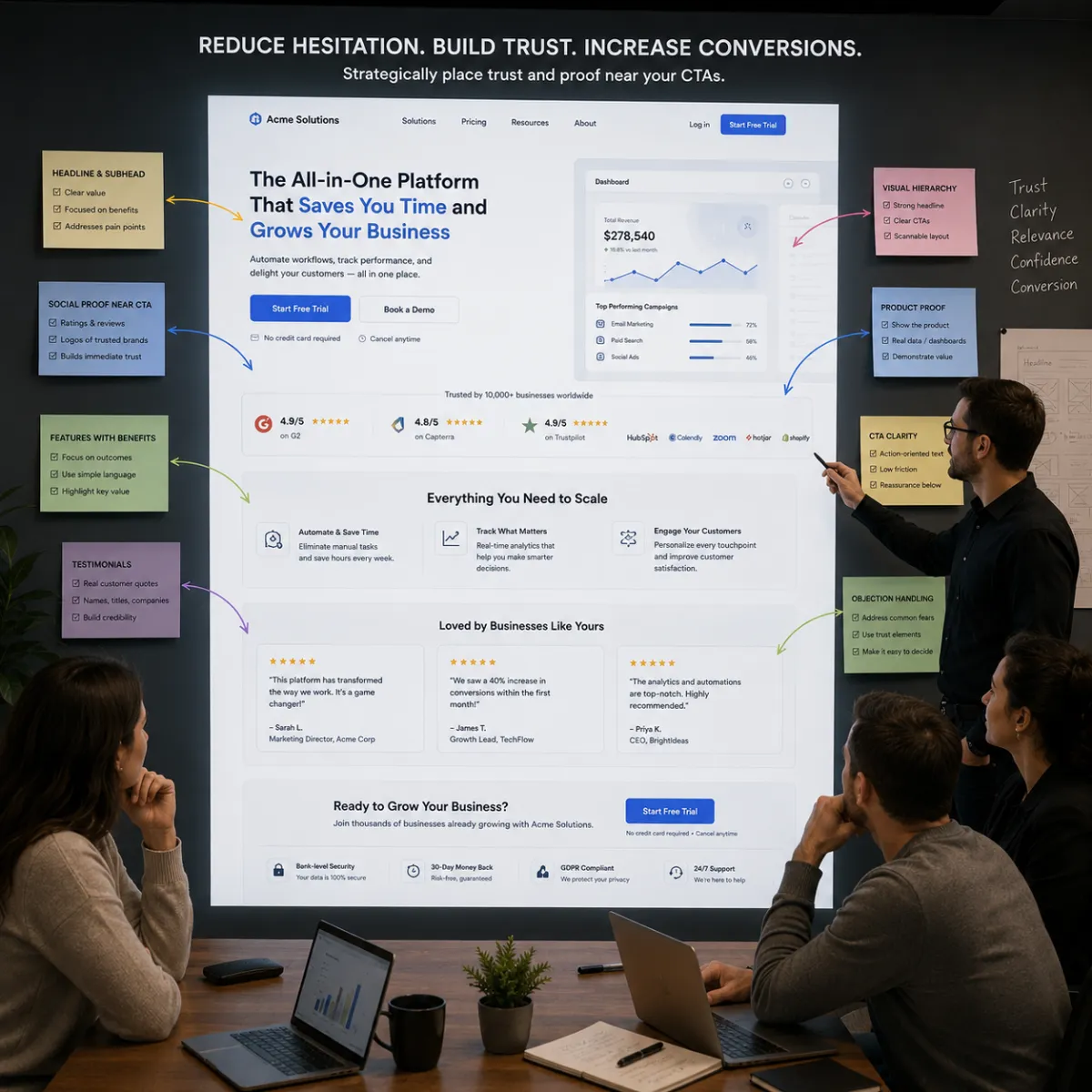
🧾 Proof That Lowers Ad Costs: What Your Buyer Persona Needs to See
🧾 Proof That Lowers Ad Costs: What Your Buyer Persona Needs to See
When ads get expensive, most people panic and change the ad.
New headline. New image. New hook. New offer.
But here’s the truth:
Ads get expensive when the buyer persona feels risk.
Because risky clicks don’t convert.
And when clicks don’t convert, platforms learn the wrong lesson:
“This ad is not helpful.”
So your costs rise. Your reach drops. Your confidence drops.
That’s why we don’t start by “making the ad prettier.”
We build a proof stack that makes clicks feel safe.
Proof is not decoration. Proof is a safety rail.
And when safety goes up, consumer behavior improves:
bounce goes down
time on page goes up
CTA clicks go up
conversions go up
ad costs often drop because engagement improves
A proof stack is a set of 3–7 proof blocks (like-me reviews, mini-cases, steps proof, and micro-FAQs) placed where buyers feel fear—especially near the CTA and pricing. Build proof by stage (cold/warm/hot) and match proof to the buyer persona’s top risk.
🧠 Quick definitions (so we build the right proof)
👤 Buyer persona
A buyer persona is the “one person story” inside your target audience:
pain, dream, moment, risk, proof needed, safe next step.
🎯 Proof stack
A proof stack is a group of proof blocks that reduce risk and increase trust:
like-me proof
steps proof
mini-case proof
objection proof (FAQ)
“what happens next” proof
🧠 Consumer behavior
Consumer behavior is what people do:
click, bounce, scroll, click CTA, convert, buy, refund.
We use behavior to decide what proof is missing.
🎯 Why proof lowers ad costs (the real reason)
Platforms want a good user experience.
When people click your ad and quickly bounce, platforms learn:
“This was not a good match.”
So costs go up.
But when people click and:
stay longer
scroll
click CTA
convert
Platforms learn:
“This was helpful.”
So performance improves.
Proof improves the experience because it reduces fear at the click.
Fear is expensive. Proof is cheaper.
🧩 The 4 proof types that matter most (simple)
To build a proof stack that converts, we use four proof types:
👥 Like-me proof (identity trust)
📖 Mini-case proof (story trust)
🧭 Steps proof (clarity trust)
❓ Objection proof (risk answers)
Now we’ll build each one.
1) 👥 Like-me proof (the fastest trust)
Like-me proof answers:
“Did this work for someone like us?”
This is one of the strongest buyer persona needs.
✅ Like-me proof examples
short reviews from the same role/industry
short quotes that mention the same pain
“before/after” lines in plain words
“I was stuck with ___, now I have ___.”
✅ Like-me proof template (copy/paste)
“People like us said:
‘[real quote about pain]’
‘[real quote about ease]’
‘[real quote about win]’”
Only use real proof. No fake testimonials.
2) 📖 Mini-case proof (tiny story, big confidence)
Mini-cases are small stories that show:
problem
steps
result
They don’t need big numbers.
They need clarity.
✅ Mini-case template (3–5 lines)
“Before: [pain].
What we changed: [step].
Week one: [first win].
Now: [new normal].”
This makes the buyer persona feel:
“This is possible.”
3) 🧭 Steps proof (the “this is not a mystery” proof)
Steps proof answers:
“What happens first?”
This reduces effort fear and confusion.
✅ Steps proof template (copy/paste)
“Here’s the simple path:
Step one: ___
Step two: ___
Step three: ___
First win in 48 hours: ___”
Steps proof works even when you’re newer, because it’s process proof.
4) ❓ Objection proof (micro-FAQ under the CTA)
Objection proof answers:
“What could go wrong?”
This is where many conversions happen.
✅ Micro-FAQ rules
4–8 questions
short answers (1–3 lines)
directly under the CTA
written in buyer persona words
✅ Micro-FAQ question bank (choose the top 6)
“Will this work for someone like us?”
“What happens first?”
“How fast is the first win?”
“How much time does this take?”
“What if we tried something before?”
“What if we get stuck?”
“What does it cost?” (if you show pricing)
“Is there a contract?” (only if relevant)
🧠 The proof stack blueprint (7 blocks)
Here’s the exact proof stack blueprint that works for most offers:
Tiny proof near the first CTA (1–2 lines)
Steps proof (3 steps)
Like-me proof (1–3 quotes)
Mini-case proof (short story)
Micro-FAQ under CTA (4–8 Qs)
Value proof near pricing (what’s included)
What happens next (3 bullets)
You don’t need all 7 on day one.
Start with 4–5. Add more as you learn.
📍 Where proof should live (ad → landing page)
Proof is not just on the landing page.
Proof starts in the ad.
We place proof in three places:
In the ad
On the landing page above the fold
Near the CTA and pricing
✅ Proof in the ad (light proof)
Use one small proof line:
“Clear steps. No guessing.”
“Built for [role].”
“Start small with a 48-hour win.”
If you have real reviews, you can reference them carefully:
“See real examples.”
“Read what buyers like you said.”
✅ Proof above the fold (fast trust)
Put:
“For…” line
tiny proof line
quick steps or “what happens next”
✅ Proof near CTA (risk spike)
Put:
like-me proof
micro-FAQ
what-happens-next
This is the highest-leverage placement.
🧭 Proof by stage (cold, warm, hot)
Different stages need different proof.
❄️ Cold stage proof (keep it light)
Cold buyers need:
steps proof
clarity proof
small “safe” proof
Best blocks:
3-step path
“what happens next”
one like-me quote (if available)
Avoid:
heavy case studies
big pricing talk early
🌤️ Warm stage proof (strong proof + objections)
Warm buyers need:
like-me proof
mini-cases
micro-FAQ under CTA
proof near pricing
Best blocks:
1 mini-case
3 quotes
6-question micro-FAQ
“what’s included” bullets
🔥 Hot stage proof (decision proof)
Hot buyers need:
speed proof
pricing clarity
next steps
fit confirmation
Best blocks:
proof beside pricing
“best for…” guidance
“what happens next” steps
last objections answered
🧠 Build proof that matches the buyer persona’s top fear
Proof works best when it answers the #1 fear.
Here are common fears and matching proof:
Fear: “We’ll waste money”
Proof that helps:
what’s included bullets
mini-case with clear steps
micro-FAQ about fit and outcomes
“start small” offer
Fear: “This won’t work for us”
Proof that helps:
like-me reviews
role-based mini-cases
“for/not-for” box
Fear: “This will be hard”
Proof that helps:
steps with time tags
“we help if you get stuck”
onboarding checklist
Fear: “This will take too long”
Proof that helps:
48-hour win plan
week-one plan
timeline mini-case
Your buyer persona decides your proof stack.
🧱 How to build a proof stack when you have limited proof
No fake testimonials. So what do we do?
We use proof types that don’t require “results claims.”
✅ Proof you can use right now
steps proof (your process)
“what happens next” clarity
screenshots of the system (if true)
example outputs (templates, sample plans)
transparent boundaries (“not for you if…”)
micro-FAQ (real objections)
This is still proof—because it reduces uncertainty.
🗓️ Proof stack assembly plan (done in 60 minutes)
Here’s a simple build plan:
Minute 1–15: Collect proof
3 real quotes (if you have them)
1 mini-case (short story)
top 6 objections
Minute 16–30: Write blocks
tiny proof line
3 steps
micro-FAQ answers
Minute 31–45: Place proof on page
tiny proof near CTA
micro-FAQ under CTA
what’s included near pricing
Minute 46–60: Make sure it matches the ad
ad headline = page headline
CTA step = same promise
first 10 words match
Done.
📊 How to measure if the proof stack is working (consumer behavior KPIs)
Track these:
bounce rate (should drop)
time on page (should rise)
scroll depth (should rise)
CTA clicks (should rise)
conversion rate (should rise)
time-to-yes (should get faster)
refund/churn (should drop, if relevant)
Proof is working when risk behavior improves.
🧪 Tiny tests to optimize proof (one win a week)
Run one test at a time:
Test 1: Proof near CTA vs proof lower
Measure: CTA clicks + conversions.
Test 2: Mini-case early vs mini-case late
Measure: time on page + CTA clicks.
Test 3: Micro-FAQ under CTA vs none
Measure: CTA clicks + time-to-yes.
Test 4: Proof type
A: 3 quotes
B: 1 mini-case
Measure: conversions + lead quality.
One change. One week. Clean learning.
🧯 Common proof stack mistakes (and quick fixes)
Mistake: Proof is buried at the bottom
Fix: move proof next to the first CTA.
Mistake: Proof doesn’t match the buyer persona
Fix: use like-me proof and answer the top fear.
Mistake: Too much proof, too messy
Fix: 3–7 blocks max. Keep it clean.
Mistake: No “what happens next”
Fix: add 3 bullets under CTA.
Mistake: Using fake proof
Fix: don’t. Use steps proof and example outputs instead.
🧠 Why this supports ranking for “buyer persona”
This post supports ranking for buyer persona because it:
defines buyer persona clearly
shows how buyer persona drives proof choices
uses buyer persona language in headings and templates
answers buyer persona proof questions in the FAQ
That builds authority across search engines and AI answer engines.
❓ FAQ — Proof Stack for Buyer Persona and Ads
1) What is a proof stack in marketing?
A proof stack is a set of proof blocks (reviews, mini-cases, steps, FAQs) that reduce risk and increase trust for a buyer persona.
2) Why does proof lower ad costs?
Proof improves consumer behavior after the click—less bounce, more engagement, more conversions—so platforms reward your ads with better performance.
3) What proof types work best for a buyer persona?
Like-me reviews, mini-cases, steps proof, and micro-FAQs work best because they match identity, trust, clarity, and risk reduction.
4) Where should proof live on the landing page?
Proof should live near the CTA and near pricing because that’s where buyer persona fear spikes.
5) What proof should we put in the ad itself?
Use light proof: “clear steps,” “what happens next,” or “start small.” Keep it short and honest.
6) What is “steps proof” and why does it help?
Steps proof shows the path in 3 steps. It reduces confusion and effort fear, which increases CTA clicks.
7) What if we don’t have testimonials yet?
Use process proof (steps), example outputs, “what happens next,” and micro-FAQ objection proof. Do not use fake testimonials.
8) What proof works best for cold traffic?
Light proof: steps and clarity. Cold buyers need a safe first step, not heavy case studies.
9) What proof works best for warm traffic?
Like-me proof + mini-cases + micro-FAQ under the CTA. Warm buyers compare and need certainty.
10) What proof works best for hot traffic?
Proof near pricing, clear next steps, and fast-start clarity. Hot buyers want to decide quickly.
11) How do we test proof placement?
Run one-change-one-week tests: proof near CTA vs lower, mini-case early vs late, micro-FAQ vs none. Track CTA clicks and conversions.
12) How does proof connect to buyer persona?
Buyer persona fear and proof needs decide which proof to use and where to place it, so the right buyers feel safe saying yes.
📌 Key Takeaways
Proof lowers ad costs by reducing buyer persona risk and improving consumer behavior
Build a proof stack with like-me reviews, mini-cases, steps proof, and micro-FAQs
Place proof where fear spikes: near CTA and pricing
Use different proof by stage: cold (light), warm (strong), hot (decision proof)
If you lack testimonials, use steps proof and example outputs—never fake proof
Test one proof change per week and let behavior pick winners
This is buyer clarity inside The Buyer Clarity System™
🎁 Complimentary Ebook
Want the proof stack blueprint, micro-FAQ templates, and proof placement maps?
Grab our COMPLIMENTARY Buyer Clarity Guide here:
👉 Download your complimentary ebook now
🧭 Final Word
Clicks don’t need more hype.
They need more safety.
Build the proof stack your buyer persona needs to see, place it where fear spikes, and your ads stop bleeding budget inside The Buyer Clarity System™.
