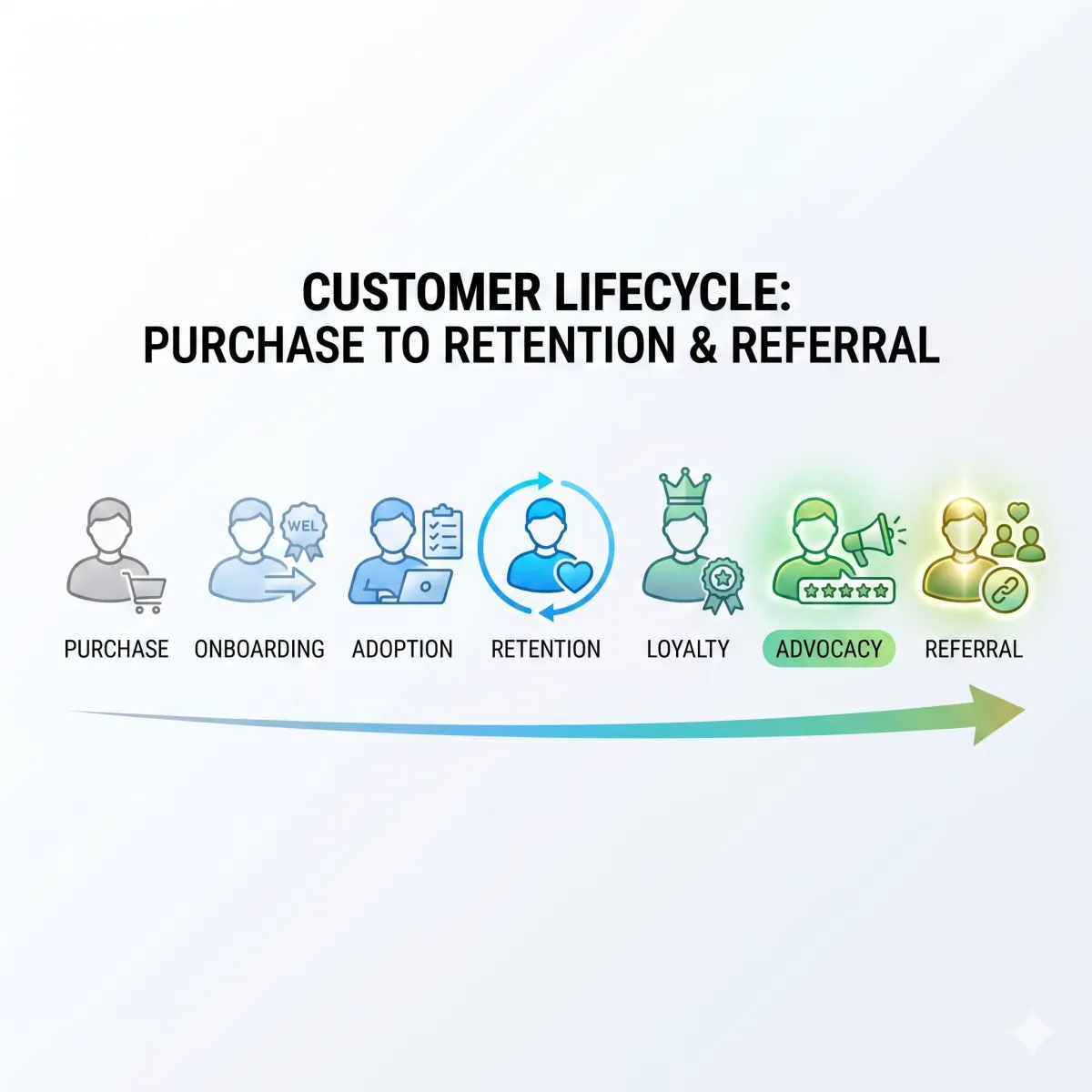
🔁 Post-Purchase Segmentation: Keep Customers and Earn Referrals
🔁 Post-Purchase Segmentation: Keep Customers and Earn Referrals
The sale is not the finish line.
It’s the handoff.
Right after purchase, the buyer’s brain asks one big question:
“Did we make the right choice?”
If we help them get a quick win, they stay.
If we leave them confused, they drift.
And drift becomes churn.
Here’s the part most marketers miss:
Psych segments don’t disappear after the sale.
They get louder.
The Proof-Seeker still needs proof.
The Time-Poor buyer still needs simplicity.
The Budget-Starter still needs safety.
The Pain-Now buyer still wants speed.
The Status-Chaser still wants progress.
So we use market segmentation after purchase.
We watch post-purchase consumer behavior by slice, then send the right nudge, the right help, and the right referral ask at the right time.
That’s how we keep customers and earn referrals inside The Buyer Clarity System™.
Segment customers after purchase by motive/moment/risk. Track health signals (activation, usage, support, time-to-first-win). Send slice-matched success nudges, run save offers when risk signals appear, and trigger referrals right after a visible win.
🧠 What “post-purchase segmentation” means (simple)
Post-purchase segmentation means:
We group customers by what they need after buying, not just before buying.
It’s still the same three drivers:
Motive (what they want)
Moment (why they bought now)
Risk (what they feared)
That is psych-based market segmentation.
Now we use it for:
onboarding
retention
renewals
upgrades
referrals
🎯 Why segmentation after the sale boosts profit
Most businesses spend money to acquire customers…
…then treat all customers the same.
That wastes profit.
Because different segments churn for different reasons.
If we segment, we can:
reduce churn
reduce refunds
increase repeat buys
increase referrals
lower support load
And we do it without pressure.
Just clarity.
🧩 The 5 post-purchase psych slices (simple and common)
We’ll use the same 5 slices we used in Pillar #7:
⚡ Pain-Now (Urgent Fixers)
🧾 Proof-Seeker
⏳ Time-Poor
💰 Budget-Starter
🏆 Status-Chaser
You may have different names, but the patterns are common.
🧠 Step 1: How to assign a customer to a slice after purchase
We don’t need fancy tools.
Use simple signals:
✅ Slice assignment signals (post-purchase)
what offer they bought (starter vs urgent vs pro)
what CTA they used (guide vs call vs buy)
what questions they asked on checkout
what emails they clicked
what onboarding step they chose
what they searched on your site (if available)
If you have a form, add one question:
“What do you want most right now?”
Then give 5 options that map to your slices.
That is a clean way to tag segment.
📊 Step 2: Track “customer health signals” by segment
We track a few simple post-purchase consumer behavior signals.
✅ Health signals (works for most businesses)
Activation: did they start?
Setup: did they complete step 1?
Usage: did they use it twice?
First win: did they get the 48-hour win?
Support: did they ask for help? (good)
Silence: did they go quiet? (bad)
Renewal intent: did they view pricing/upgrade?
Referral intent: did they share/review?
These signals tell us: healthy vs at-risk.
🟩🟨🟥 Segment health grading (simple)
🟩 Green (healthy)
started quickly
got first win
repeats the key action
asks normal questions
🟨 Yellow (watch)
slow start
stuck on setup
repeated FAQ views
long gaps
🟥 Red (save now)
no start after 72 hours
“this isn’t what I expected”
refund language
angry support message
no use for 7 days
Now we match nudges by slice.
⚡ Slice: Pain-Now (Urgent Fixers) — retention playbook
🧠 What they need after purchase
Speed + certainty.
✅ Success nudges (Pain-Now)
“Here’s step one now (5 minutes).”
“We’re starting today. Here’s the schedule.”
“Your first win happens by __.”
✅ Best onboarding style
short messages
fast scheduling
clear “what happens next”
minimal reading
🟥 Red flags (Pain-Now)
waiting too long for response
unclear timeline
unclear next step
🛟 Save offer (Pain-Now)
Offer speed, not discounts:
priority support
quick start call
“we’ll do step one with you”
🎯 Referral trigger (Pain-Now)
Ask after the first fast relief win:
“Know one person who needs this fixed this week?”
🧾 Slice: Proof-Seeker — retention playbook
🧠 What they need after purchase
Proof it’s working + proof they chose right.
✅ Success nudges (Proof-Seeker)
“Here’s what success looks like in week one.”
“Here’s a like-me example of the first win.”
“Here’s how to measure progress.”
✅ Best onboarding style
short progress checkpoints
proof timeline (week 1/2/3)
clear metrics and screenshots (if true)
🟥 Red flags (Proof-Seeker)
“I’m not sure this is working.”
repeated “how do I know?” questions
comparing your offer to others
🛟 Save offer (Proof-Seeker)
Offer certainty:
progress review
simple dashboard
“here’s your next best step” plan
🎯 Referral trigger (Proof-Seeker)
Ask right after a measurable win:
“When you saw that first result, who came to mind?”
⏳ Slice: Time-Poor — retention playbook
🧠 What they need after purchase
Less effort and fewer decisions.
✅ Success nudges (Time-Poor)
“Do this one thing today (5 minutes).”
“Here’s the shortest path.”
“Skip this part. Do this instead.”
✅ Best onboarding style
3-step checklist
time tags
short videos (optional)
fewer emails, more clarity
🟥 Red flags (Time-Poor)
they stop after step 1
they don’t finish setup
they say “I’m busy”
🛟 Save offer (Time-Poor)
Offer simplification:
done-with-you setup
a “lite plan”
fewer steps and reminders
🎯 Referral trigger (Time-Poor)
Ask after they say “this was easy”:
“Know someone who wants the simple way?”
💰 Slice: Budget-Starter — retention playbook
🧠 What they need after purchase
Value proof and safety.
✅ Success nudges (Budget-Starter)
“Here’s what you get this week.”
“Here’s how to get value fast.”
“Here’s the starter checklist.”
✅ Best onboarding style
value bullets
clear “what happens next”
show progress in simple wins
🟥 Red flags (Budget-Starter)
refund questions early
“is this worth it?” language
no usage after purchase
🛟 Save offer (Budget-Starter)
Offer a safe continuation:
smaller plan
pause option (if you have it)
extra onboarding help
“value recap” email
🎯 Referral trigger (Budget-Starter)
Ask after a clear value moment:
“If this saved you money or time, who else would want that?”
🏆 Slice: Status-Chaser — retention playbook
🧠 What they need after purchase
Progress, momentum, and “level up” signals.
✅ Success nudges (Status-Chaser)
“Here’s your pro roadmap.”
“Here’s the next best move.”
“Track this KPI this week.”
✅ Best onboarding style
milestones
progress dashboards
“level” language (simple, not hypey)
🟥 Red flags (Status-Chaser)
boredom
lack of progress signals
“what’s next?” messages early
🛟 Save offer (Status-Chaser)
Offer advancement:
pro review call
upgrade path guidance
new milestone challenge
🎯 Referral trigger (Status-Chaser)
Ask after a milestone win:
“Who do you know that wants this level of result too?”
✉️ Email cadences by segment (simple schedules)
You don’t need 50 emails.
You need the right emails for the right slice.
✅ Universal 7-day base cadence
Day 0: welcome + step 1
Day 1: first win reminder
Day 3: progress check
Day 5: common questions
Day 7: next step + support offer
Now we tune the message per slice.
🧾 Proof-Seeker tuning
Add: “How to measure progress” email.
⏳ Time-Poor tuning
Shorten emails. Add checklists.
💰 Budget-Starter tuning
Add: “What you got this week” value recap.
🏆 Status-Chaser tuning
Add: milestone + KPI email.
⚡ Pain-Now tuning
Use SMS/calls and short confirmations.
🛟 Save offers (how to stop churn by slice)
A “save offer” is not always a discount.
A save offer is the thing that reduces risk for that slice.
✅ Save offer menu (by slice)
Pain-Now: speed + priority help
Proof-Seeker: progress review + proof
Time-Poor: simplify + done-with-you setup
Budget-Starter: value recap + smaller plan
Status-Chaser: milestone roadmap + next-level plan
Always lead with help first.
🎯 Referral triggers (when to ask)
Referrals happen when confidence is high.
Best moments:
after the 48-hour win
after a support win
after a milestone
after a “thank you” reply
Don’t ask too early.
Ask at the moment of belief.
🗣️ Referral scripts by segment (simple and human)
⚡ Pain-Now
“Do you know one person who needs this fixed fast? If yes, send them this link.”
🧾 Proof-Seeker
“Now that you’ve seen the first win, who do you know that would want the same result?”
⏳ Time-Poor
“Know someone who would love the simple path? We can help them too.”
💰 Budget-Starter
“If this saved you money or time, who else would want that?”
🏆 Status-Chaser
“Who do you know that wants to level up like this?”
Short. Kind. No pressure.
📊 How to measure retention success by segment (KPIs)
Track these by slice:
time-to-first-win
activation rate (started in 72 hours)
week-one completion
support tickets (and tone)
churn rate
renewal rate
referrals asked vs referrals received
The goal is not perfection.
The goal is improvement.
🧠 Why this supports “buyer persona” authority too
Each slice is still powered by a buyer persona story.
Post-purchase messages work best when they match the persona’s:
fears
proof needs
definition of “win”
So this post strengthens both:
market segmentation
consumer behavior
buyer persona
That helps SEO and conversions together.
❓ FAQ — Post-Purchase Segmentation for Retention and Referrals
1) What is post-purchase market segmentation?
It is using market segmentation after the sale to send the right onboarding, support, and referral messages to each slice.
2) Why should we segment customers after they buy?
Because different segments churn for different reasons. Segmenting reduces churn and increases referrals.
3) What consumer behavior signals show customer health?
Activation, setup completion, usage, time-to-first-win, support activity, silence, and repeat purchases.
4) What is the best first goal after purchase?
A 48-hour win. It reduces risk and builds confidence fast.
5) How do we handle Pain-Now customers after purchase?
Give speed, clear next steps, and fast support. They need relief and certainty.
6) How do we handle Proof-Seeker customers after purchase?
Show progress proof, measurement, and like-me examples. They need certainty.
7) How do we handle Time-Poor customers after purchase?
Reduce steps, use time-tag checklists, and offer done-with-you setup. They need simplicity.
8) How do we handle Budget-Starter customers after purchase?
Show value fast, recap what they got, and reduce money fear with clear steps and support.
9) How do we handle Status-Chaser customers after purchase?
Give milestones, progress signals, and next-level steps. They need momentum.
10) When should we ask for referrals?
After a visible win: 48-hour win, support win, milestone, or positive reply.
11) What is a save offer after purchase?
A save offer is a slice-matched help step that prevents churn (speed, proof, simplification, value recap, or next-level plan).
12) How do we measure if post-purchase segmentation works?
Track activation rate, time-to-first-win, churn, renewals, and referrals by segment.
📌 Key Takeaways
Psych segments continue after the sale
Use market segmentation to tailor onboarding, support, and referral asks
Track customer health signals using consumer behavior
Build slice-specific nudges, save offers, and referral triggers
Ask for referrals right after a visible win
Measure retention and referrals by slice
This is buyer clarity inside The Buyer Clarity System™
🎁 Complimentary Ebook
Want the post-purchase segment playbooks and email cadences in one place?
Grab our COMPLIMENTARY Buyer Clarity Guide here:
👉 Download your complimentary ebook now
🧭 Final Word
Most businesses lose money after the sale because they treat every customer the same.
Don’t.
Segment after purchase. Deliver the first win fast. Save at-risk buyers early. Ask for referrals at the moment of belief.
That’s how we grow past the checkout—inside The Buyer Clarity System™.
