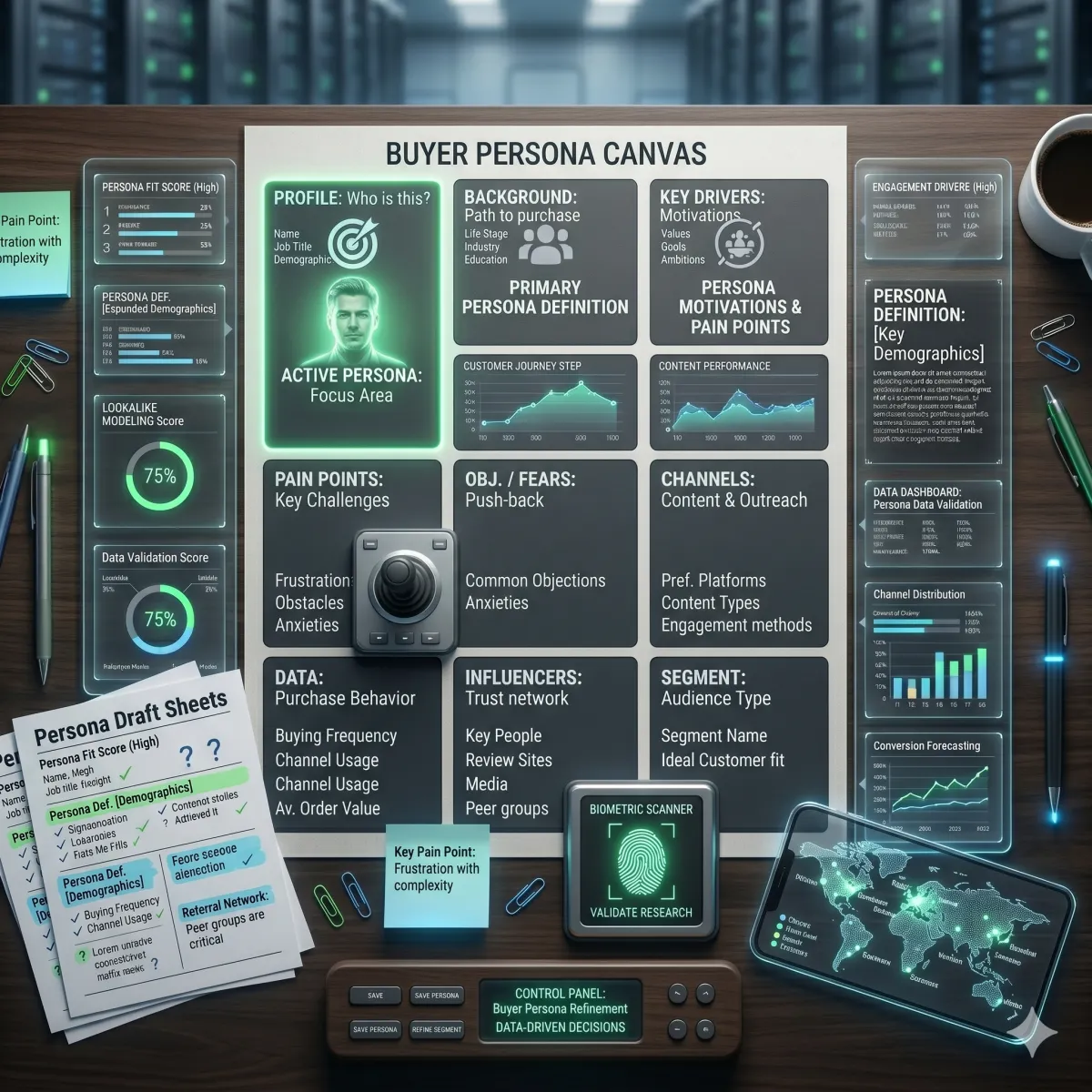
🧩 Persona Canvas Lite: Build a Buyer Persona That Converts
🧩 Persona Canvas Lite: Build a Buyer Persona That Converts
A buyer persona should do one job:
Make your marketing feel like a mirror.
So the right person lands on the page and thinks:
“That’s us.”
“That’s our problem.”
“That’s what we want.”
“This feels safe.”
When a buyer persona is wrong, your content gets loud… but not effective.
You see it in consumer behavior:
people click, then leave
pages bounce
CTAs don’t get pressed
calls feel “not a fit”
sales slow down
So we don’t build buyer personas like school projects.
We build buyer personas like tools.
Simple. Real. Measurable.
That’s what Persona Canvas Lite is for.
Persona Canvas Lite is a one-page worksheet that turns real buyer words into a buyer persona that converts. We fill 9 fields, build a small Objection Bank, add a 48-hour win, then use copy templates to write the page and CTA.
🧠 What a buyer persona is (simple definition)
A buyer persona is not a demographic profile.
It is a decision pattern.
A buyer persona tells us:
what hurts (pain)
what they want (dream)
why now (moment)
what they fear (risk)
what they tried already (past tries)
what proof they need (trust)
what step feels safe (CTA)
That’s why buyer persona work is so powerful.
It tells you what to say and where to say it.
🎯 Why most buyer personas don’t convert
Most buyer personas fail because they are built from:
guesses
stereotypes
demographics only
“nice” assumptions
copied templates
So the page sounds generic.
Generic pages don’t convert.
A converting buyer persona uses:
real words
real doubts
real triggers
real proof needs
That’s what Persona Canvas Lite captures.
🧩 What Persona Canvas Lite is (and why it’s “lite”)
Persona Canvas Lite is a one-page buyer persona canvas.
It is “lite” because it removes fluff.
It keeps only what we need to write:
ads
emails
landing pages
offers
FAQs
It’s fast enough to do in one sitting, but deep enough to convert.
🧾 Persona Canvas Lite (copy/paste the canvas)
Here is the full canvas. Paste into a doc.
✅ Persona Canvas Lite
Target audience line: For ____ who ____
Pain (what hurts): “We’re stuck with ____.”
Dream (what they want): “We want ____.”
Moment (why now): “We need this because ____.”
Past tries: “We tried ____.”
Top doubt (risk): “We worry ____.”
Proof needed: “We need to see ____.”
First safe step (CTA): guide / trial / call / buy
48-hour win: “In 48 hours, we will ____.”
That’s the core.
Now we fill it with real words.
🧠 Where to get real buyer persona words (no guessing)
We pull words from consumer behavior sources:
reviews (yours + competitors)
emails and DMs
support chats
sales call notes
refund reasons
on-site search terms
comment sections
Rule: copy the words exactly.
Don’t “clean them up.”
Buyer words beat marketer words.
🧭 Step-by-step: Fill Persona Canvas Lite
✅ Step 1: Write the target audience line
Use a clear “For…” line.
Template:
For [group] who want [result] without [pain] in [time].
Example:
“For local service owners who want booked calls without wasting money on ads.”
This makes the buyer persona focused.
✅ Step 2: Write the pain (in buyer words)
Pain is what makes them move.
Ask: “What is hard right now?”
Examples:
“We’re spending money and it’s not working.”
“We don’t know what to say.”
“We keep losing time.”
Keep it simple.
✅ Step 3: Write the dream (the next win they want)
Dream is the better future.
Examples:
“We want steady booked calls.”
“We want a plan that’s clear.”
“We want to feel confident.”
Dream makes the offer feel worth it.
✅ Step 4: Write the moment (why now)
Moment is what turns “later” into “today.”
Examples:
“We need this because slow months are coming.”
“We need this because payroll is due.”
“We need this because we’re launching.”
Moment makes the buyer persona time-sensitive.
✅ Step 5: Write past tries (what failed)
Past tries reveal what not to say.
Examples:
“We boosted posts.”
“We hired an agency.”
“We tried DIY ads.”
“We posted every day.”
This helps you write better proof and better FAQs.
✅ Step 6: Write the top doubt (the risk fear)
Risk is the brain’s stop sign.
Examples:
“We worry we’ll waste money again.”
“We worry it will be hard.”
“We worry this won’t work for our business.”
One main doubt is enough to start.
✅ Step 7: Write proof needed (what makes them trust)
Different buyer personas need different proof.
Examples:
“We need to see people like us win.”
“We need to see the steps.”
“We need to see what happens first.”
“We need to know it’s safe.”
Proof needed controls proof placement.
✅ Step 8: Choose the first safe step (CTA)
The CTA should match stage.
Cold buyer persona → guide/checklist
Warm buyer persona → trial/demo/audit
Hot buyer persona → book/buy
If your CTA is too big, they stall.
✅ Step 9: Design the 48-hour win (fast confidence)
A 48-hour win reduces risk fast.
It can be:
clarity win (clear plan)
setup win (first step done)
proof win (first signal)
relief win (pain reduced)
confidence win (first action)
Examples:
“In 48 hours, we will have a clear plan and the first step done.”
“In 48 hours, we will see our first signal of progress.”
A 48-hour win makes your buyer persona say “yes” faster.
🧱 Build the Objection Bank (small but powerful)
A buyer persona converts when we answer doubts.
So we build a small Objection Bank.
✅ What an Objection Bank is
A list of the top fears buyers have, in their words.
✅ How to build it fast (10 minutes)
Pull 15–25 buyer questions from emails, DMs, calls
Circle repeats
Pick the top 8–12
Write 1–3 line calm answers
✅ Common objection types
“Will this work for me?” (fit)
“How long does it take?” (time)
“Is it hard?” (effort)
“Is it worth it?” (money)
“What happens next?” (uncertainty)
“What if I fail again?” (identity)
Now we place objections where they matter.
📍 Where objections should live on the page
Objections belong near the click.
That means:
micro-FAQs under CTA
proof next to CTA
“what happens next” block near CTA
pricing clarity (if relevant)
That’s how you turn a buyer persona into a converting page.
🧩 Copy templates (use your buyer persona to write fast)
Now we turn the canvas into copy.
🪧 Hero headline template (buyer persona)
“Stop [pain] and get [dream] without [fear].”
Example:
“Stop wasting money on ads and get steady booked calls without guessing.”
🎯 “For…” line template (target audience)
“For [group] who want [result] without [pain] in [time].”
🪞 Persona mirror block (buyer persona)
“We’re stuck with [pain].
We want [dream].
We tried [past try]. It didn’t work.
We worry [doubt].
We need [proof] to feel safe.”
🧭 Steps block template
Step 1 (5 min): ____
Step 2 (10 min): ____
Step 3 (15 min): ____
“First win in 48 hours.”
⭐ Proof block template
“Here’s what changed for people like us:
First win: ____
Next win: ____
Now: ____”
(Use real proof only.)
🔘 CTA template
“Start small: [CTA].
Takes 2 minutes. No big leap.”
❓ Micro-FAQ answer template
“Yes. Here’s what happens first: ____.
And if you get stuck, we ____.”
🧭 Turn the canvas into one page (simple layout)
Use this layout:
Headline
For line
CTA + micro proof
Steps
Persona mirror block
Micro-FAQ under CTA
Proof block
Final CTA
This order matches consumer behavior.
It gives clarity, then safety, then action.
🧪 How to validate your buyer persona (quick test)
A buyer persona is “true” when it performs.
Run a simple one-week test:
same audience
same budget
one page
test one headline angle (pain vs proof)
Track:
CTR
bounce
time on page
CTA clicks
conversions
close quality
Let behavior pick the winner.
🧯 Common mistakes (and quick fixes)
Mistake: persona is only demographics
Fix: add pain, moment, doubt, proof needed.
Mistake: CTA is too big
Fix: choose a smaller first safe step.
Mistake: proof is buried
Fix: move proof next to the CTA.
Mistake: FAQs are random
Fix: pull objections from real buyer questions.
Mistake: no 48-hour win
Fix: add a small first win and put it near the CTA.
🧠 Why this helps us rank for “buyer persona”
This post supports ranking for buyer persona because it:
defines buyer persona clearly
teaches a repeatable framework
uses the keyword naturally in headings and explanations
includes AEO-ready FAQs around buyer persona intent
connects buyer persona to conversion steps (copy, CTA, proof)
This builds authority with search engines and answer engines.
❓ FAQ — Persona Canvas Lite and Buyer Persona Conversion
1) What is Persona Canvas Lite?
Persona Canvas Lite is a one-page worksheet that helps us build a buyer persona using pain, moment, risk, proof needed, and a 48-hour win.
2) Why does a buyer persona help conversion?
A buyer persona gives us the exact pain, doubts, and proof needs so our copy feels like a mirror and buyers feel safe enough to act.
3) What is the biggest mistake in buyer persona building?
Using demographics only. A converting buyer persona needs pain, trigger, doubts, and proof needed.
4) Where do we get real buyer persona words?
From consumer behavior sources like reviews, emails, chats, call notes, refunds, and search terms.
5) What is an Objection Bank and why does it matter?
An Objection Bank is a list of buyer doubts in their words. It matters because unanswered doubts stop CTA clicks and slow sales.
6) Where should objections go on the page?
Under the CTA as micro-FAQs, and near pricing if you show pricing. Fear spikes at the click.
7) What is a 48-hour win for a buyer persona?
A 48-hour win is a small result buyers can feel in two days that proves progress and reduces risk.
8) What is the best CTA for a cold buyer persona?
A small safe step like a complimentary guide, checklist, or “see the steps” page.
9) How do we turn a buyer persona into page copy?
Use the For line, persona mirror block, steps block, proof near CTA, and micro-FAQs under CTA.
10) How do we test if our buyer persona is right?
Run a one-week test and track consumer behavior: CTR, bounce, time, CTA clicks, conversions, and lead quality.
11) How many buyer personas should we start with?
Start with one primary buyer persona for one target audience. Add more only after you have a clear winner.
12) How often should we update a buyer persona?
Do a light review every 90 days and a deeper refresh every 6–12 months using consumer behavior signals.
📌 Key Takeaways
Persona Canvas Lite builds a buyer persona that converts using 9 simple fields
Use real buyer words from consumer behavior sources
Add an Objection Bank and place answers near the CTA
Design a 48-hour win to reduce risk and speed up yes
Use copy templates to turn the buyer persona into a page fast
Validate with one-week tests and clean KPIs
This is buyer clarity inside The Buyer Clarity System™
🎁 Complimentary Ebook
Want the Persona Canvas Lite worksheet, Objection Bank template, and copy blocks?
Grab our COMPLIMENTARY Buyer Clarity Guide here:
👉 Download your complimentary ebook now
🧭 Final Word
A buyer persona is not a file.
It’s a lever.
When we use real words, answer real doubts, and give a real first win, buyers stop stalling.
That’s how a buyer persona starts converting—inside The Buyer Clarity System™.
