⏰ Moment Mapping: Time Your Message With Consumer Behavior
⏰ Moment Mapping: Time Your Message With Consumer Behavior
A great message at the wrong time is invisible.
The buyer may need you.
They may like you.
They may even trust you.
But if the moment is wrong, they do nothing.
They say:
“Later.”
“Not now.”
“We’ll come back.”
“Send me info.”
And then they vanish.
That is not always a copy problem.
It is often a moment problem.
Buyers take action when the message meets the moment.
A launch is coming.
A bill is due.
A campaign is failing.
A child is starting school.
A boss asks for numbers.
A competitor gets loud.
A pain finally gets too expensive.
That is consumer behavior in motion.
And when we map those moments, we can time emails, ads, landing pages, CTAs, and offers better.
And it supports our strategic goal to rank for buyer persona because a buyer persona is not just who someone is. It is also when they are ready to act.
Moment mapping means finding the times when your buyer persona is most likely to care, click, compare, and buy. Map four moment types: calendar moments, life moments, market moments, and pain spikes. Then match each moment with the right message, proof, CTA, and offer.
🧠 What Is Moment Mapping?
Moment mapping is the process of finding the key times when buyers are more likely to act.
It answers:
Why now?
What changed?
What pressure is rising?
What risk do they feel?
What proof do they need?
What CTA feels right today?
Moment mapping helps you stop sending the same message all year.
Instead, you match the message to the buyer’s real world.
👤 Why Moment Mapping Starts With Buyer Persona
A buyer persona is the one-person story inside your target audience.
It explains:
what the buyer wants
what hurts
what they fear
what proof they need
what first step feels safe
what makes them decide now
That last part matters.
A weak buyer persona says:
“Our buyer wants more leads.”
A strong buyer persona says:
“Our buyer wants more leads before the next ad budget is wasted this month.”
See the difference?
The second one has a moment.
Moments create action.
🧩 What Consumer Behavior Tells Us About Timing
Consumer behavior means what buyers do before, during, and after they buy.
Timing shows up in behavior like:
sudden search spikes
repeat pricing visits
more FAQ clicks
faster email replies
urgent call questions
abandoned carts before deadlines
more competitor comparisons
higher clicks on “this week” copy
These clues tell us when the buyer is warming up.
Moment mapping helps us catch that heat.
🚨 The Big Mistake: Sending Evergreen Messages to Moment-Driven Buyers
Evergreen copy is useful.
But buyers are not robots.
They live inside time.
They have:
busy seasons
deadlines
pay cycles
launches
school years
holidays
budget windows
tax seasons
sales slumps
health scares
family changes
company changes
If your message ignores the moment, it feels flat.
Better copy says:
“Here is why this matters now.”
🧭 The 4 Moment Types That Drive Action
There are four main types of buyer moments:
📅 Calendar moments
🧬 Life moments
🌪️ Market moments
🔥 Pain spikes
Each one changes what the buyer sees, feels, and decides.
Let’s build the map.
1) 📅 Calendar Moments: Dates Buyers Already Care About
Calendar moments are times on the calendar that change buyer behavior.
These can be:
holidays
seasons
month-end
quarter-end
year-end
back-to-school
tax season
open enrollment
launch dates
event dates
budget planning cycles
Calendar moments are powerful because buyers already have time pressure.
You do not need fake urgency.
The calendar creates real urgency.
🧠 Buyer Persona Clue
Ask:
“What dates make this buyer pay attention?”
For example:
A small business owner may care about:
end of month sales
holiday promotions
ad budget cycles
tax prep
event launches
A parent may care about:
school start
summer break
holidays
birthdays
sports seasons
A B2B manager may care about:
quarterly reports
annual planning
budget approvals
team meetings
project deadlines
✍️ Calendar Moment Copy You Can Use
Headlines
“Before Your Next Campaign Goes Live, Fix This”
“Your End-of-Month Buyer Clarity Check”
“Get Ready Before the Busy Season Hits”
“What to Fix Before Q4 Planning”
“The 48-Hour Plan Before Launch Week”
CTAs
“Get Ready This Week”
“Check Before Launch”
“Build the Plan Now”
“Start Before Month-End”
“Get the 48-Hour Map”
Email subject lines
“Before the month ends…”
“One fix before launch week”
“Your Q4 buyer persona check”
“Don’t wait until the campaign is live”
2) 🧬 Life Moments: Personal Changes That Shift Buying Behavior
Life moments are changes in a person’s life or role.
They can make a buyer suddenly need help.
Examples:
new job
new baby
moving
getting married
divorce
illness
promotion
business launch
hiring first employee
losing a client
starting school
empty nest
retirement planning
Life moments are emotional.
So the message must feel human.
🧠 Buyer Persona Clue
Ask:
“What life change makes this buyer look for a solution?”
For example:
A new founder may search for:
buyer persona template
first marketing plan
how to get first customers
simple landing page copy
A new manager may search for:
how to organize team work
best reporting tool
how to fix missed deadlines
team dashboard template
A new parent may search for:
easy meals
sleep help
fast workouts
budget planning
Life moments create fresh intent.
✍️ Life Moment Copy You Can Use
Headlines
“New Role? Start With the Buyer Persona First”
“First Campaign? Don’t Guess Who You’re Selling To”
“Starting Fresh? Build the Message Around Real Buyer Behavior”
“When Everything Changes, Start With One Clear Step”
“A Simple Plan for Your First 30 Days”
CTAs
“Start With the Checklist”
“Get the Beginner Plan”
“Find the First Step”
“Build My Persona”
“Show Me What to Do First”
Email subject lines
“New role, same buyer confusion?”
“Start here first”
“Your first 30-day message map”
“A simple step for this new season”
3) 🌪️ Market Moments: Outside Changes That Shake the Buyer Awake
Market moments happen outside the buyer.
Something changes in the market, industry, economy, platform, or competition.
Examples:
new competitor enters
ad costs rise
platform rules change
search behavior changes
economy tightens
customer expectations shift
new tech appears
big brand changes pricing
industry trend gets attention
regulations change
These moments make buyers ask:
“Do we need to adapt?”
That is a strong opening.
🧠 Buyer Persona Clue
Ask:
“What market change makes this buyer nervous or curious?”
For a marketing team:
ad costs rise
organic reach drops
AI search changes traffic
competitor launches new offer
reviews mention a new pain
For a local business:
new competitor opens nearby
seasonal foot traffic changes
Google ranking drops
review rating falls
For a B2B company:
competitor lowers price
buyers ask for new features
sales cycle gets longer
procurement tightens
Market moments create comparison behavior.
✍️ Market Moment Copy You Can Use
Headlines
“When Ad Costs Rise, Fix Buyer Persona Fit First”
“Competitor Getting Loud? Sharpen Your Buyer Message”
“If Buyers Are Comparing More, Show Proof Earlier”
“Market Shift? Time to Map Consumer Behavior”
“Don’t Fight the Market. Read the Buyer.”
CTAs
“Run the Buyer Fit Check”
“Get the Market Shift Map”
“See the Proof Plan”
“Find the Gap”
“Fix the Message Match”
Email subject lines
“Ad costs up? Check this first”
“A competitor move worth watching”
“Your buyers may be comparing differently now”
“The market shifted. Did your message?”
4) 🔥 Pain Spikes: When the Problem Gets Too Loud to Ignore
Pain spikes are the strongest moments.
This is when the buyer says:
“We can’t keep doing this.”
Pain spikes can be caused by:
failed launch
bad sales month
budget waste
angry customer
lost deal
refund increase
bad review
team burnout
missed deadline
website traffic drop
ad campaign flop
sales call no-show spike
Pain spikes create action because delay hurts.
🧠 Buyer Persona Clue
Ask:
“What event makes this pain impossible to ignore?”
For a business owner:
ad budget burned
leads are junk
sales calls are empty
competitor is stealing attention
For a manager:
report is late
boss asks for answers
team misses goals
customer complains
For a consumer:
jeans no longer fit
energy crashes
bill is overdue
big event is coming
Pain spikes create “now” energy.
✍️ Pain Spike Copy You Can Use
Headlines
“Ads Wasting Money? Fix Buyer Persona Fit First”
“When Buyers Bounce, Your Message Is the First Suspect”
“Lost Too Many Good Leads? Start Here”
“If the Page Isn’t Converting, Check This Before More Traffic”
“Stop the Leak Before You Spend Again”
CTAs
“Find the Leak”
“Get the Fix-First Audit”
“Show Me What’s Broken”
“Fix This Week”
“Get the 48-Hour Plan”
Email subject lines
“If leads feel wrong, read this”
“Before you spend again”
“The buyer leak hiding in plain sight”
“Fix the first thing first”
🧾 The Moment Map Template
Copy this into a doc or sheet.
✅ Moment Map
Buyer persona: ____
Target audience: For ____ who ____
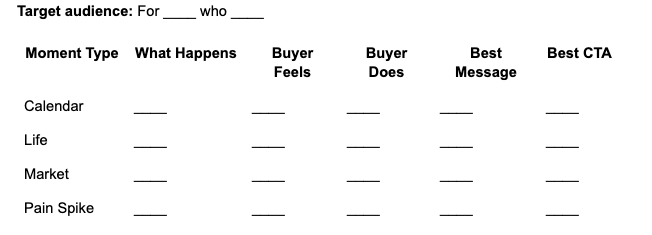
This one page can guide your emails, ads, social posts, and landing pages.
🧠 How to Fill the Moment Map
Use real data.
Look at:
search terms
call notes
reviews
support tickets
refund reasons
email replies
sales objections
seasonal sales trends
ad performance by date
website behavior by week
Do not guess if you can observe.
Consumer behavior leaves timing clues.
🗓️ The Timing Calendar: Turn Moments Into Campaigns
Once you know moments, build a simple timing calendar.
Weekly
Use weekly pain spikes.
Examples:
“Before your Monday meeting…”
“This week’s buyer clarity fix”
“Fix one leak before Friday”
Monthly
Use month-end or month-start behavior.
Examples:
“Start the month with a cleaner buyer persona”
“Before the month-end budget review”
“Your first-week message check”
Quarterly
Use planning windows.
Examples:
“Before Q3 campaigns launch”
“Quarterly buyer behavior review”
“What changed in buyer intent this quarter?”
Annual
Use big planning moments.
Examples:
“Before the year-end push”
“New year, sharper buyer persona”
“Plan next year’s campaigns with real behavior”
📧 Email Timing by Moment
Email works best when the topic matches the moment.
Calendar moment email
Subject: “Before your next campaign goes live”
Body angle: check message fit before more spend
CTA: “Get the 48-hour buyer persona map”
Life moment email
Subject: “New role? Start here first”
Body angle: simple first step for clarity
CTA: “Get the beginner buyer persona checklist”
Market moment email
Subject: “If buyers are comparing more…”
Body angle: show proof earlier and sharpen fit
CTA: “Get the comparison proof map”
Pain spike email
Subject: “Before you spend again”
Body angle: find the leak first
CTA: “Get the fix-first audit”
📣 Ad Timing by Moment
Ads need stronger timing because attention is quick.
Calendar ad
“Launch next week? Fix your buyer persona before traffic hits.”
Life moment ad
“New business? Build your buyer persona before your first campaign.”
Market moment ad
“Ad costs rising? Stop guessing who your buyer is.”
Pain spike ad
“Wrong leads again? Your message may be aimed at the wrong buyer.”
Each ad names the moment first.
🔁 Retargeting by Moment
Retargeting should change based on behavior and timing.
If they visited a blog post
Message:
“You’re learning. Here’s the next step.”
CTA:
“Get the checklist.”
If they visited pricing twice
Message:
“Still comparing? See what’s included and what happens next.”
CTA:
“See the starter path.”
If they clicked CTA but stopped
Message:
“Need a smaller first step? Start with the complimentary guide.”
CTA:
“Start small.”
If they returned before a deadline
Message:
“Before launch week, fix the buyer message.”
CTA:
“Get the 48-hour plan.”
This is moment mapping plus consumer behavior.
🧱 Landing Page Blocks for Each Moment
Different moments need different page blocks near the top.
Calendar moment page
Put early:
deadline line
48-hour plan
“what happens before launch”
CTA
Life moment page
Put early:
beginner-friendly language
simple steps
no-pressure CTA
“start here” block
Market moment page
Put early:
market shift statement
competitor gap or buyer change
proof
comparison CTA
Pain spike page
Put early:
pain line
leak finder
“what to fix first”
fast CTA
Message timing affects page order.
🧲 Triggers by Moment Type
Use the right behavioral trigger.
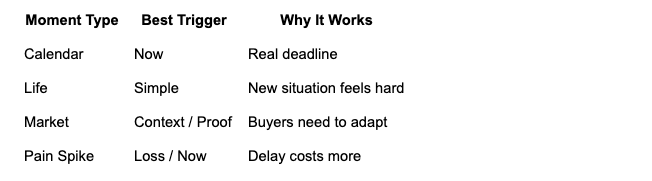
This keeps copy focused.
🧪 Weekly Moment Tests
Test timing like you test copy.
Test 1: Calendar vs evergreen
Variant A: “Before your next campaign…”
Variant B: “Improve your campaign…”
Track CTR, bounce, CTA clicks.
Test 2: Pain spike vs dream
Variant A: “Stop wasting ad spend.”
Variant B: “Get better leads.”
Track lead quality and close rate.
Test 3: Now CTA vs safe CTA
Variant A: “Fix this week.”
Variant B: “Get the checklist.”
Track conversions and time-to-yes.
Test 4: Deadline proof vs general proof
Variant A: “48-hour buyer clarity map”
Variant B: “buyer clarity map”
Track CTA clicks.
One test. One week.
📊 KPIs That Show Moment Mapping Works
Track:
CTR by moment
email replies by moment
CTA clicks by moment
conversions by moment
close rate by moment
time-to-yes by moment
refunds by moment
LTV by moment
The most important is velocity.
If moment mapping works, buyers say yes faster.
🧯 Common Moment Mapping Mistakes
Mistake 1: Using fake urgency
Fix: use real timing from the buyer’s world.
Mistake 2: Sending the same message all year
Fix: build a timing calendar.
Mistake 3: Ignoring buyer persona
Fix: map moments by persona, not just by product.
Mistake 4: Treating every deadline as urgent
Fix: ask if the buyer truly cares about that date.
Mistake 5: Missing pain spikes
Fix: review calls, support, refunds, and search terms weekly.
👤 How Moment Mapping Improves Your Buyer Persona
A buyer persona gets stronger when it includes moments.
Add this section to your buyer persona card:
✅ Moment Section
Calendar moments: ____
Life moments: ____
Market moments: ____
Pain spikes: ____
Best timing trigger: ____
Best timed CTA: ____
Best 48-hour win: ____
Now your buyer persona can guide timing, not just copy.
❓ FAQ — Moment Mapping and Buyer Persona
1) What is moment mapping?
Moment mapping means finding the key times when buyers are more likely to act. It maps calendar, life, market, and pain spike moments so your message reaches the buyer when they care most.
2) How does moment mapping connect to buyer persona?
A buyer persona explains what the buyer wants and fears. Moment mapping adds when the buyer is most ready to act, which makes the persona more useful.
3) What are the four main buyer moments?
The four main buyer moments are calendar moments, life moments, market moments, and pain spikes.
4) What is a calendar moment?
A calendar moment is a date or season that affects action, like month-end, launch week, tax season, holidays, or annual planning.
5) What is a life moment?
A life moment is a personal or role change, like starting a business, getting promoted, moving, having a baby, or taking on a new job.
6) What is a market moment?
A market moment is an outside change, such as rising ad costs, a new competitor, platform changes, or shifts in buyer behavior.
7) What is a pain spike?
A pain spike is when a problem becomes too costly or stressful to ignore, such as wasted ad spend, poor leads, missed deadlines, or failed launches.
8) How do we find buyer moments?
Use consumer behavior data from search terms, sales calls, reviews, support tickets, refunds, email replies, and page behavior.
9) How do we time emails with buyer moments?
Match email topics to real timing. Use calendar reminders, life-stage guidance, market shift alerts, or pain spike fixes depending on the buyer persona.
10) How do we time ads with consumer behavior?
Use ads that name the moment first, such as “before launch,” “ad costs rising,” “new business,” or “wrong leads again.”
11) What KPI proves moment mapping works?
Velocity, or time-to-yes, is one of the best KPIs. If buyers decide faster, the message likely matched the moment.
12) What is the biggest moment mapping mistake?
The biggest mistake is using fake urgency. Use real buyer timing, not made-up pressure.
📌 Key Takeaways
Moment mapping helps you time messages around real buyer behavior
A strong buyer persona includes timing, not just pain and goals
Use four moments: calendar, life, market, and pain spikes
Match each moment with the right trigger, proof, CTA, and offer
Use timed emails, ads, retargeting, and landing page blocks
Track velocity to see if buyers say yes faster
This is buyer clarity inside The Buyer Clarity System™
🎁 Complimentary Ebook
Want the Moment Map template, timing calendar, and buyer persona timing worksheet?
Grab our COMPLIMENTARY Buyer Clarity Guide here:
👉 Download your complimentary ebook now
🧭 Final Word
The right message matters.
But timing matters too.
Find the moment.
Name the moment.
Match the proof.
Choose the right CTA.
When your buyer persona meets the right message at the right time, action gets easier.
That is how consumer behavior turns into faster yeses—inside The Buyer Clarity System™.
