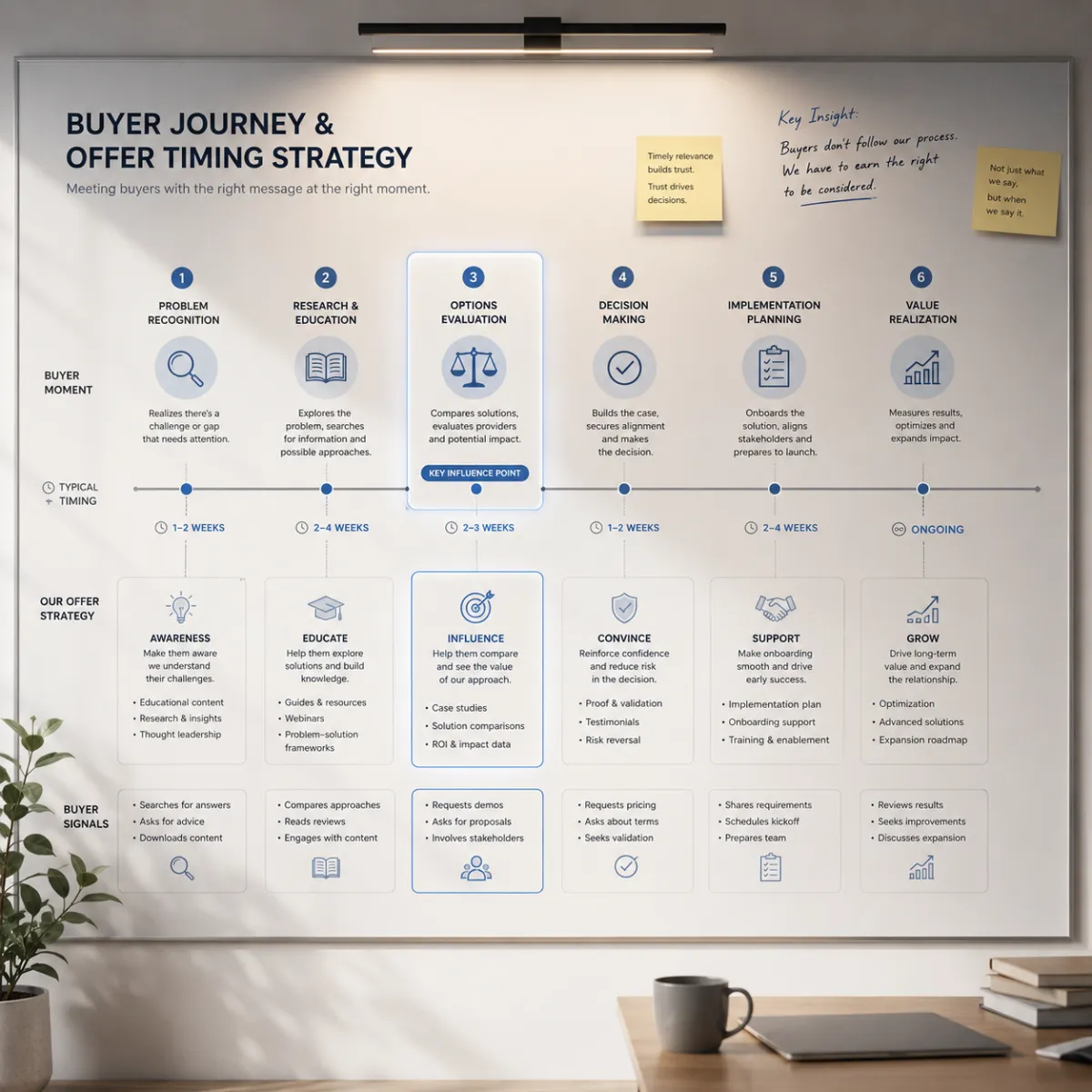
⏰ Moment Map: Time Your Offer for Your Target Audience
⏰ Moment Map: Time Your Offer for Your Target Audience
A great message at the wrong time feels like noise.
A good message at the right time feels like help.
That’s the hidden truth behind buyer clarity.
Most businesses lose not because their offer is bad…
but because they show up too early or too late.
And the buyer’s brain does what it always does when timing feels off:
It waits.
That waiting shows up in consumer behavior:
they save the post “for later”
they open the email but don’t click
they visit pricing… then disappear
they say “circle back next month”
So we don’t just build the right message.
We time it.
We use a Moment Map—a simple way to find the moments when your target audience is most likely to say yes, then match your buyer persona message to that moment.
A Moment Map finds “yes windows” by tracking calendar moments, life moments, market moments, and pain spikes. Then we schedule emails, ads, and offers around those moments, using buyer persona fears and proof needs to reduce risk at the click.
🧠 What a “buyer moment” is (simple definition)
A buyer moment is a trigger that turns:
“someday” → “today”
It can be:
a deadline
a life change
a budget cycle
a pain spike
a boss question
a new rule
a new competitor
A buyer moment matters because it creates urgency without hype.
In the buyer persona, it’s the moment field:
“Why now?”
🎯 Why timing is part of buyer persona (and why it converts)
A buyer persona is not just:
who they are
what they want
It is also:
when they care most
Because timing changes risk.
At the wrong time, the buyer fears wasting money.
At the right time, the buyer fears staying stuck.
So our job is to catch the moment when the cost of doing nothing feels bigger than the cost of acting.
That’s when the brain says yes.
🧭 What Moment Map is (simple)
Moment Map is a 4-part map:
📅 Calendar moments
🧍 Life moments
🌊 Market moments
🔥 Pain spikes
We list these moments, then we plan messaging and offers around them.
It’s like fishing:
you can have the best bait
but you still need to fish when the fish are hungry
Your target audience is hungry at specific times.
🧩 Step 1: Pick ONE target audience slice first
Moment Map only works when you pick a focused group.
Example target audiences:
local service owners
busy parents
agency owners
ecommerce founders
ops leads
coaches
Write your target audience line:
For [group] who want [result] without [pain] in [time].
Now we map moments for that group.
📅 Moment Type 1: Calendar moments (the easy wins)
Calendar moments happen every year, month, or week.
These are predictable “yes windows.”
✅ Common calendar moments
start of month (fresh start)
end of month (budget + panic)
Mondays (reset energy)
Fridays (wrap up, planning)
holidays (family time, travel)
back-to-school
end of quarter
New Year (big reset)
tax season (money focus)
🧠 What this means for consumer behavior
At these times, buyers search more, compare more, and decide faster.
Not always. But often enough to plan around.
✅ Best use
Calendar moments are best for:
planning offers
email sequences
content calendars
ad bursts
🧍 Moment Type 2: Life moments (identity changes)
Life moments change behavior fast.
A new identity creates new needs.
✅ Common life moments
new job
promotion
moving
new baby
health scare
divorce
starting a business
big birthday
kids change schedule
🧠 Why life moments are powerful
They create a new fear:
“I can’t do it the old way anymore.”
That is a deep buyer persona shift.
✅ Best use
Life moments are best for:
empathy-first messaging
“this is for you if…” targeting
content that feels personal and safe
🌊 Moment Type 3: Market moments (external pressure)
Market moments are things that happen to your audience:
new rules
new tech
new competitors
price changes
algorithm changes
economic shifts
These create urgency without you forcing urgency.
✅ Common market moments
Google updates change leads
ad costs rise
platform changes (reach drops)
new compliance rules
seasonal demand changes
competitor discounts or new offers
🧠 What this means
Market moments create a new question in the buyer’s head:
“What should we do now?”
Your Moment Map helps you show up with the answer.
🔥 Moment Type 4: Pain spikes (the “I can’t take this” moment)
Pain spikes are the most powerful moments.
A pain spike is when the problem gets sharp.
✅ Common pain spikes
a bad month
a big bill
a failed campaign
a bad review
a broken system
a missed deadline
a team mistake
a customer complaint
🧠 Why pain spikes convert
Because the brain switches from:
“I should…”
to
“I must…”
Pain spikes are where your buyer persona is most ready.
🧩 Step 2: Build your Moment Map (worksheet)
Copy this:
✅ Moment Map Worksheet
Target audience: ____
Calendar moments (5):
____________________________________________________
____________________________________________________
____________________________________________________
____________________________________________________
____________________________________________________
Life moments (5):
____________________________________________________
____________________________________________________
____________________________________________________
____________________________________________________
____________________________________________________
Market moments (5):
____________________________________________________
____________________________________________________
____________________________________________________
____________________________________________________
____________________________________________________
Pain spikes (5):
____________________________________________________
____________________________________________________
____________________________________________________
____________________________________________________
____________________________________________________
Now we pick the top “yes windows.”
🧮 Step 3: Score the moments (so we pick winners)
Score each moment 1–5:
Frequency: how often it happens
Intensity: how strongly it hurts
Reach: how easy it is to target
Fit: how well your offer solves it
Total max = 20.
Pick the top 3 moments.
Those are your best “launch windows.”
🧠 Step 4: Match the buyer persona to the moment
This is where it gets powerful.
For each top moment, write:
what the buyer says in that moment
what they fear
what proof they need
what CTA feels safe
✅ Buyer persona moment block (copy/paste)
Moment: ____
They say: “____”
They fear: ____
They need to see: ____
Safe next step: ____
48-hour win: ____
This turns timing into copy.
📍 Where moments show up in consumer behavior data
Even if you don’t have deep data, you can still observe timing signals:
spikes in website visits
spikes in pricing page visits
spikes in “near me” searches
spikes in DM questions
spikes in certain keywords
spikes after weekends or holidays
Timing patterns are hidden in behavior.
🗓️ Email schedules by moment (simple and effective)
Here are simple email plays that match moments.
📅 Calendar moment email schedule (5-day run)
Day 1: “The moment is here” (why now)
Day 2: “What happens if you wait” (loss)
Day 3: “Proof and steps” (certainty)
Day 4: “FAQ answers” (risk reducers)
Day 5: “Last call for this window” (gentle urgency)
🔥 Pain spike email schedule (3-day run)
Day 1: “Fast relief plan”
Day 2: “What happens next” + proof
Day 3: “Start small” CTA
Keep it calm. No pressure. Just clarity.
📣 Ad schedules by moment (simple)
✅ Calendar moments
run ads heavier 3–7 days before and during the moment
use “why now” copy
✅ Pain spikes
always-on ads with pain language
retarget with proof + risk reducers
✅ Market moments
quick response ads (within days)
“here’s what changed and what to do”
🧱 Moment-based page blocks (where to show timing)
Timing belongs in:
the first 100 words
the subhead
a “perfect if…” block
your micro-FAQ
✅ “Perfect if…” moment block (copy/paste)
“Perfect if you:
need ___ before ___
are dealing with ___ right now
tried ___ and it didn’t work
want a safe first win in 48 hours”
This block helps your buyer persona self-select fast.
🧩 Case snippets (simple examples by niche)
No fake stats. Just realistic scenarios.
🛠️ Local service business
Moment: weekend break + Monday panic
Message: “Book this week. No surprises.”
CTA: “Book now”
48-hour win: schedule confirmed + first fix step
💻 B2B service
Moment: end-of-month reporting
Message: “Walk into the meeting with clear numbers.”
CTA: “Get the dashboard checklist”
48-hour win: one-page plan + first metric tracked
🛒 Ecommerce
Moment: pre-event purchase (wedding, vacation)
Message: “Start a simple routine now.”
CTA: “Try the starter kit”
48-hour win: first two-day routine completed
🎓 Coach
Moment: “new month reset”
Message: “Pick your niche and message in 7 days.”
CTA: “Get the niche guide”
48-hour win: niche picked + first post written
🧠 The 48-hour win is a timing weapon
Timing gets attention.
A 48-hour win closes the sale.
Because it answers the brain’s fear:
“What if we buy and nothing happens?”
When you pair a moment with a 48-hour win, the buyer feels:
urgency
safety
clarity
That’s conversion.
🧯 Common timing mistakes (and fixes)
Mistake: launching when buyers are calm
Fix: launch around moments and pain spikes.
Mistake: using hype urgency
Fix: use real timing triggers, not fake countdowns.
Mistake: not changing copy by moment
Fix: match the buyer persona’s “why now” words.
Mistake: not planning follow-up
Fix: use a simple 3–5 email cadence per moment.
Mistake: forgetting to retarget
Fix: retarget with proof + micro-FAQ.
🧪 One-week Moment Map action plan
Day 1: Pick the target audience
Use your “For…” line.
Day 2: List 20 moments
Use calendar, life, market, pain spikes.
Day 3: Score moments
Pick top 3.
Day 4: Write moment-based copy
One headline, one proof block, one CTA per moment.
Day 5: Launch a small test
Email + small ad budget.
Day 6–7: Read consumer behavior
CTR, bounce, clicks, conversions.
Then tune one thing next week.
🧠 Why this supports ranking for “buyer persona”
This post strengthens your buyer persona authority because it:
defines buyer persona timing (“moment”) clearly
shows how moments affect message, proof, and CTA
includes buyer persona templates and FAQs
repeats “buyer persona” naturally in explanations
Search engines reward useful, structured clarity.
❓ FAQ — Moment Map, Target Audience Timing, and Buyer Persona
1) What is a buyer moment?
A buyer moment is a trigger that turns “later” into “today.” It can be a deadline, life change, market shift, or pain spike.
2) Why does timing matter for a target audience?
Because buyers are more ready at certain times. Consumer behavior shows more searching, clicking, and buying during “yes windows.”
3) How does timing connect to a buyer persona?
Timing is the buyer persona “moment” field. It tells why now and what words the buyer uses when they are ready.
4) What are the four moment types in Moment Map?
Calendar moments, life moments, market moments, and pain spikes.
5) Which moment type converts best?
Pain spikes often convert best because urgency is real. But calendar and market moments are easier to plan for.
6) How do we find our best moments without deep data?
Look at repeat questions, spikes in visits, pricing loops, and common “why now” phrases in emails and reviews.
7) Where should we show timing on a page?
In the first 100 words, in a “perfect if…” block, and in the micro-FAQ near the CTA.
8) How do we score moments to pick the best ones?
Score frequency, intensity, reach, and fit (1–5 each). Pick the top three.
9) What email cadence works best for a moment-based offer?
A 3–5 email run: moment → loss of waiting → proof + steps → FAQs → gentle last call.
10) What should our ads say during a moment?
Use real “why now” language: “before Friday,” “this week,” “end of month,” “launch coming,” and pair it with a safe next step.
11) What is a 48-hour win and why does it help timing?
A 48-hour win is a fast micro-result. It reduces risk and makes buyers feel safe saying yes during the moment.
12) How do we know our timing is working?
Consumer behavior improves: CTR rises, bounce drops, CTA clicks rise, and conversions happen faster.
📌 Key Takeaways
Timing is a hidden conversion lever for your target audience
Moment Map uses four moment types: calendar, life, market, pain spikes
Score moments by frequency, intensity, reach, and fit
Match buyer persona message, proof, and CTA to the moment
Use simple email/ad schedules to show up during “yes windows”
Pair moments with a 48-hour win to reduce risk and speed up yes
This is buyer clarity inside The Buyer Clarity System™
🎁 Complimentary Ebook
Want the Moment Map worksheet, scoring grid, and message templates?
Grab our COMPLIMENTARY Buyer Clarity Guide here:
👉 Download your complimentary ebook now
🧭 Final Word
Buyers don’t buy when we’re ready.
They buy when they are ready.
Map the moments. Show up on time. Speak to the buyer persona fear and need.
That’s how “maybe later” becomes “yes”—inside The Buyer Clarity System™.
