🎯 Market Segmentation for Ads: Build 3 Simple Slices That Convert
🎯 Market Segmentation for Ads: Build 3 Simple Slices That Convert
Ads get expensive when we aim at “everyone.”
Because “everyone” clicks for random reasons.
And random clicks do random things.
They bounce.
They hesitate.
They ask weird questions.
They don’t buy.
That’s why we use market segmentation.
But here’s the problem:
Most marketers make segmentation too complex.
They build 12 segments.
They build 20 buyer personas.
They build 50 ad sets.
Then they drown.
So we’re going to do the opposite.
We’re going to rebuild ad targeting with 3 simple slices—clean, easy, and powerful.
Each slice will have:
one target audience angle
one buyer persona message
one CTA step
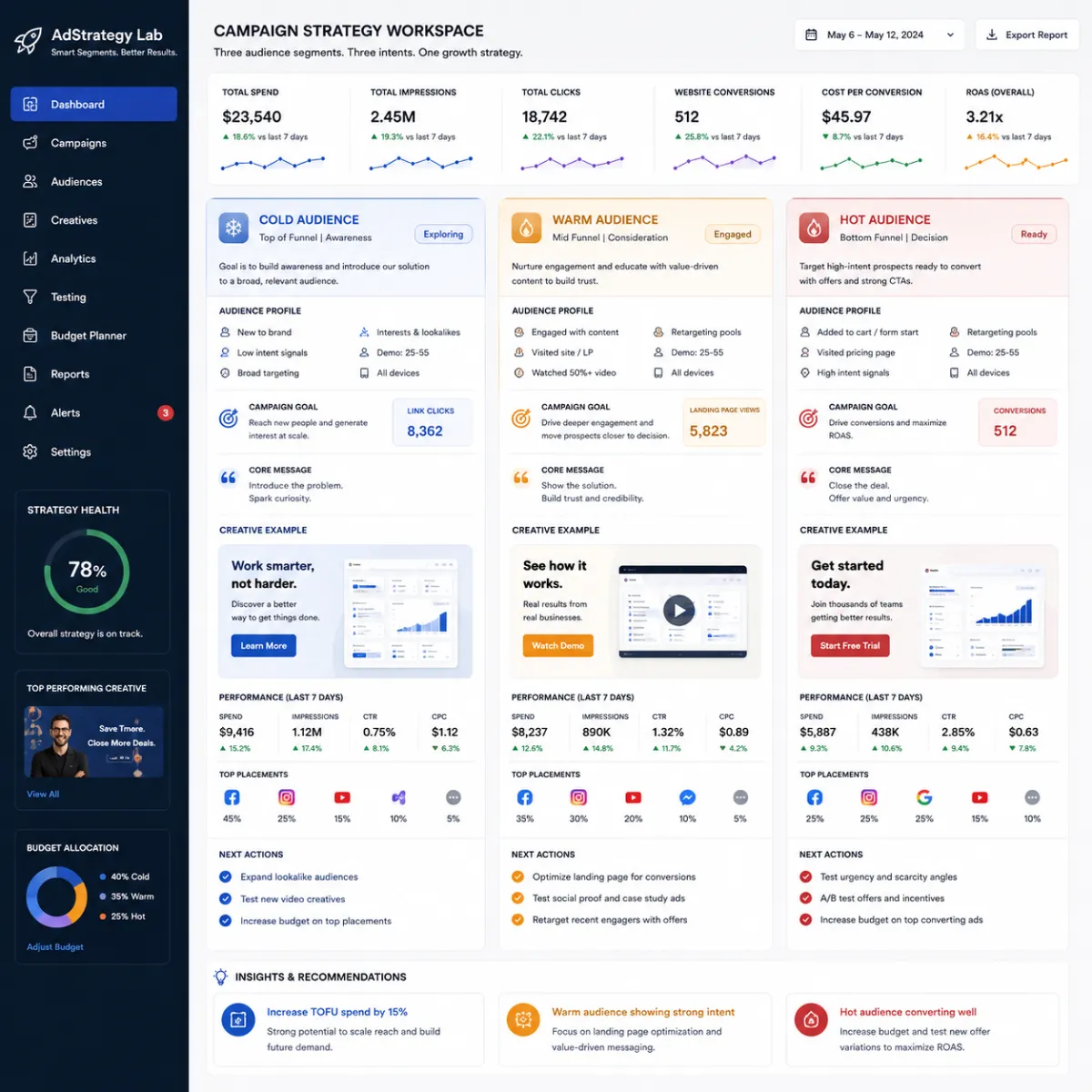
And we’ll use consumer behavior to move people from cold → warm → hot.
Build 3 slices that match behavior: Cold (learning), Warm (comparing), Hot (ready). Or use Pain/Urgency/Budget if that fits your market better. Then map each slice to one message and one CTA. Keep targeting tight, keep the page matched, and test one change per week.
🧠 Quick definitions (so the system stays clear)
🎯 Market segmentation
Market segmentation means splitting your market into smaller slices so messages match better.
🎯 Target audience
Your target audience is the group you aim at.
👤 Buyer persona
Your buyer persona is the “one person story” inside that group:
pain, dream, moment, risk, proof needed, safe step.
Market segmentation helps ads because it stops mixed messages.
🧩 Why 3 slices beats 20 slices
When you have 20 slices:
you spread budget too thin
you don’t learn fast
tests get noisy
results feel random
When you have 3 slices:
each slice gets enough budget to learn
messages stay clear
pages stay matched
results improve faster
Simple wins.
🧭 Pick your 3-slice model (choose one)
You have two easy options.
✅ Option A: Cold / Warm / Hot (best for most ads)
This is segmentation by consumer behavior stage.
❄️ Cold = learning
🌤️ Warm = comparing
🔥 Hot = ready
✅ Option B: Pain / Urgency / Budget (best for some markets)
This is segmentation by decision driver.
🩹 Pain = what hurts most
⏰ Urgency = how soon
💰 Budget = safe vs premium
Either model works. Pick one and stay consistent for 30 days.
🎯 The Cold/Warm/Hot slice model (simple and powerful)
Let’s build it.
❄️ Slice 1: Cold (learning slice)
Cold buyers are not ready to buy.
They are trying to understand:
what’s wrong
what to do
what’s possible
Consumer behavior signs:
reads blogs
watches short videos
clicks “how to”
searches “what is” and “how to”
Best CTA (cold):
complimentary guide
checklist
mini training
“see the steps”
Cold needs a small step.
🌤️ Slice 2: Warm (comparing slice)
Warm buyers are interested, but cautious.
They ask:
“Will this work for me?”
“Is this safe?”
“How does it work?”
“What happens first?”
Consumer behavior signs:
pricing page visits
FAQ clicks
repeat visits
case study clicks
Best CTA (warm):
trial
demo
audit
“get the proof pack”
Warm needs proof and risk reduction.
🔥 Slice 3: Hot (ready slice)
Hot buyers want a decision path.
They ask:
“How soon can we start?”
“What does it cost?”
“What do I do next?”
Consumer behavior signs:
repeat pricing loops
checkout starts
booking page visits
direct messages asking for timing
Best CTA (hot):
book now
start now
buy now
Hot needs speed and certainty.
🧠 The Pain/Urgency/Budget slice model (also simple)
Use this if your market is driven by emotion triggers more than stages.
🩹 Slice 1: Pain-first
Hook to the main pain.
“Stop wasting money on ads.”
“Stop chasing leads.”
CTA: small step, often guide or audit.
⏰ Slice 2: Urgency-first
Hook to “why now.”
“If you need leads this month…”
“Before your next launch…”
CTA: call/demo/audit, because urgency increases action.
💰 Slice 3: Budget-fit
Hook to safe value.
“Start small.”
“Starter plan.”
CTA: starter offer, sample, small paid audit.
This keeps targeting clean and avoids “everyone.”
🧩 Step-by-step: Build your 3 slices (the worksheet)
Copy this and fill it out.
✅ 3-Slice Ad Segmentation Worksheet
Target audience group: For ____ who ____
Slice 1 name: ____
Stage/Driver: ____
Pain: ____
Dream: ____
Risk: ____
Proof needed: ____
CTA: ____
Slice 2 name: ____
Stage/Driver: ____
Pain: ____
Dream: ____
Risk: ____
Proof needed: ____
CTA: ____
Slice 3 name: ____
Stage/Driver: ____
Pain: ____
Dream: ____
Risk: ____
Proof needed: ____
CTA: ____
Now we map each slice to targeting, message, and CTA.
🧠 Targeting setup (keep it clean)
Here’s the biggest rule:
One slice per ad set.
That means:
one audience setup
one message angle
one CTA
one landing page (or one section matched to it)
If you mix slices in one ad set, you get mixed data.
Mixed data creates wrong decisions.
🧭 Targeting setup by slice (simple)
❄️ Cold targeting ideas
Goal: reach people before they decide.
broad-ish but still relevant
interests that show the problem
lookalikes if you have them
educational keywords if on search
Do not use hot CTAs here.
🌤️ Warm targeting ideas
Goal: reach people who are already aware.
retarget site visitors
video viewers
engaged social users
email list (if you have it)
Warm is where proof works.
🔥 Hot targeting ideas
Goal: reach people ready now.
high-intent search terms
retarget pricing visitors
cart/check-out abandoners
“book now” clickers
Hot is where speed and clarity win.
🗣️ Message mapping (slice → buyer persona words → ad copy)
Each slice needs a different message.
❄️ Cold message block (buyer persona)
“Here’s what’s happening.”
“Here’s why it hurts.”
“Here’s the simple first step.”
Cold ad template:
“Still stuck with [pain]?
For [target audience].
Start small: get the complimentary guide.”
🌤️ Warm message block (buyer persona)
“Here’s proof.”
“Here’s how it works.”
“Here’s what happens first.”
Warm ad template:
“Will this work for people like us?
Here’s proof and the steps.
For [target audience].
Get the proof pack.”
🔥 Hot message block (buyer persona)
“Here’s the next step.”
“Here’s timing.”
“Here’s what happens next.”
Hot ad template:
“Ready to fix [pain] this week?
For [target audience].
Book now and get your first win fast.”
Only claim what you can deliver.
🔘 CTA mapping (slice → safe step)
CTA is where most ads break.
They ask for too much too soon.
Here’s the easy mapping:
Cold → guide/checklist
Warm → trial/demo/audit
Hot → book/buy
That’s it.
📍 Landing page mapping (match the slice or it will bounce)
Your landing page must match the slice.
❄️ Cold landing page must have:
short hero
“For…” line
steps
guide CTA
light proof
🌤️ Warm landing page must have:
proof near CTA
micro-FAQ under CTA
“what happens next”
case mini-stories
🔥 Hot landing page must have:
pricing clarity (if possible)
booking steps
proof near pricing and CTA
speed and next steps
This is how we keep consumer behavior clean:
CTR up, bounce down, clicks up.
💸 Budget split (simple starter plan)
If budget is small, don’t split it into dust.
Start with:
50% warm (retargeting + proof)
30% cold (education + guide)
20% hot (high intent + booking)
Then adjust after 7–14 days.
Why this works:
Warm traffic converts faster and teaches faster.
📊 KPIs by slice (what to watch so you don’t guess)
❄️ Cold slice KPIs
CTR
time on page
guide opt-ins
🌤️ Warm slice KPIs
CTA clicks
conversions
reply rate (if email)
🔥 Hot slice KPIs
booking starts
close rate
time-to-yes (velocity)
Track per slice. Averages lie.
🧯 Common mistakes (and quick fixes)
Mistake: too many segments
Fix: 3 slices only for 30 days.
Mistake: one landing page for every slice
Fix: match page sections or create one page per slice.
Mistake: big CTA for cold traffic
Fix: start with a safe step.
Mistake: proof buried
Fix: move proof near CTA and near pricing.
Mistake: changing everything at once
Fix: one-change-one-week rule.
🧪 The 7-day setup plan (fast and clean)
Day 1: Pick your 3-slice model
Cold/warm/hot or pain/urgency/budget.
Day 2: Write your 3 slice cards
Pain, dream, risk, proof, CTA.
Day 3: Build 3 ad sets
One ad set per slice.
Day 4: Match landing pages
At least match hero and CTA to slice.
Day 5: Launch small
Don’t overthink. Launch and learn.
Day 6–7: Read behavior
CTR, bounce, clicks, conversions, lead quality.
Then improve one thing next week.
🧠 Why this helps rank for “buyer persona”
Even though this post is about market segmentation, it supports the “buyer persona” keyword goal because it:
shows how buyer persona powers ad messaging per slice
repeats buyer persona naturally in definitions and templates
answers buyer persona + targeting questions in the FAQ
connects buyer persona to consumer behavior metrics
That builds authority across search and AI engines.
❓ FAQ — Market Segmentation for Ads (3 Slices)
1) What is market segmentation for ads?
Market segmentation for ads means splitting your audience into smaller slices so the message and CTA match better, which improves consumer behavior and conversions.
2) Why should we use only 3 ad segments?
Three segments are enough to learn fast without spreading budget too thin. More segments often creates noise and confusion.
3) What is the best 3-slice model for most businesses?
Cold, warm, and hot is best for most businesses because it matches consumer behavior stages.
4) What is the pain/urgency/budget model?
It’s a simple market segmentation approach that groups buyers by what drives decisions: pain level, urgency, and budget fit.
5) How does buyer persona fit into segmentation?
Buyer persona gives the words for pain, fear, proof needed, and safe next step. Each segment uses different buyer persona words.
6) What CTA should we use for cold segments?
Use a small safe step like a complimentary guide, checklist, or “see the steps” page.
7) What CTA should we use for warm segments?
Use proof-based steps like a trial, demo, audit, or proof pack.
8) What CTA should we use for hot segments?
Use book/buy CTAs with clear “what happens next” and proof near pricing.
9) How do we avoid making segmentation too complex?
Use one slice per ad set, one CTA per slice, and one landing page or page section per slice. Keep it simple for 30 days.
10) What KPIs show a segment is working?
CTR, bounce, CTA clicks, conversion rate, close rate, and time-to-yes. Track KPIs by slice, not blended.
11) How do we test segments without guessing?
Use one-change-one-week tests. Change one variable (hook, proof placement, CTA) and measure consumer behavior.
12) What is the fastest way to improve segment performance?
Match the landing page hero to the ad, place proof near the CTA, and use the right CTA step for the segment stage.
📌 Key Takeaways
Use market segmentation to stop aiming at “everyone”
Build 3 simple slices: cold/warm/hot (or pain/urgency/budget)
One slice per ad set, one CTA per slice, one page per slice
Match landing pages to slice to reduce bounce
Track KPIs by slice (CTR, bounce, clicks, conversions, time-to-yes)
Buyer persona words power the copy for each segment
This is buyer clarity inside The Buyer Clarity System™
🎁 Complimentary Ebook
Want the 3-slice worksheet, ad templates, and KPI tracker?
Grab our COMPLIMENTARY Buyer Clarity Guide here:
👉 Download your complimentary ebook now
🧭 Final Word
Stop building 20 segments.
Build 3 slices that match real consumer behavior.
Aim clearly. Speak in buyer persona words. Use the right CTA step.
That’s how ads start converting without chaos—inside The Buyer Clarity System™.
