🏠 Homepage That Speaks to One Target Audience (Hero, Proof, CTA)
🏠 Homepage That Speaks to One Target Audience (Hero, Proof, CTA)
Your homepage is not a résumé.
It’s not a menu.
It’s a doorway.
And the buyer’s brain asks one fast question at that doorway:
“Is this for us?”
If the answer is fuzzy, they leave.
That shows up in consumer behavior right away:
bounce rate climbs
time on page drops
people scroll but don’t click
calls and leads feel random
So we stop trying to please everyone.
We build a homepage that speaks to one target audience first.
Then we route everyone else to the right place with small “tiles.”
That’s how The Buyer Clarity System™ keeps the message strong without losing other opportunities.
A converting homepage has one “For…” line for one target audience, one main promise, proof near the first CTA, a short 3-step path, a “for/not-for” box, and tiles that route other segments to the right pages.
🧠 Quick definitions (so the homepage stays clear)
🎯 Target audience
Your target audience is the group you choose to aim at.
👤 Buyer persona
Your buyer persona is the “one person” inside that group with pain, doubts, and proof needs.
Target audience = who the homepage is for.
Buyer persona = what words the homepage uses.
🎯 Why most homepages fail (and feel “busy”)
Most homepages fail because they try to speak to:
everyone
every industry
every pain
every offer
So the hero becomes a “nice” sentence that means nothing.
Examples of fuzzy heroes:
“We help businesses grow.”
“We offer solutions for your success.”
“We help you reach your goals.”
Those lines don’t grab a buyer persona.
They don’t calm risk.
They don’t create action.
🧩 The rule: One homepage = one primary target audience
This is the rule:
Your homepage is your main door.
It should speak to the best audience first.
Other audiences still matter.
But they should be routed with small tiles.
That keeps the hero strong.
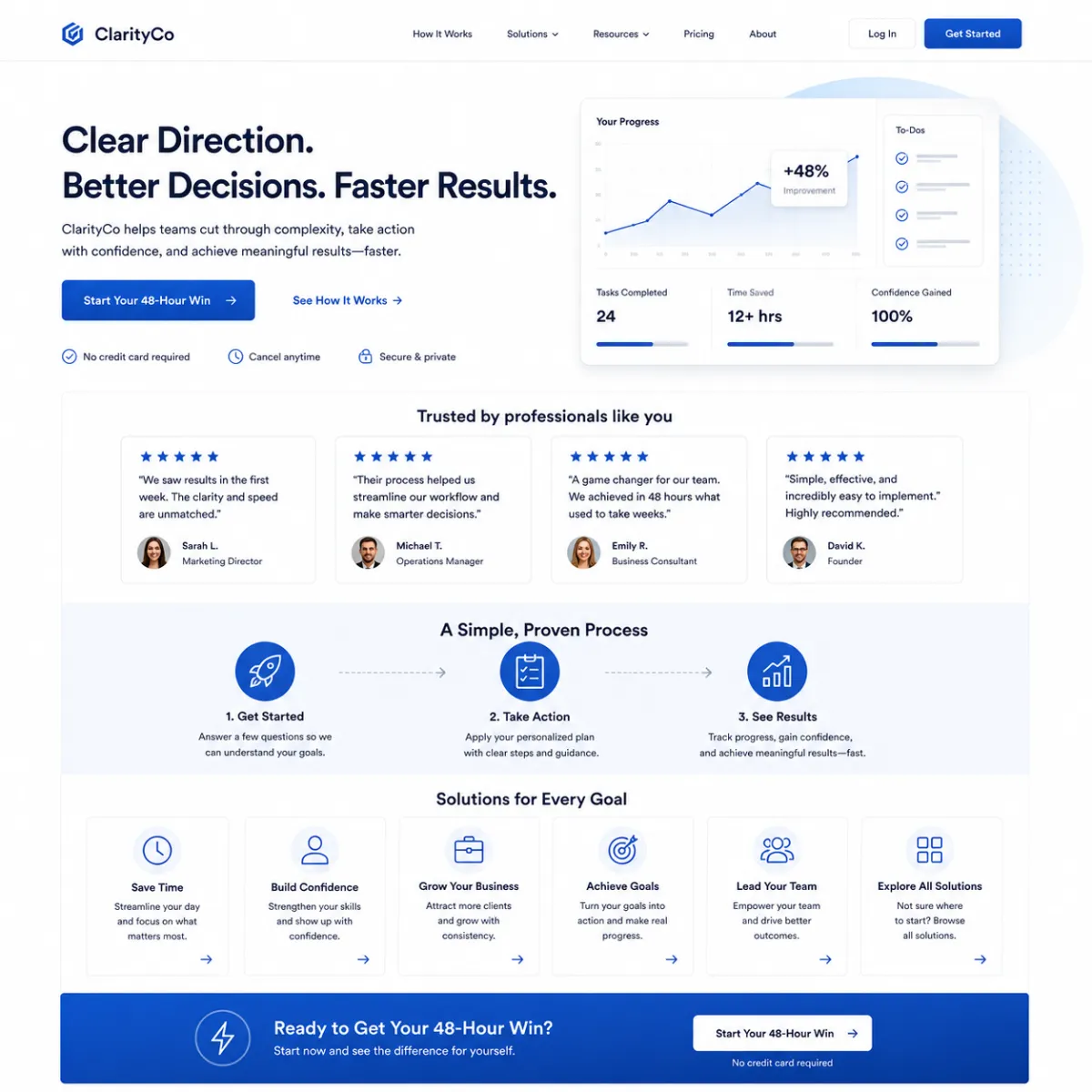
🧱 The homepage wireframe (hero, proof, CTA)
Here’s the clean homepage layout:
Hero: headline + “For…” line + CTA
Proof stack (near CTA)
3-step path (simple)
“For / Not For” box
Tiles for other slices (routing)
Mini FAQ (top doubts)
Final CTA
Now we build it.
1) 🪧 Hero Block (say it in one breath)
The hero must do three jobs:
name the target audience
promise a clear result
give a safe next step
✅ Hero headline formulas (buyer persona driven)
Formula A:
“Stop [pain] and get [result] without [fear].”
Formula B:
“Get [result] for [target audience] (simple steps).”
Formula C:
“If you need [result] this month, start here.”
✅ The “For…” line (required)
This is the target audience boundary:
For [group] who want [result] without [pain] in [time].
This line makes buyers feel safe fast.
✅ One main CTA (stage matched)
Cold: “Get the complimentary guide”
Warm: “Book a quick call” / “Start the trial”
Hot: “Book now” / “Start now”
✅ Hero micro-copy
“Start small. Takes 2 minutes. No big leap.”
2) ⭐ Proof Stack (proof near the first CTA)
Proof is not decoration.
Proof is a risk reducer.
So proof goes near the button.
✅ Proof stack options (use 2–4)
1–3 real review lines
mini “what happens next” bullets
simple “week one win” checklist
simple outcome bullets (no fake stats)
✅ Proof stack template
“Here’s what buyers like you want most:
clear steps
fast first win
proof it works
That’s what we deliver.”
(Only claim what you can deliver.)
3) 🧭 3-Step Path (clarity beats clever)
A 3-step path lowers effort fear.
It helps the buyer persona see the road.
✅ 3-step template
Step 1: get clarity
Step 2: take the first win step
Step 3: scale what works
Add time tags if needed:
Step 1 (5 min)
Step 2 (10 min)
Step 3 (15 min)
4) ✅ “For / Not For” Box (filter wrong leads)
This box protects your time and improves lead quality.
It also helps buyers self-select faster.
✅ “For / Not For” template
This is for you if:
you are a [role]
you want [result]
you are dealing with [pain]
you want a clear plan
This is not for you if:
you want a magic button
you refuse to follow steps
you want results with no effort
Keep it kind. Keep it honest.
5) 🧩 Tiles for other slices (route without weakening the hero)
This is how we keep one primary target audience without losing others.
Use 3–6 tiles.
Each tile is a door to a segment page.
✅ Tile template
Tile title: “If you are [type]…”
Tile line: “Start here.”
Tile link: goes to a specific page
✅ Example tiles
“If you’re new and want to start small…”
“If you need proof before you decide…”
“If you need help fast this week…”
“If you want the pro path…”
Tiles keep the homepage clean.
6) ❓ Mini FAQ (top 4–6 doubts)
A homepage FAQ should be short.
It should answer the fears that block action.
✅ Mini FAQ questions (choose 5)
“Is this for my type of business?”
“What happens first?”
“How fast is the first win?”
“How much time does this take?”
“What if we tried something before?”
“How do we get started?”
Keep answers 1–3 lines.
7) 🔘 Final CTA (repeat the safe step)
The bottom CTA is for proof readers.
Keep it the same as the hero CTA.
Repeat the micro-copy.
Add “what happens next.”
This reduces fear at the final click.
🧠 How buyer persona language powers the homepage
Here’s the simple rule:
use buyer persona pain words in the headline
use buyer persona fear words in the FAQ
use buyer persona proof needs in the proof stack
use buyer persona stage to pick the CTA
That’s how the homepage becomes a mirror.
📱 Mobile checklist (don’t lose the majority)
Most buyers will see your homepage on mobile.
✅ Mobile checklist
headline fits in 2–3 lines
CTA button is full width
proof is near CTA on mobile
tiles are easy to tap
paragraphs are short
page loads fast
If mobile feels hard, conversions drop.
🧪 How to test the homepage (clean tests)
One change per week.
✅ High-impact homepage tests
headline: pain vs proof
“For…” line: tight vs broad
proof near CTA vs proof lower
CTA: guide vs call
tiles: 3 tiles vs 6 tiles
Track consumer behavior:
bounce
scroll
CTA clicks
conversions
lead quality
Let behavior pick winners.
🧯 Common homepage mistakes (and fixes)
Mistake: “We help everyone”
Fix: pick one target audience and commit for 30 days.
Mistake: proof is buried
Fix: move proof next to the first CTA.
Mistake: too many CTAs
Fix: one main CTA + tiles for other paths.
Mistake: no “not-for” filter
Fix: add the for/not-for box.
Mistake: homepage reads like a brochure
Fix: rewrite using buyer persona words.
🧠 Why this helps rank for “buyer persona”
This post supports SEO for buyer persona because it:
defines buyer persona and shows how it’s used on the homepage
repeats the term naturally in templates and explanations
answers buyer persona questions in a clean FAQ
ties buyer persona to conversion elements (hero, proof, CTA)
That builds topical authority across search engines and AI answer engines.
❓ FAQ — Homepage for One Target Audience
1) Should a homepage focus on one target audience?
Yes. A homepage converts best when it speaks to one primary target audience. Other audiences can be routed using tiles.
2) What is the most important homepage line to add?
The “For…” line. It clearly names the target audience and helps buyers self-select fast.
3) How does buyer persona affect homepage copy?
Buyer persona provides pain words, fear words, and proof needs. Those words shape the hero, proof stack, FAQ, and CTA.
4) Where should proof go on a homepage?
Near the first CTA. Fear spikes at the click, so proof should live close to the button.
5) What should the homepage CTA be?
One stage-matched CTA. Cold visitors need a guide. Warm visitors fit a call or trial. Hot visitors fit booking or buying.
6) What are tiles and why do we use them?
Tiles are small links for other slices. They keep the homepage focused while still serving other segments.
7) What should be in a “for/not-for” box?
Clear fit signals and clear non-fit signals. This improves lead quality and reduces wasted calls.
8) How long should a homepage be?
Long enough to answer top doubts and show proof, but short enough to scan. Use short sections, bullets, and clear CTAs.
9) How do we make a homepage mobile-friendly?
Use short headlines, full-width buttons, proof above the fold, tap-friendly tiles, and fast load speed.
10) How do we test homepage changes?
Run one change per week: headline, For line, proof placement, CTA wording, or tiles. Track bounce, clicks, and conversions.
11) What is the biggest homepage mistake?
Trying to speak to too many people at once. That makes the message generic and weak.
12) How do we know the homepage is working?
Consumer behavior improves: bounce drops, time and scroll increase, CTA clicks rise, and leads fit better.
📌 Key Takeaways
A homepage should speak to one primary target audience
Use a sharp hero + “For…” line + one main CTA
Put proof near the CTA because fear spikes at the click
Add a 3-step path and a for/not-for box to filter and clarify
Use tiles to route other segments without weakening the hero
Test one change per week using consumer behavior metrics
Buyer persona words make the homepage feel like a mirror
This is buyer clarity inside The Buyer Clarity System™
🎁 Complimentary Ebook
Want the homepage wireframe, “For…” line templates, and proof stack swipe file?
Grab our COMPLIMENTARY Buyer Clarity Guide here:
👉 Download your complimentary ebook now
🧭 Final Word
Your homepage doesn’t need to impress everyone.
It needs to help the right buyer persona feel:
“This is for us.”
Pick one target audience. Speak clearly. Place proof near the click. Route the rest with tiles.
That’s how homepages convert—inside The Buyer Clarity System™.
