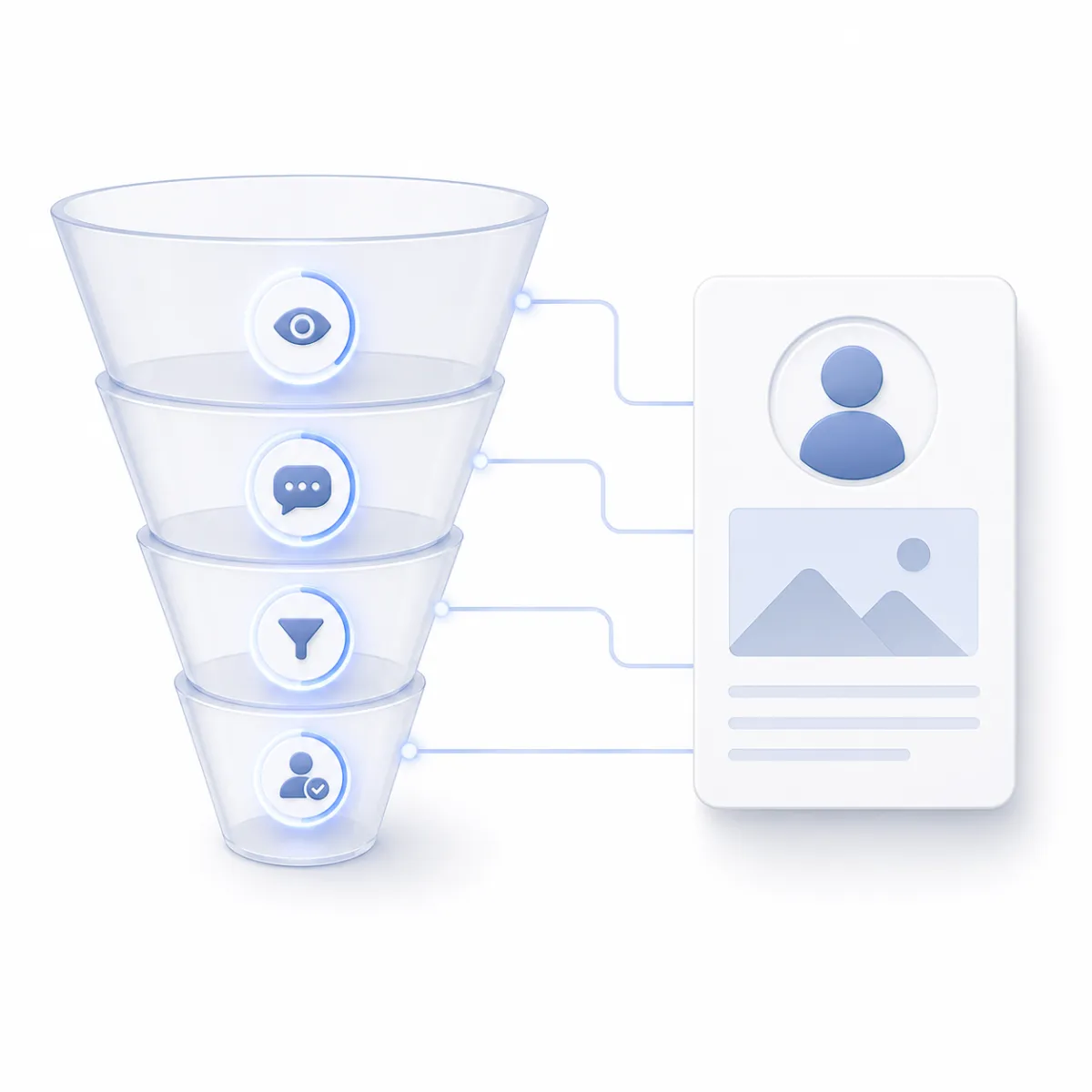
🛡️ Objection Handling by Funnel Stage (Powered by Buyer Persona)
🛡️ Objection Handling by Funnel Stage (Powered by Buyer Persona)
Most funnels do not lose buyers because the buyer says “no.”
They lose buyers because the buyer has a quiet doubt.
They do not always tell you.
They just leave.
They see the ad and think:
“Is this for me?”
They read the page and think:
“Can I trust this?”
They reach the offer and think:
“What if I choose wrong?”
Then they bounce.
Or they do not click.
Or they do not book.
Or they book and ghost.
Or they buy and refund.
That is an objection.
And objections are not random.
They come from the buyer persona.
A strong buyer persona tells you what the buyer fears before they act. Once you know that, you can place the right proof, FAQ, and CTA at the right funnel stage.
Here is the core idea: cold buyers need clarity, warm buyers need proof, and hot buyers need confidence. Use buyer persona insights to answer each objection before it stops the sale.
🧠 What Is Objection Handling in a Funnel?
Objection handling means answering the buyer’s doubts before they block action.
In a funnel, objections show up as behavior.
A buyer may:
bounce from the landing page
avoid the CTA
read the FAQ but not click
visit pricing many times
start a form but quit
book a call but not show
ask the same sales question over and over
buy and then refund
Those actions are clues.
They tell you where the buyer persona needs more clarity, proof, or safety.
👤 What Is a Buyer Persona?
A buyer persona is the one-person story inside your target audience.
It explains:
what the buyer wants
what hurts right now
why now matters
what they fear
what proof they need
what first step feels safe
what words they use before they buy
A buyer persona is not just a fake name and age.
It is not:
“Sarah is 37 and likes coffee.”
That does not help your funnel.
A useful buyer persona says:
“Sarah runs ads, gets clicks, but the leads are weak. She fears wasting more money. She needs proof that the first fix will be simple and useful.”
Now you know what objection to handle.
🎯 Why Objections Change by Funnel Stage
Buyers do not have the same doubts all the way through the funnel.
At the top, they ask:
“Is this for me?”
In the middle, they ask:
“Can I trust this?”
At the bottom, they ask:
“Should I act now?”
That means one FAQ section at the bottom of the page is not enough.
You need objection handling across the whole funnel.
TOFU needs clarity objections answered
MOFU needs trust objections answered
BOFU needs decision objections answered
Same buyer persona.
Different stage.
Different objection.
🪜 The Simple Funnel Objection Ladder
Use this ladder:
👀 Cold / TOFU — awareness objections
🌤️ Warm / MOFU — trust objections
🔥 Hot / BOFU — decision objections
🔁 Post-purchase — success objections
Each stage needs the right answer in the right place.
👀 Cold Stage Objections: “Is This For Me?”
Cold buyers are just noticing you.
They may see:
an ad
a search result
a blog post
a short video
a social post
a lead magnet page
They do not know you yet.
They may not fully understand the problem.
So their objections are simple.
They wonder:
“Is this for me?”
“Do I have this problem?”
“Is this worth my time?”
“Will this be too salesy?”
“Do I need this right now?”
This is where many funnels push too hard.
A cold buyer usually does not need a sales pitch.
They need a clear first step.
🧊 Cold Objection Bank
Use this bank when writing TOFU ads, landing pages, blog intros, and lead magnet pages.
Objection 1: “I do not know if this is for me.”
What it means:
The target audience is not clear enough.
Fix it with a “For…” line.
Swipe copy
“For service business owners who get clicks but not enough qualified calls.”
“For busy founders who want a clearer buyer persona without a long strategy project.”
“For teams that have traffic but do not know where the funnel is leaking.”
Objection 2: “I do not know what problem this solves.”
What it means:
The pain is too vague.
Fix it by naming the real buyer persona pain.
Swipe copy
“If people click your ads and bounce from your page, your buyer persona message may not match the click.”
“Wrong leads are often a sign that your funnel is talking to the wrong buyer.”
“Low CTA clicks usually mean the next step feels too risky or unclear.”
Objection 3: “I do not have time for this.”
What it means:
The buyer may be time-poor.
Fix it with a small step and time tag.
Swipe copy
“Start with a 10-minute checklist.”
“Find the first funnel leak before you rebuild anything.”
“Use this quick scorecard to see if your buyer persona is clear enough.”
Objection 4: “This sounds like a sales pitch.”
What it means:
The buyer fears pressure.
Fix it with low-risk language.
Swipe copy
“No call needed. Start with the checklist.”
“No pressure. Just see where your funnel may be leaking.”
“Use the guide first. Book only when you are ready.”
Objection 5: “I do not see why this matters now.”
What it means:
The moment is missing.
Fix it with real timing.
Swipe copy
“Before your next campaign goes live, check buyer persona fit.”
“If ad spend is already running, message mismatch can cost you every day.”
“Before you buy more traffic, fix the buyer words on the page.”
✅ Best Proof for Cold Buyers
Cold buyers need light proof.
Use:
one short credibility line
one clear example
one checklist preview
one “what you’ll learn” list
one simple before/after
Do not bury them in a long case study yet.
Cold buyers need to understand first.
❓ Micro-FAQ Placement for Cold Buyers
Put micro-FAQs near:
lead magnet opt-in
blog intro
ad landing page hero
first CTA
quiz start page
Cold Micro-FAQ Example
Is this for beginners?
Yes. It is built for people who want to spot the first buyer persona problem in their funnel without rebuilding everything.
Do I need a full funnel first?
No. You can use it on one ad, one page, or one lead magnet.
Will this require a sales call?
No. Start with the checklist. A call is only the next step if you want help.
🌤️ Warm Stage Objections: “Can I Trust This?”
Warm buyers already care.
They may have:
downloaded a guide
read emails
clicked proof
watched a video
read a case study
returned to the site
visited a service page
checked pricing once
They are interested.
But interest is not trust.
Warm buyers think:
“Will this work for us?”
“What proof do you have?”
“Have people like me used this?”
“What exactly happens?”
“Is this worth the time?”
“What if I tried something like this before?”
This is where your buyer persona proof needs matter most.
🌤️ Warm Objection Bank
Use this bank for emails, proof pages, retargeting ads, webinar pages, audit pages, and case study pages.
Objection 1: “Will this work for someone like me?”
What it means:
The buyer needs like-me proof.
Fix it by naming the buyer type.
Swipe copy
“Built for small teams getting traffic but weak buyer action.”
“Best for service businesses that need better-fit calls, not just more clicks.”
“Made for founders who want to fix message fit before spending more on ads.”
Objection 2: “What proof do you have?”
What it means:
The buyer needs evidence before action.
Fix it with examples, process proof, and before/after copy.
Swipe copy
“See how buyer persona words become stronger headlines, CTAs, proof blocks, and lead magnets.”
“The audit checks TOFU, MOFU, and BOFU messaging so you can see where buyers are getting stuck.”
“You get a simple fix-first map, not a vague strategy document.”
Objection 3: “What happens after I click?”
What it means:
The next step is unclear.
Fix it with a process block.
Swipe copy
“After you request the audit, we review your ad, page, CTA, and proof placement. Then we map the first buyer persona mismatch to fix.”
“Here is what happens next: we check the buyer, the promise, the proof, and the CTA.”
“No mystery. You get one clear next step.”
Objection 4: “I tried something like this before.”
What it means:
The buyer has past disappointment.
Fix it by showing what is different.
Swipe copy
“This is not a full funnel rebuild. It is a fix-first buyer persona audit.”
“We do not start with more traffic. We start with message match.”
“Instead of guessing, we compare buyer behavior to the words on the page.”
Objection 5: “I am not sure this is worth it.”
What it means:
Value is unclear.
Fix it with the 48-hour win.
Swipe copy
“In 48 hours, you will know the first funnel message leak to fix.”
“You will leave with the buyer persona mismatch, the broken stage, and the first test to run.”
“Start small before you make a bigger funnel change.”
⭐ Best Proof for Warm Buyers
Warm buyers need stronger proof.
Use:
like-me examples
mini-case stories
before/after copy
process screenshots
comparison blocks
proof packs
FAQ answers near CTA
48-hour win proof
Proof should be near the action point.
Do not hide it.
❓ Micro-FAQ Placement for Warm Buyers
Put micro-FAQs near:
audit CTA
demo CTA
webinar signup
case study CTA
proof pack download
comparison page CTA
retargeting landing page button
Warm Micro-FAQ Example
What do you check in the audit?
We check your buyer persona, ad hook, landing page hero, proof placement, CTA, and offer fit.
What do I get?
You get one fix-first map that shows the first message mismatch to test.
Is this a full funnel rebuild?
No. The goal is to find the first buyer persona leak before you change everything.
🔥 Hot Stage Objections: “Should I Act Now?”
Hot buyers are close.
They may have:
visited pricing
clicked “book a call”
started a form
returned within 24 hours
opened sales emails
asked final questions
compared packages
abandoned checkout
They do not need more beginner education.
They need confidence.
Hot buyers think:
“Is this the right choice?”
“What exactly do I get?”
“Can I trust the process?”
“What happens after I pay?”
“What if it does not work?”
“Can I start smaller?”
“Is now the right time?”
This is BOFU.
This is where objections get loud.
🔥 Hot Objection Bank
Use this bank for pricing pages, sales pages, checkout pages, booking pages, proposals, and final emails.
Objection 1: “What exactly do I get?”
What it means:
The offer is unclear.
Fix it with a clear deliverables block.
Swipe copy
“You get a buyer persona funnel audit, TOFU/MOFU/BOFU review, proof placement check, CTA review, and one fix-first plan.”
“Your audit includes the broken stage, the likely buyer persona mismatch, and the first test to run.”
“You leave with a clear next step, not a giant list of random fixes.”
Objection 2: “What happens after I book?”
What it means:
The buyer fears uncertainty.
Fix it with a “what happens next” block.
Swipe copy
“After you book, you will answer a short intake form. Then we review your funnel and map the first buyer persona leak.”
“On the call, we look at your buyer persona, funnel stage, and next safest offer.”
“You will know what to fix first before you spend more.”
Objection 3: “What if this is not right for us?”
What it means:
The buyer needs fit filters.
Fix it with For / Not For copy.
Swipe copy
This is for you if:
You have traffic, but buyers are not taking the next step.
This is not for you if:
You only want more traffic and do not want to fix the message.
Objection 4: “Can we start small?”
What it means:
The buyer wants safety.
Fix it with a starter offer or backup CTA.
Swipe copy
“Start with the 48-hour audit before a bigger funnel rebuild.”
“Not ready for the full sprint? Start with the buyer persona funnel review.”
“Begin with one funnel stage and one clear fix.”
Objection 5: “Is this worth the money?”
What it means:
Value is not clear.
Fix it with value math and outcome clarity.
Swipe copy
“If your funnel is sending paid clicks to the wrong message, fixing one mismatch can protect future ad spend.”
“The audit helps you avoid rebuilding the wrong thing.”
“Start by finding the leak before you buy more traffic.”
Objection 6: “What if we do not get a result?”
What it means:
The buyer fears regret.
Fix it by being clear and honest.
Swipe copy
“This audit does not promise instant sales. It gives you the first buyer persona mismatch to fix and the test to run next.”
“No fake guarantees. No mystery. Just a clear fix-first map.”
“You will know what to change, where to change it, and why it matters.”
⭐ Best Proof for Hot Buyers
Hot buyers need decision proof.
Use:
deliverables list
timeline
fit filters
pricing clarity
“what happens next”
comparison table
final FAQ
proof near booking button
backup CTA
At BOFU, proof should sit beside the decision.
Not at the bottom.
❓ Micro-FAQ Placement for Hot Buyers
Put micro-FAQs near:
pricing table
checkout button
booking form
proposal
final CTA
package comparison
abandoned cart email
Hot Micro-FAQ Example
What happens after I book?
You complete a short intake form. Then we review your funnel and send or discuss the first buyer persona mismatch to fix.
Is this a full funnel rebuild?
No. This is a fix-first audit. It shows where your funnel is leaking and what to test first.
Can I start small?
Yes. Start with one funnel stage, one buyer persona, and one 48-hour win.
🔁 Post-Purchase Objections: “Did I Make the Right Choice?”
The sale is not the end.
New buyers still have objections.
They think:
“What now?”
“How fast will this help?”
“Did I choose the right thing?”
“Will this be hard?”
“Do I need to do anything first?”
“Where do I get help?”
If you do not handle these objections, you may get refunds, support tickets, and churn.
🔁 Post-Purchase Objection Bank
Objection 1: “What do I do first?”
Fix it with onboarding.
Swipe copy
“Start here. Step 1 is the buyer persona intake. Step 2 is the funnel review. Step 3 is your fix-first map.”
Objection 2: “How do I know this is working?”
Fix it with success markers.
Swipe copy
“You are on track when you know the broken funnel stage, the buyer persona mismatch, and the first test to run.”
Objection 3: “This feels bigger than I expected.”
Fix it with scope clarity.
Swipe copy
“We are not fixing the whole funnel today. We are finding the first leak and the first test.”
Objection 4: “I need help applying this.”
Fix it with support.
Swipe copy
“Use the worksheet first. If you need help, book the setup step.”
🧾 The Objection Handling Map
Use this simple table.
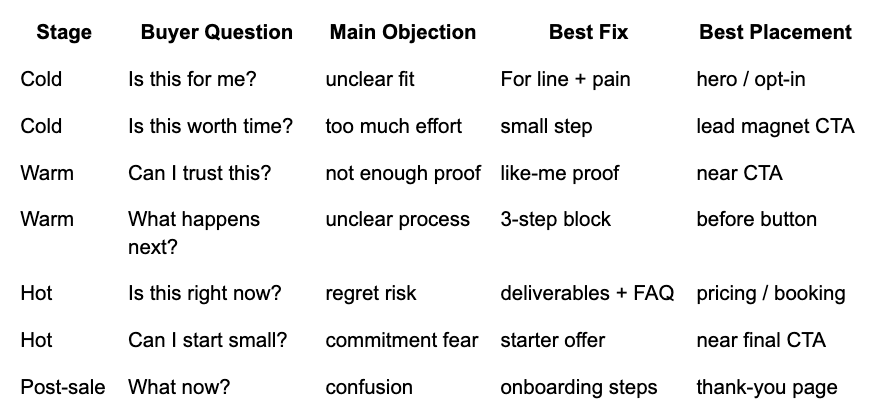
This map helps you place answers before buyers leave.
🧠 Objections by Buyer Persona Type
Different buyer personas have different objections.
⚡ Pain-Now Buyer
Main objection:
“Will this help fast enough?”
Answer with:
speed
48-hour win
clear next step
urgent audit
Swipe copy:
“Find the first leak in 48 hours before you spend more.”
🧾 Proof-Seeker Buyer
Main objection:
“Can I see proof first?”
Answer with:
case examples
before/after copy
proof pack
like-me stories
Swipe copy:
“See how buyer persona words turn into stronger headlines, CTAs, and proof blocks.”
⏳ Time-Poor Buyer
Main objection:
“Will this take too much time?”
Answer with:
checklist
short steps
low-friction form
setup help
Swipe copy:
“Start with one 10-minute scorecard. No full rebuild needed.”
💰 Budget-Starter Buyer
Main objection:
“Will this waste money?”
Answer with:
starter offer
scope clarity
value bullets
honest fit
Swipe copy:
“Start with the audit before making a bigger funnel change.”
🏆 Status-Chaser Buyer
Main objection:
“Is this the best path?”
Answer with:
roadmap
expert process
milestones
strategy framing
Swipe copy:
“Use the buyer persona roadmap before building more funnel assets.”
🧱 Where to Place Objection Answers on the Page
Placement matters.
The right answer in the wrong place is still easy to miss.
Above the fold
Answer:
Is this for me?
What problem does this solve?
What is the promise?
Use:
headline
subhead
For line
first CTA
one proof line
Near the first CTA
Answer:
Can I trust this?
What happens next?
Is this safe?
Use:
proof line
process block
micro-FAQ
48-hour win
Near pricing
Answer:
Is this worth it?
What do I get?
Can I start small?
Use:
what’s included
starter path
fit filters
value bullets
proof
Near form or checkout
Answer:
How long does this take?
What happens after I submit?
Will I be pressured?
Use:
form microcopy
short FAQ
privacy note
call agenda
confirmation copy
Thank-you page
Answer:
What now?
Did I do the right thing?
What is step one?
Use:
next steps
onboarding checklist
calendar link
first-win instructions
✍️ Swipe Copy: Micro-FAQs by Stage
Cold Micro-FAQs
Is this for me?
This is for teams getting clicks, views, or traffic but not enough buyer action.
Do I need a complete funnel?
No. You can start with one ad, one page, or one CTA.
Is this hard to use?
No. Start with one checklist and one buyer persona question.
Warm Micro-FAQs
What do you check?
We check the buyer persona, pain match, proof placement, CTA, and offer stage.
What will I learn?
You will learn where your funnel is likely losing the right buyer.
Do I need more traffic first?
Not always. If your message is mismatched, more traffic can make the leak more expensive.
Hot Micro-FAQs
What happens after I book?
You complete a short intake form. Then we review the funnel stage and buyer persona mismatch.
Can I start small?
Yes. Start with one stage and one fix-first map.
What if this is not a fit?
Use the fit call or audit to find the safest next step before a bigger move.
📧 Swipe Copy: Email Objection Handling
Cold email
Subject: “Is your funnel leaking or just unclear?”
Body:
“If buyers click but do not act, the funnel may not be broken. The buyer persona message may be fuzzy. Start with one simple checklist and find the first place to look.”
CTA:
“Get the Checklist”
Warm email
Subject: “What happens after the audit?”
Body:
“The audit checks your TOFU, MOFU, and BOFU messaging against one buyer persona. You get the broken stage, the likely mismatch, and the first test to run.”
CTA:
“See What to Fix First”
Hot email
Subject: “Ready to find the first leak?”
Body:
“If you are getting traffic but weak buyer action, start with the 48-hour buyer persona funnel audit. You will know what to fix first before you spend more.”
CTA:
“Book the Audit”
📣 Swipe Copy: Retargeting Objection Ads
Cold retargeting ad
“Still not sure where buyers drop? Start with the Buyer Persona Funnel Checklist.”
Warm retargeting ad
“Need proof before you fix the page? See how buyer words become headlines, CTAs, and proof blocks.”
Hot retargeting ad
“Visited pricing? Start small with the 48-hour audit and find the first funnel leak.”
📊 KPIs That Show Objection Handling Works
Track:
bounce rate
time on page
scroll depth
FAQ clicks
CTA clicks
form starts
form completions
booking completion
show rate
close rate
refunds
time-to-yes
What to watch
If FAQ clicks rise and CTA clicks rise, your FAQ is helping.
If FAQ clicks rise but conversions do not, your answers may not be strong enough.
If pricing visits rise but close rate falls, value or fit is unclear.
If refunds rise, post-purchase objections were not handled well.
🧪 Weekly Objection Tests
Run one clean test per week.
Test 1: Micro-FAQ under CTA
Add 3 questions under the main CTA.
Track CTA clicks and conversions.
Test 2: Proof near CTA
Move proof next to the button.
Track CTA clicks.
Test 3: For / Not For section
Add fit filters near pricing.
Track lead quality and close rate.
Test 4: What happens next block
Place it before the form.
Track form completion and show rate.
Test 5: Starter offer
Add a smaller backup CTA.
Track hot buyer conversions.
🧯 Common Objection Handling Mistakes
Mistake 1: Waiting until the sales call
Fix: answer objections on the page, in emails, and near CTAs.
Mistake 2: Same FAQ for every stage
Fix: cold, warm, and hot buyers need different answers.
Mistake 3: Proof is too far from the button
Fix: move proof near the CTA.
Mistake 4: Objections are too generic
Fix: use buyer persona language from calls, reviews, emails, and support tickets.
Mistake 5: Hiding “what happens next”
Fix: show process before the buyer clicks.
Mistake 6: No post-purchase objection handling
Fix: use onboarding, first-win steps, and clear scope.
🧠 How Objection Handling Updates Your Buyer Persona
Every objection teaches you something.
Add these fields to your buyer persona card:
✅ Objection Fields
Cold objection: ____
Warm objection: ____
Hot objection: ____
Post-purchase objection: ____
Proof needed: ____
Best FAQ answer: ____
Best risk reducer: ____
Best safe CTA: ____
Now your buyer persona can guide copy and conversion.
❓ FAQ — Objection Handling by Funnel Stage and Buyer Persona
1) What is objection handling in a funnel?
Objection handling means answering buyer doubts before they stop action. It uses copy, proof, FAQs, CTAs, and risk reducers throughout the funnel.
2) How does buyer persona help with objections?
A buyer persona shows what the buyer fears, what proof they need, and what first step feels safe. That tells you which objections to answer.
3) What objections do cold buyers have?
Cold buyers ask, “Is this for me?” “Do I need this?” “Is this worth my time?” and “Will this be too salesy?”
4) What objections do warm buyers have?
Warm buyers ask, “Can I trust this?” “Will this work for me?” “What proof do you have?” and “What happens next?”
5) What objections do hot buyers have?
Hot buyers ask, “Is this the right choice?” “What do I get?” “Can I start small?” “What if it does not work?” and “Should I act now?”
6) Where should FAQs go in a funnel?
Place FAQs near decision points. Use cold FAQs near opt-ins, warm FAQs near proof and audit CTAs, and hot FAQs near pricing, booking, and checkout.
7) Where should proof go on a funnel page?
Proof should sit near the CTA. Buyers need trust most right before they click, book, or buy.
8) What is a micro-FAQ?
A micro-FAQ is a small FAQ block with 3–5 key questions placed near a CTA, form, pricing table, or booking button.
9) What is the best objection answer for cold traffic?
Use clarity. Name the buyer, pain, and small first step. Do not push cold buyers too hard too soon.
10) What is the best objection answer for warm traffic?
Use proof. Show examples, process steps, like-me proof, and what happens next.
11) What is the best objection answer for hot traffic?
Use confidence builders. Show deliverables, pricing clarity, fit filters, final FAQs, and a safe decision path.
12) How do we know if objection handling is working?
Track bounce, FAQ clicks, CTA clicks, form completion, show rate, close rate, refunds, and time-to-yes.
📌 Key Takeaways
Objections change by funnel stage
Cold buyers need clarity
Warm buyers need proof
Hot buyers need confidence
Post-purchase buyers need onboarding and first-win clarity
Buyer persona insights show which objections matter most
Place proof and FAQs near the decision point
Use micro-FAQs to reduce doubt before clicks
Test one objection fix per week
This is buyer clarity inside The Buyer Clarity System™
🎁 Complimentary Ebook
Want the cold/warm/hot objection bank, micro-FAQ templates, and buyer persona objection worksheet?
Grab our COMPLIMENTARY Buyer Clarity Guide here:
👉 Download your complimentary ebook now
🧭 Final Word
Objections are not the enemy.
They are clues.
They show where your buyer persona needs more clarity, more proof, or a safer next step.
Answer cold doubts with clarity.
Answer warm doubts with proof.
Answer hot doubts with confidence.
Answer post-purchase doubts with onboarding.
That is how you fix funnel objections by fixing the buyer persona first—inside The Buyer Clarity System™.
