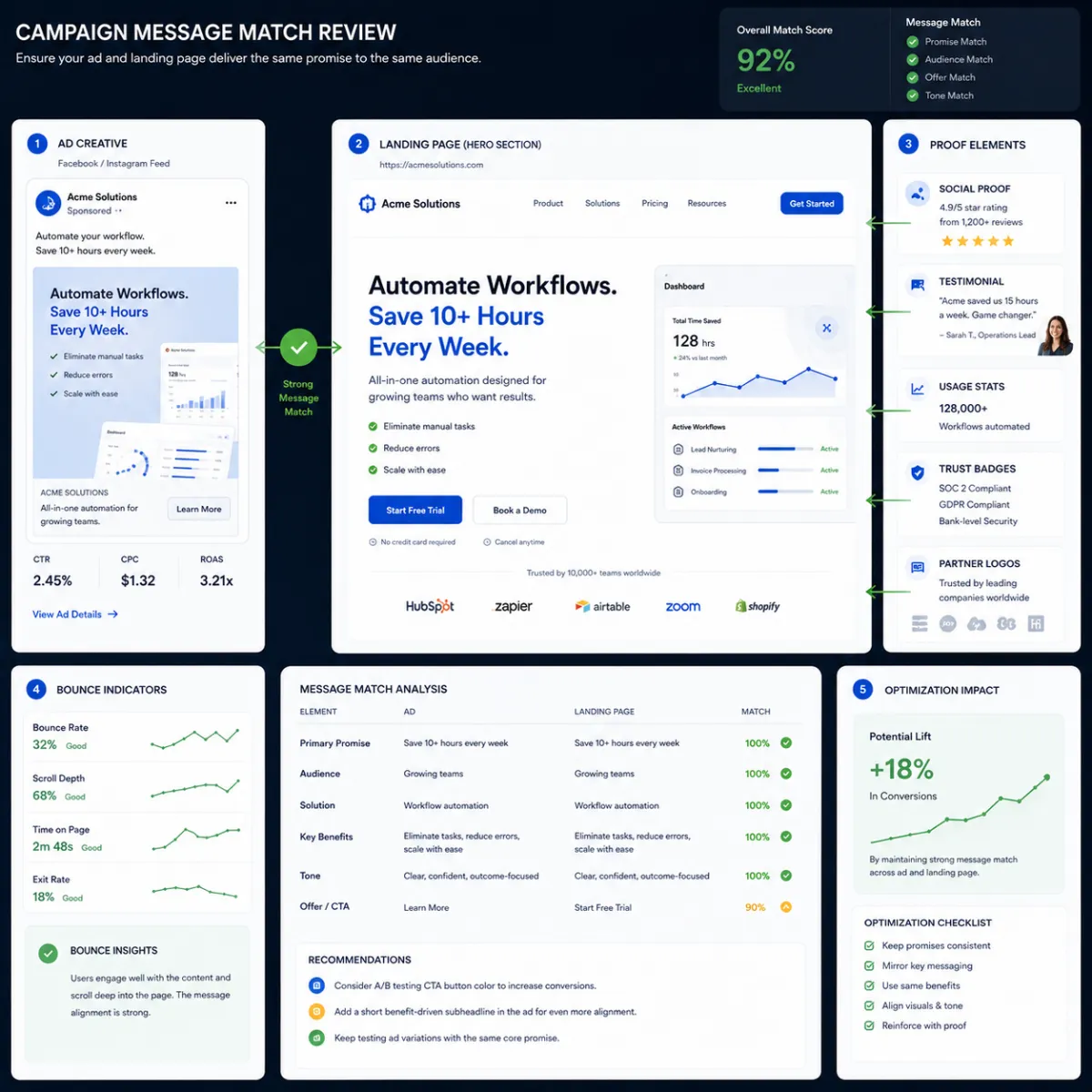
🚪 High Bounce Fix: Match Your Ad Promise to Your Target Audience Page
🚪 High Bounce Fix: Match Your Ad Promise to Your Target Audience Page
High bounce after an ad click feels like getting slapped.
We pay for the click…
they land…
and they leave.
Fast.
That is not “the algorithm.”
That is the buyer’s brain saying:
“This is not what I expected.”
“This isn’t for me.”
“This feels risky.”
“This feels like work.”
And that reaction shows up in consumer behavior as bounce.
So we don’t fix bounce by writing more paragraphs.
We fix bounce by fixing message match.
Message match means:
✅ the ad promise and the page promise feel like the same sentence.
High bounce happens when your ad promise doesn’t match your landing page hero, your CTA step is too big, or proof is missing near the button. Fix bounce with a promise-matching checklist, rewrite the hero to mirror the ad, rebuild above-the-fold, and add a micro-FAQ under the CTA.
🧠 Quick definitions (so we fix the right thing)
🎯 Target audience
Your target audience is the group you aim your ads at.
👤 Buyer persona
Your buyer persona is the “one person story” inside that group:
pain, dream, moment, risk, proof needed, safe step.
🚪 Bounce
Bounce means they landed and left fast.
Bounce is not always “bad,” but for most ads, high bounce is a message match problem.
🎯 Why high bounce is expensive
High bounce does three painful things:
It wastes money (paid clicks that vanish)
It confuses learning (we don’t know what works)
It often raises costs over time (platforms see low quality traffic)
So bounce is not just a “site metric.”
It’s a budget leak.
🧠 The real reason people bounce after clicking an ad
Most bounces happen because of one of these:
The ad says X, the page says Y
The buyer persona expected a small step, but you asked for a big leap
The page does not feel “for me” (target audience is unclear)
Proof is missing where fear spikes (near the CTA)
The page is hard on mobile (painful reading, slow load, tiny buttons)
We fix in that order.
✅ The Promise-Matching Checklist (copy/paste)
This checklist is the fast fix.
Print it. Use it every time you run ads.
✅ Promise-Matching Checklist
Ad promise: What are we promising in one sentence? ____
Page promise: What are we promising in one sentence? ____
Now check these:
Same pain words: Ad and page use the same pain phrase
Same result words: Ad and page promise the same outcome
Same audience: Ad and page clearly say who this is for
Same moment: If ad says “this week/this month,” page says it too
Same step: If ad offers a guide, page CTA offers the guide
Proof near click: Proof is visible near the first CTA
What happens next: Page explains the first step after clicking
Mobile scan: The first screen is easy to read on mobile
If you fail 2+ checks, bounce will rise.
🧠 The “First 10 Words” rule (fastest bounce fix)
This is one of the easiest fixes.
Make the first 10 words of the landing page match the ad.
If the ad headline says:
“Stop wasting money on ads…”
The landing page should begin with:
“Stop wasting money on ads…”
Not:
“Welcome to our website…”
The brain wants a clean handoff.
🧱 Above-the-fold rebuild (the exact blocks that reduce bounce)
High bounce often means your first screen is weak.
So we rebuild above-the-fold with 5 blocks:
Headline (matches ad)
“For…” line (names target audience)
One CTA (safe step)
Tiny proof near CTA
“What happens next” (3 bullets)
That’s it.
No long story above the fold.
🪧 Hero rewrite formulas (match ad promise fast)
Here are plug-and-play formulas.
✅ Formula 1: Pain → Dream → Risk reducer
“Stop [pain] and get [dream] without [fear].”
✅ Formula 2: Moment-based
“If you need [result] this [week/month], start here.”
✅ Formula 3: Proof-based
“See how [people like you] get [result] with simple steps.”
✅ Formula 4: Simple path
“A simple 3-step plan for [target audience] to get [result].”
Pick one and keep it clean.
🎯 The “For…” line (target audience clarity that lowers bounce)
A lot of bounce is “wrong person” bounce.
That happens when the page doesn’t label who it’s for.
Use this under your headline:
For [group] who want [result] without [pain] in [time].
Examples:
“For local service owners who want booked calls without wasting money on ads this month.”
“For coaches who want a clear message without feeling salesy.”
This line filters fast.
🔘 CTA step-size check (small step vs big leap)
A common message match problem is CTA mismatch.
❄️ Cold traffic
They clicked out of curiosity and pain.
Cold CTA should be:
complimentary guide
checklist
“see the steps”
quick audit request (short)
🌤️ Warm traffic
They clicked because they’re comparing.
Warm CTA should be:
trial
proof pack
demo
audit
🔥 Hot traffic
They clicked because they’re ready.
Hot CTA should be:
book now
start now
buy now
If your ad is cold but your page asks for a call, bounce rises.
⭐ Proof placement (where buyers need safety)
Proof must live near fear.
Fear spikes at the click.
So proof must sit near the first CTA, not buried at the bottom.
✅ Tiny proof options (above the fold)
“Clear steps. No guessing.”
“Start small. First win in 48 hours.” (only if true)
1–2 real review lines
“What happens next” bullets
✅ Bigger proof options (below fold)
mini-case
more reviews
proof pack section
timeline of week one
❓ Micro-FAQ under the CTA (bounce blocker)
Even when the page matches the ad, buyers still have doubts.
A micro-FAQ under the CTA reduces bounce and increases clicks.
✅ Micro-FAQ rules
4–8 questions
short answers (1–3 lines)
written in buyer persona words
placed under the CTA
✅ Micro-FAQ questions that fix message match
“Is this for [role]?”
“What happens first?”
“How fast is the first win?”
“How much time does this take?”
“What if we tried something before?”
“What if we get stuck?”
“Is this a contract?” (only if relevant)
This is where conversion often happens.
🧠 Use consumer behavior to diagnose the exact mismatch
Bounce alone isn’t enough.
Pair bounce with these signals:
If bounce is high + time on page is very low
Promise mismatch or wrong audience.
Fix: headline match + “For…” line.
If bounce is high + scroll is low
Above-the-fold is confusing.
Fix: rebuild first screen, add steps.
If bounce is high + CTA clicks are low
Risk at the click.
Fix: proof near CTA + micro-FAQ.
If bounce is high on mobile but not desktop
Mobile experience is broken.
Fix: mobile layout + speed + button size.
📱 Mobile checklist (bounce killer)
Most ad traffic is mobile.
If mobile is hard, bounce rises.
✅ Mobile bounce checklist
headline is 2–3 lines max
button is full width
proof is visible without scrolling
paragraphs are short
page loads fast
form has fewer fields
no popups that block reading
Small mobile fixes create big bounce drops.
🧪 A/B tests to reduce bounce (one-change-one-week)
Don’t change 10 things.
Test one.
Test 1: Headline match
A: same words as ad
B: different words
Measure: bounce + time on page.
Test 2: Proof near CTA
A: proof block near CTA
B: proof lower
Measure: bounce + CTA clicks.
Test 3: CTA step size
A: guide CTA
B: call CTA
Measure: bounce + conversions + lead quality.
🧱 Example: Before-and-after “message match” (simple)
❌ Ad says:
“Stop wasting money on ads.”
❌ Page says:
“We help businesses grow with marketing.”
Mismatch.
✅ Fix page hero:
Headline: “Stop wasting money on ads.”
For line: “For [target audience] who want [result] without [pain] in [time].”
CTA: “Get the complimentary guide”
Tiny proof: “Clear steps. No guessing.”
What next: “1) get step one 2) see your first win 3) scale what works”
Now the brain relaxes.
🧯 Common bounce mistakes (and quick fixes)
Mistake: The landing page is generic
Fix: one target audience, one promise, one CTA.
Mistake: The page starts with your brand story
Fix: start with buyer pain and outcome.
Mistake: The CTA is too big
Fix: smaller first step for cold clicks.
Mistake: Proof is buried
Fix: move proof near CTA.
Mistake: No “what happens next”
Fix: add 3 bullets under CTA.
🧠 Why this supports ranking for “buyer persona”
This post supports “buyer persona” authority because it:
ties buyer persona to message match (ad → page)
uses buyer persona in templates, checklists, and FAQs
answers common buyer persona questions in AEO format
connects buyer persona to consumer behavior signals (bounce, time, clicks)
That helps search engines and AI engines trust the content.
❓ FAQ — Fix High Bounce After an Ad Click
1) What causes high bounce after an ad click?
High bounce usually happens when the ad promise and landing page promise don’t match, the CTA step is too big, or proof is missing near the button.
2) What is “message match” in ads?
Message match means the ad and the landing page feel like the same message—same pain, same result, same audience, same next step.
3) What is the fastest way to fix high bounce?
Match the first 10 words of the landing page to the ad headline and add a clear “For…” line for the target audience.
4) Where should proof go to reduce bounce?
Put proof near the first CTA and near pricing. That’s where buyer persona fear spikes.
5) What CTA should we use for cold ad clicks?
Use a small safe step like a complimentary guide, checklist, or “see the steps.” Cold buyers often bounce when asked to book a call.
6) What should be above the fold on the landing page?
Headline that matches the ad, “For…” line, one CTA, tiny proof near CTA, and “what happens next” in 3 bullets.
7) How do micro-FAQs help with bounce?
Micro-FAQs answer buyer persona doubts right under the CTA, which reduces risk and increases action.
8) How do we know if bounce is a mobile problem?
Compare bounce rates by device. If mobile bounce is much higher, your page is likely hard to read or slow on mobile.
9) What consumer behavior metrics should we check with bounce?
Time on page, scroll depth, CTA clicks, and conversion rate. These show where the mismatch happens.
10) How do we test bounce fixes without guessing?
Run one-change-one-week A/B tests: headline match, proof placement, CTA step size, or micro-FAQ vs none.
11) What if the ad CTR is good but bounce is high?
That usually means the ad hook works, but the landing page doesn’t deliver the same promise or feels risky.
12) How does buyer persona help fix bounce?
Buyer persona tells you the exact pain words, fears, and proof needs so the page feels like a mirror and the click feels safe.
📌 Key Takeaways
High bounce usually means message match is broken (ad promise ≠ page promise)
Fix bounce fast with the Promise-Matching Checklist and the First 10 Words rule
Rebuild above-the-fold: headline match + “For…” line + CTA + proof + what-next
Add micro-FAQ under the CTA to reduce buyer persona fear
Match CTA step size to stage (cold/warm/hot)
Test one change per week and let consumer behavior pick winners
This is buyer clarity inside The Buyer Clarity System™
🎁 Complimentary Ebook
Want the promise-matching checklist, hero rewrite swipe file, and micro-FAQ templates?
Grab our COMPLIMENTARY Buyer Clarity Guide here:
👉 Download your complimentary ebook now
🧭 Final Word
High bounce is not a mystery.
It’s a mismatch.
Match the promise. Match the persona. Make the next step feel safe.
That’s how clicks stop leaking money—inside The Buyer Clarity System™.
