
👤 Behavior → Persona: Build a Buyer Persona From Real Actions
👤 Behavior → Persona: Build a Buyer Persona From Real Actions
Most buyer personas are fake.
Not fake because people lie on purpose.
Fake because the persona was built from guesses.
Someone sits in a meeting and says:
“Our buyer is Sarah. She is 38. She likes coffee. She wants growth.”
Okay.
But what does Sarah click?
What does she fear?
What does she ask before buying?
What proof does she need?
What makes her say, “Yes, I’m ready”?
That is what matters.
A buyer persona should not be a cute bio.
It should be a money map.
It should help you write better:
headlines
ads
emails
landing pages
offers
CTAs
FAQs
tests
And the best way to build one is simple:
Start with consumer behavior.
Watch what buyers see.
Watch what they do.
Listen to what they say.
Track what makes them decide.
Then turn those real actions into a buyer persona that converts.
To build a buyer persona from real actions, collect consumer behavior from reviews, calls, support, search terms, heatmaps, and sales notes. Tag the data by pain, dream, moment, risk, proof, trigger, and safe next step. Then write a simple buyer persona card that guides copy, offers, pages, and tests.
🧠 What Is a Buyer Persona?
A buyer persona is the one-person story inside your target audience.
It shows:
what the buyer wants
what hurts right now
why they care now
what they fear
what proof they need
what words they use
what first step feels safe
A good buyer persona helps your marketing feel personal.
A weak buyer persona makes your message sound like everyone else.
🧩 What Is Consumer Behavior?
Consumer behavior means what buyers do before, during, and after they buy.
It includes:
what they search
what they click
what they read
what they ignore
what they ask
what they compare
what they buy
why they leave
why they refund
why they refer
Consumer behavior shows the real path to action.
That path is better than guesses.
🚨 The Big Problem With Most Buyer Personas
Most buyer personas are built from surface details.
They include things like:
age
job title
income
hobbies
favorite apps
random names
stock photos
Some of that can help.
But it does not tell you what to write.
A persona that says “Sarah likes coffee” does not tell you:
which headline to use
where to place proof
which CTA feels safe
what objection blocks action
what offer should come first
A converting buyer persona must be built from behavior.
✅ The Better Rule: Build the Persona From Action
Do not start with:
“Who do we think they are?”
Start with:
“What did they do?”
Ask:
What did they search?
What did they click?
What did they ask?
What did they fear?
What made them trust?
What made them buy?
What made them leave?
That is where the real buyer persona lives.
🧭 The Behavior → Persona Framework
We use seven simple tags:
🩹 Pain
🌟 Dream
⏰ Moment
🛡️ Risk
⭐ Proof
🧲 Trigger
✅ Safe Step
These tags turn messy consumer behavior into a clear buyer persona.
Let’s break each one down.
1) 🩹 Pain: What Hurts Right Now?
Pain is the problem the buyer feels.
Not the problem you think they should care about.
The real pain shows up in buyer words.
✅ Where to find pain
Look in:
reviews
sales calls
support tickets
search terms
social comments
emails
refund notes
✅ Pain phrases to look for
Watch for:
“I’m tired of…”
“I can’t figure out…”
“We keep losing…”
“It takes too long…”
“Nothing works…”
“I don’t know where to start…”
“We’re wasting money…”
✍️ Persona pain example
“Our buyer is stuck wasting money on ads because the message does not match the right buyer persona.”
That is useful.
That can become copy.
2) 🌟 Dream: What Do They Want Instead?
Dream is the better future the buyer wants.
It does not have to be huge.
Sometimes the dream is simple:
fewer headaches
better leads
clear steps
more time
less stress
faster decisions
safer growth
✅ Dream phrases to look for
“I just want…”
“It would be great if…”
“I need a simple way to…”
“I want to feel…”
“We’re trying to…”
“The goal is…”
✍️ Persona dream example
“Our buyer wants clear buyer persona messaging that makes the right people click, stay, and act.”
Now we know where copy should go.
3) ⏰ Moment: Why Now?
Moment is the reason the buyer cares today.
Without a moment, buyers delay.
A strong buyer persona includes the trigger moment.
✅ Common buyer moments
launch coming
ads wasting money
sales are slow
team is stuck
budget review
new competitor
bad results
growth push
event deadline
refund problem
✅ Moment phrases to look for
“before we launch…”
“this month…”
“we need this by…”
“we can’t keep…”
“after the last campaign…”
“now that…”
✍️ Persona moment example
“Our buyer needs this now because the next campaign is about to launch and they do not want to waste more ad spend.”
That moment creates urgency without fake pressure.
4) 🛡️ Risk: What Scares Them?
Risk is the fear that blocks action.
Many buyers want the result.
But fear stops them.
Common risks:
wasting money
looking dumb
losing time
choosing wrong
buying something too hard
being pressured
getting no support
not seeing proof
failing again
✅ Risk phrases to look for
“I’m worried…”
“What if…”
“I don’t want to…”
“We tried before…”
“How do I know…”
“Is this right for…”
“Will this work if…”
✍️ Persona risk example
“Our buyer fears building a buyer persona that looks nice but does not improve clicks, calls, or sales.”
Now we know what to answer on the page.
5) ⭐ Proof: What Do They Need to Believe?
Proof is what lowers risk.
Different buyer personas need different proof.
Some need examples.
Some need reviews.
Some need steps.
Some need numbers.
Some need “what happens next.”
✅ Proof types
like-me examples
mini-case stories
before/after samples
screenshots
process steps
testimonials
FAQs
comparison tables
guarantee mechanics
demo or walkthrough
Use real proof only.
No fake stats.
No fake reviews.
No fake stories.
✍️ Persona proof example
“Our buyer needs to see real buyer words turned into actual headlines, CTAs, and page sections.”
That proof feels useful.
6) 🧲 Trigger: What Moves Them?
A behavioral trigger is a message cue that helps the buyer take action.
Common triggers:
loss
now
simple
proof
like-me
default
context
✅ Match trigger to persona
Pain-now buyer → loss + now
Proof-seeker → proof + like-me
Time-poor buyer → simple + default
Budget-starter → proof + safe step
Status-chaser → like-me + context
✍️ Persona trigger example
“Our buyer responds best to simple and proof triggers because they are busy and skeptical.”
Now copy gets easier.
7) ✅ Safe Step: What First CTA Feels Easy?
The safe step is the first action the buyer will take.
It must match stage.
Cold buyers may not book a call.
Warm buyers may want proof.
Hot buyers may want pricing or a demo.
✅ Safe step examples
get the guide
see the checklist
get the audit
watch the demo
see examples
compare options
book a quick call
start with Starter
✍️ Persona safe step example
“Our buyer’s safest first step is a 48-hour buyer persona audit that shows what to fix first.”
That is a strong CTA.
🧾 The Buyer Persona From Behavior Template
Copy this.
✅ Behavior-Based Buyer Persona Card
Persona name: ____
Target audience: For ____ who ____
Pain: “We’re stuck with ____.”
Dream: “We want ____.”
Moment: “We need this now because ____.”
Risk: “We worry ____.”
Proof needed: “We need to see ____.”
Main trigger: ____
Safe first step: ____
48-hour win: “In 48 hours, we will ____.”
Best CTA: ____
Words they use: ____
Words to avoid: ____
This is the buyer persona you can actually use.
🧠 Example Buyer Persona Built From Real Actions
Let’s say we study consumer behavior and find:
people search “buyer persona template”
sales calls mention “we don’t know who we’re talking to”
heatmaps show visitors click examples
exit surveys say “not sure this fits my business”
emails with “simple steps” get clicks
Now we build the persona.
✅ Persona Example: The Guessing Founder
Target audience:
For small business owners who want better leads without wasting money on the wrong message.
Pain:
“We’re getting traffic, but the wrong people click.”
Dream:
“We want the right buyers to understand us fast.”
Moment:
“We need this now before our next campaign spends more money.”
Risk:
“We worry this will be another strategy doc we never use.”
Proof needed:
“We need examples of buyer words turned into real copy.”
Main trigger:
Simple + proof.
Safe first step:
48-hour buyer persona audit.
Best CTA:
“Find What to Fix First.”
That persona can now guide an ad, page, email, and offer.
✍️ Turn the Persona Into Copy
A behavior-based buyer persona should create copy fast.
Headline from pain
Pain: “We’re getting traffic, but the wrong people click.”
Headline:
“Stop Getting Clicks From the Wrong Buyers”
Subheadline from dream
Dream: “We want the right buyers to understand us fast.”
Subheadline:
“Build a buyer persona message that makes the right people click, stay, and act.”
Urgency from moment
Moment: “Before our next campaign spends more money.”
Copy:
“Before you spend another ad dollar, fix the message match.”
Proof block from proof need
Proof need: “Examples of buyer words turned into copy.”
Copy:
“See real buyer language turned into headlines, CTAs, and landing page sections.”
CTA from safe step
Safe step: “48-hour buyer persona audit.”
CTA:
“Get the 48-Hour Persona Audit”
That is how behavior becomes copy.
🧱 Turn the Persona Into a Landing Page
Use this page map.
✅ Buyer Persona Landing Page Wireframe
Hero headline from pain
“For…” line from target audience
Proof near the first CTA
3-step path from safe step
Risk block from buyer fear
Example block from proof need
Micro-FAQ from objections
Final CTA with 48-hour win
This page will feel specific because it was built from action.
🎁 Turn the Persona Into an Offer
A buyer persona should shape the offer.
If risk is high
Add proof pack and FAQ.
If time is low
Add setup help and short steps.
If budget fear is high
Add Starter package.
If urgency is high
Add 48-hour win.
If confusion is high
Add audit or clarity map.
The offer should feel like the next safe step.
🧲 Turn the Persona Into Triggers
The buyer persona also tells you which triggers to use.
Example trigger map
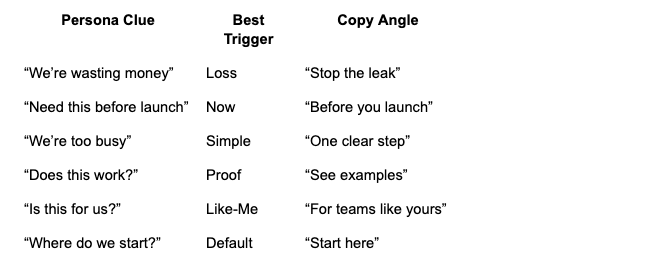
This gives you fast copy options.
🧪 Turn the Persona Into Tests
Do not treat the buyer persona as final.
Test it.
✅ Test the pain
Variant A: “Stop wasting ad spend.”
Variant B: “Get better leads.”
Track CTR and bounce.
✅ Test the proof
Variant A: proof near CTA
Variant B: proof lower on page
Track CTA clicks and conversions.
✅ Test the CTA
Variant A: “Get the guide”
Variant B: “Get the audit”
Track conversions and lead quality.
✅ Test the trigger
Variant A: simple trigger
Variant B: proof trigger
Track close rate and time-to-yes.
A buyer persona gets stronger when behavior proves it.
📊 How to Know Your Buyer Persona Converts
Your buyer persona is working when:
CTR rises
bounce drops
time on page improves
CTA clicks rise
conversions rise
close rate improves
refunds drop
time-to-yes gets faster
If clicks rise but close rate falls, the persona may be too broad.
If traffic stays but conversions rise, the message fit improved.
If refunds drop, the promise got clearer.
That is buyer persona performance.
🧯 Common Mistakes When Building a Buyer Persona From Behavior
Mistake 1: Using demographics first
Fix: start with actions, fears, and proof needs.
Mistake 2: Building one persona for everyone
Fix: build one persona per segment or core buying pattern.
Mistake 3: Using made-up words
Fix: use buyer words from reviews, calls, emails, and search terms.
Mistake 4: Forgetting the safe step
Fix: include the CTA the buyer is actually ready to take.
Mistake 5: Never testing the persona
Fix: run one-change-one-week tests.
🧠 How to Gather Data Fast
Use this fast research plan.
30-minute data pull
5 reviews
5 sales call notes
5 support tickets
5 search terms
5 heatmap/page clues
5 email replies or comments
Tag each line by:
pain
dream
moment
risk
proof
trigger
safe step
You will see patterns fast.
🧾 The 5-Line Buyer Persona Summary
When the full card feels too long, use this.
✅ 5-Line Persona Summary
This buyer is: ____
They want: ____
They are stuck because: ____
They fear: ____
They will act when: ____
Example:
This buyer is: a small business owner spending money on ads
They want: better leads
They are stuck because: their message is too broad
They fear: wasting more money on another marketing fix
They will act when: they see a simple 48-hour audit that shows what to fix first
That is clear.
🔁 Keep the Buyer Persona Alive
Your buyer persona is not a statue.
It is a living map.
Update it when:
search terms change
sales objections shift
support issues repeat
refunds rise
new segments buy
a new CTA wins
a new proof type works
The best buyer personas grow with behavior.
🧠 Why This Supports Ranking for “Buyer Persona”
This article supports the keyword buyer persona because it gives a full, useful answer to:
what a buyer persona is
how to build a buyer persona
how consumer behavior improves a buyer persona
how to use buyer persona data in copy
how to test if a buyer persona converts
It is built for search engines and AI answer engines because it includes clear definitions, direct answers, templates, examples, and FAQs.
❓ FAQ — Behavior to Buyer Persona
1) What is a buyer persona?
A buyer persona is the one-person story inside your target audience. It explains the buyer’s pain, dream, moment, risk, proof needs, and safest next step.
2) How do we build a buyer persona from consumer behavior?
Collect buyer actions from reviews, calls, support, search terms, heatmaps, and sales notes. Tag patterns by pain, dream, moment, risk, proof, trigger, and safe step.
3) Why is consumer behavior better than guessing?
Consumer behavior shows what buyers actually do. It reveals clicks, questions, objections, pricing visits, refunds, and decisions, so the buyer persona is based on real action.
4) What data should we use first for a buyer persona?
Start with sales calls, reviews, support tickets, refund notes, search terms, and heatmaps. These sources show real buyer words and action signals.
5) What should a buyer persona include?
A strong buyer persona includes target audience, pain, dream, moment, risk, proof needed, main trigger, safe first step, 48-hour win, and buyer words.
6) How does a buyer persona improve copy?
It gives you the headline pain, proof block, CTA, FAQ questions, offer angle, and emotional trigger that match the buyer’s real decision path.
7) What is the biggest mistake in buyer persona research?
The biggest mistake is using made-up details instead of real consumer behavior. Demographics alone do not tell you what makes people act.
8) How many buyer personas should we have?
Start with one clear buyer persona for one segment. Add more only when behavior shows a real pattern that needs different copy, proof, or offers.
9) What is a 48-hour win in a buyer persona?
A 48-hour win is the first small result that makes the buyer feel safe and see progress fast. It helps turn interest into action.
10) How do we test if a buyer persona works?
Test hooks, proof placement, CTA step size, and offer angle. Track CTR, bounce, CTA clicks, conversions, close rate, and time-to-yes.
11) How often should we update a buyer persona?
Update it weekly or monthly when new buyer behavior appears in calls, reviews, searches, support tickets, refunds, and page behavior.
12) How does this help buyer persona SEO?
It gives useful, direct content around buyer persona definitions, research, templates, behavior, copy, offers, and testing. That supports SEO and AI search visibility.
📌 Key Takeaways
A buyer persona should be built from real consumer behavior, not guesses
Use seven tags: pain, dream, moment, risk, proof, trigger, safe step
Real buyer actions create better headlines, CTAs, proof blocks, and offers
A strong buyer persona includes a 48-hour win and a safe first step
Test the persona with clean A/B tests and behavior metrics
Update the buyer persona as new buyer data appears
This is buyer clarity inside The Buyer Clarity System™
🎁 Complimentary Ebook
Want the Behavior → Persona worksheet, buyer persona card, and copy map?
Grab our COMPLIMENTARY Buyer Clarity Guide here:
👉 Download your complimentary ebook now
🧭 Final Word
A buyer persona should not sit in a folder.
It should make pages click.
It should make offers clearer.
It should make buyers feel seen.
It should help the right people say yes faster.
Start with behavior. Tag the clues. Build the persona. Test the message.
That is how consumer behavior becomes a buyer persona that converts—inside The Buyer Clarity System™.
