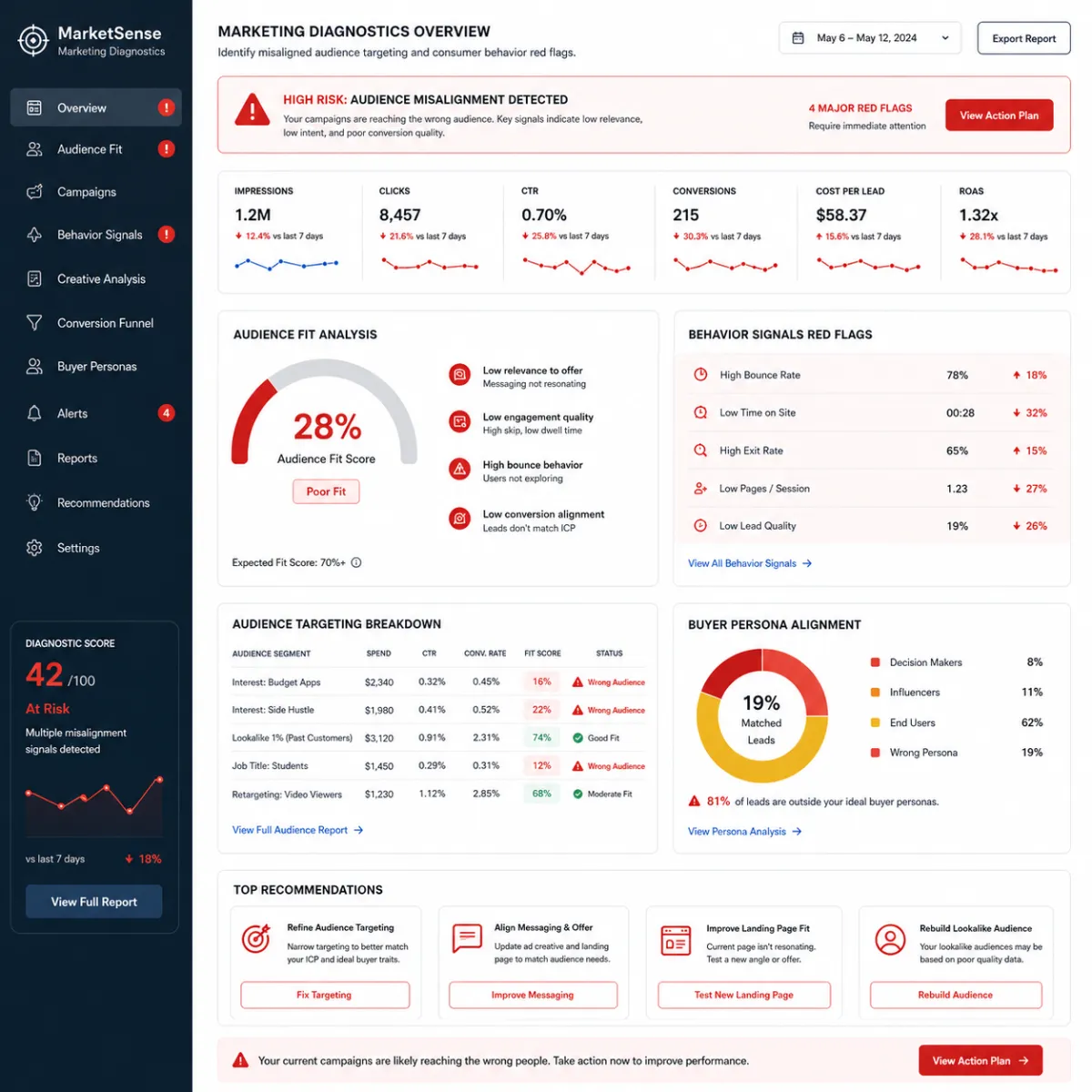
🚩 Consumer Behavior Red Flags: 9 Signs Your Target Audience Targeting Is Off
🚩 Consumer Behavior Red Flags: 9 Signs Your Target Audience Targeting Is Off
Ads don’t “randomly” fail.
Your budget doesn’t “just disappear.”
When targeting is off, the truth leaks out in consumer behavior.
It shows up in the numbers.
It shows up in the clicks.
It shows up in the weird leads.
And here’s the scary part:
If our target audience is wrong, no clever headline will save us.
Because we’re talking to the wrong people.
That’s why this post is simple:
We’re going to spot the red flags that prove targeting is off—fast.
Then we’ll fix the first broken link—fast.
Target audience targeting is off when consumer behavior shows mismatch: low CTR, rising CPC, high bounce, low scroll, weak CTA clicks, poor lead quality, slow time-to-yes, high refunds/churn, and “wrong question” leads. Use the fix-first flow to repair aim before you rewrite everything.
🧠 Quick definitions (so we fix the right thing)
🎯 Target audience
Your target audience is the group you aim your ads at.
👤 Buyer persona
Your buyer persona is the “one person” inside that group with:
pain
dream
moment (why now)
risk (fear)
proof needed
safe next step (CTA)
Target audience = who sees it.
Buyer persona = what makes them act.
If either one is off, ads struggle.
🧭 Why consumer behavior is the best “truth detector”
Opinions lie.
Hope lies.
Even “likes” can lie.
But consumer behavior usually tells the truth.
Because behavior is action:
click
leave
scroll
tap
fill a form
book a call
buy
refund
So we read behavior like a map.
✅ The 9 consumer behavior red flags (targeting is off)
Here are the 9 signs your target audience targeting is off.
We’ll explain:
what it means
why it happens
the fast fix
1) 📉 CTR is low (nobody cares enough to click)
What it means
Low CTR often means the wrong people are seeing the ad.
Or the hook doesn’t match their pain.
Why it happens
target audience is too broad
wrong interests/job titles
wrong location
wrong stage (cold buyers getting a hot CTA)
buyer persona language is missing
Fast fix ✅
tighten targeting to one clear slice
add a “For…” line in the ad
test pain vs proof hook
Buyer persona hook test (copy/paste):
A: “Stop [pain] without [fear].”
B: “See how people like you got [result].”
2) 💸 CPC is rising (you’re paying more for worse attention)
What it means
You’re buying attention from people who aren’t a good fit.
Platforms charge more when engagement is weak.
Why it happens
targeting is too wide
creative is shown to bored people
your target audience isn’t on that channel
your message doesn’t match their moment
Fast fix ✅
narrow the audience
shift channel (search vs social)
tighten to high-intent keywords (if using search ads)
match the moment: “this week / this month / before Friday”
3) 🚪 Bounce is high (they click then leave fast)
What it means
Your ad promise and landing page promise don’t match.
Or you attracted curiosity clicks, not buyers.
Why it happens
ad says “X” page says “Y”
page is generic and not for one target audience
proof is missing near CTA
CTA is too big too early
Fast fix ✅
make page hero match ad headline
move proof next to CTA
shrink the first step CTA (guide first)
Rule: fear spikes at the click. Proof must live near the button.
4) 🧗 Scroll is low (they don’t even explore)
What it means
They didn’t feel seen.
Or the page felt hard to read.
Why it happens
wrong target audience
confusing hero
big text walls
mobile layout is painful
Fast fix ✅
tighten the “For…” line
add a 3-step path above the fold
convert paragraphs into bullets
use a simple “perfect if…” block
5) 🖱️ CTA clicks are weak (they hesitate at the button)
What it means
They feel risk.
They don’t trust the next step.
Why it happens
buyer persona fears not answered
no micro-FAQ under CTA
no “what happens next” block
proof buried at the bottom
CTA is too big for stage
Fast fix ✅
add micro-FAQ under CTA (4–6 Qs)
add “what happens next” under CTA
place proof beside CTA
6) 🧟 Leads show up… but they’re wrong (bad lead quality)
What it means
You’re paying for “hands raised,” but they aren’t your buyers.
Why it happens
targeting is too broad
copy attracts bargain hunters
your ad sounds like it’s for “everyone”
no filters (“for/not-for”) on page
Fast fix ✅
add “not for you if…” line in ad and page
tighten “For…” line
segment by pain/urgency (simple market segmentation)
Example filter line:
“Not for people who want magic results with no steps.”
7) ⏳ Time-to-yes is slow (buyers stall forever)
What it means
They’re interested, but not confident.
Why it happens
missing proof near pricing
missing 48-hour win
unclear steps after purchase
buyer persona doubts not handled
Fast fix ✅
add a 48-hour win block
add week-one plan
add proof near pricing + CTA
add “what happens next” box
8) 🔁 Pricing loops happen (pricing → FAQ → pricing)
What it means
This is classic risk checking behavior.
They want to act but fear wasting money.
Why it happens
pricing is unclear
value is unclear
proof not placed near pricing
buyer persona risk is not reduced
Fast fix ✅
add “what’s included” bullets
add proof beside plan buttons
add FAQ right under pricing
add “best for…” plan guidance (only if true)
9) ❓ People ask the “wrong questions” (signal of mismatch)
What it means
Their questions reveal they aren’t the right target audience.
Why it happens
ad targeting is too wide
ad copy is too vague
wrong stage (cold buyers asked to buy now)
Examples of “wrong questions”
“Do you do this other thing instead?”
“Is this free?” (when you’re premium)
“Can you do it for my totally different niche?”
Fast fix ✅
tighten targeting
tighten page with “for/not-for”
adjust CTA step size
🧭 The Fix-First Flow (what to fix first, every time)
Don’t change everything.
Fix the first broken link.
✅ Step 1: If CTR is low
Fix: targeting + hook.
✅ Step 2: If CTR is okay but bounce is high
Fix: promise match + proof near CTA.
✅ Step 3: If bounce is okay but CTA clicks are low
Fix: risk reducers (proof, FAQ, what-next) + CTA step size.
✅ Step 4: If conversions happen but lead quality is bad
Fix: filters + segmentation.
✅ Step 5: If leads are good but time-to-yes is slow
Fix: proof near pricing + 48-hour win + week-one plan.
That order saves money.
🧩 Simple dashboard (track these weekly)
Track per ad set / per slice:
CTR
CPC
bounce rate
time on page
scroll depth
CTA clicks
conversion rate
lead quality (good/ok/bad)
time-to-yes
One row per slice per week.
If you track it, you can fix it.
🧪 Tiny tests to prove targeting vs message (no guessing)
Run one test per week:
Test A: Target audience slice (who)
Keep the ad the same. Change only targeting.
Measure: CTR + bounce.
Test B: Buyer persona message (what)
Keep targeting the same. Change only headline hook.
Measure: CTA clicks + conversions.
This keeps learning clean.
❓ FAQ — Consumer Behavior Red Flags and Target Audience Targeting
1) What is the biggest consumer behavior sign our target audience is wrong?
Low CTR and high bounce together often mean the wrong people are seeing the ad or the promise doesn’t match the page.
2) What does low CTR mean for target audience targeting?
It usually means your target audience is too broad or your buyer persona hook isn’t speaking in real buyer words.
3) What does high bounce mean after an ad click?
It usually means message match is broken: the ad promise and the landing page hero don’t match, or the CTA is too big too soon.
4) What does rising CPC tell us?
Rising CPC can mean the platform is finding low-fit people because engagement is weak. Tighten targeting and clarify your buyer persona hook.
5) What does low scroll depth mean?
Low scroll often means the visitor didn’t feel seen or the page feels hard to read, especially on mobile.
6) What does low CTA click rate mean?
It means fear is high at the click. Add proof near the CTA, micro-FAQs under the button, and a clear “what happens next.”
7) What does bad lead quality mean?
It means your target audience filters are weak. Use a tighter “For…” line and add “not-for” filters in both the ad and page.
8) What is time-to-yes and why does it matter?
Time-to-yes is how long buyers take to decide. Slow time-to-yes often means your buyer persona doubts and proof needs aren’t handled.
9) What’s the fastest fix when targeting is off?
Tighten the target audience slice, rewrite the hook in buyer persona pain words, and match the landing page hero to the ad.
10) How do we know if it’s targeting or creative?
Test separately. Change targeting only (keep ad same) to test audience. Change message only (keep targeting same) to test buyer persona copy.
11) Should we change platforms when results are bad?
Only after you confirm fit issues. Sometimes the target audience is on a different channel, but usually the first fix is clarity and match.
12) How does market segmentation help targeting?
Market segmentation helps you aim one slice at a time (pain-now, proof-seeker, budget-starter) so your message matches consumer behavior better.
📌 Key Takeaways
Targeting is off when consumer behavior shows mismatch: low CTR, high bounce, weak CTA clicks, bad leads, slow time-to-yes
Use the 9 red flags to diagnose the real problem fast
Fix in order: CTR → bounce → CTA clicks → lead quality → time-to-yes
Place proof near the CTA and answer objections under the CTA
Run one tiny test per week and let behavior pick winners
This is buyer clarity inside The Buyer Clarity System™
🎁 Complimentary Ebook
Want the red-flag checklist, fix-first flow chart, and a one-sheet dashboard template?
Grab our COMPLIMENTARY Buyer Clarity Guide here:
👉 Download your complimentary ebook now
🧭 Final Word
Ads don’t waste money. Confusion wastes money.
Let consumer behavior tell you the truth.
Fix the target audience first.
Then sharpen the buyer persona message.
That’s how we stop bleeding budget—inside The Buyer Clarity System™.
