🧭 Channel Strategy: Where Your Target Audience Hangs Out (What to Say There)
🧭 Channel Strategy: Where Your Target Audience Hangs Out (What to Say There)
A lot of marketing fails for one silly reason:
We’re talking in the wrong place.
Or we’re in the right place… saying the wrong thing.
So we burn time.
We burn money.
And we start thinking, “Maybe our offer isn’t good.”
Most of the time, the offer is fine.
The problem is channel fit and message fit.
Target audience decides WHERE we show up.
Buyer persona decides WHAT we say.
When we get that split right, the numbers calm down:
CTR goes up
bounce goes down
replies go up
sales speed up
That’s consumer behavior telling us we’re finally aligned.
Choose 2–3 channels based on where your target audience already searches, scrolls, and asks for help. Then write message blocks using buyer persona words: pain, moment, risk, proof, and a safe CTA. Run a simple weekly calendar and track KPIs by channel and stage.
🧠 Quick definitions (so we don’t mix jobs)
🎯 Target audience (the group)
Your target audience is the group you’re aiming at.
It answers: “Who are we trying to reach?”
👤 Buyer persona (the one-person story)
Your buyer persona is a “one person” story inside that group.
It answers: “Why do they buy or not buy?”
🧭 Channel strategy
Channel strategy is picking:
where to show up
what to post there
what CTA to use
what KPI to watch
🎯 Why channel strategy must start with consumer behavior
We don’t pick channels because they’re popular.
We pick channels because your target audience already uses them when they want help.
That is consumer behavior.
Examples:
Pain-now buyers search “near me.”
Proof seekers read reviews and comparison pages.
Busy people scroll short videos.
High-ticket buyers ask questions on calls.
So channel strategy is really behavior strategy.
🧩 Step 1: Pick the target audience slice (one, not everyone)
Channel strategy breaks when we aim at everyone.
So first, write your target audience line:
For [group] who want [result] without [pain] in [time].
Examples:
“For local service owners who want booked calls without wasting money on ads.”
“For busy parents who want energy without long workouts.”
“For agency owners who want smoother cash flow without chasing invoices.”
Now we pick channels for that group.
🧭 Step 2: Use the channel matrix by stage (cold, warm, hot)
Every buyer moves in stages:
❄️ Cold: learning
🌤️ Warm: comparing
🔥 Hot: ready
Different channels are stronger at different stages.
✅ Channel matrix (simple)
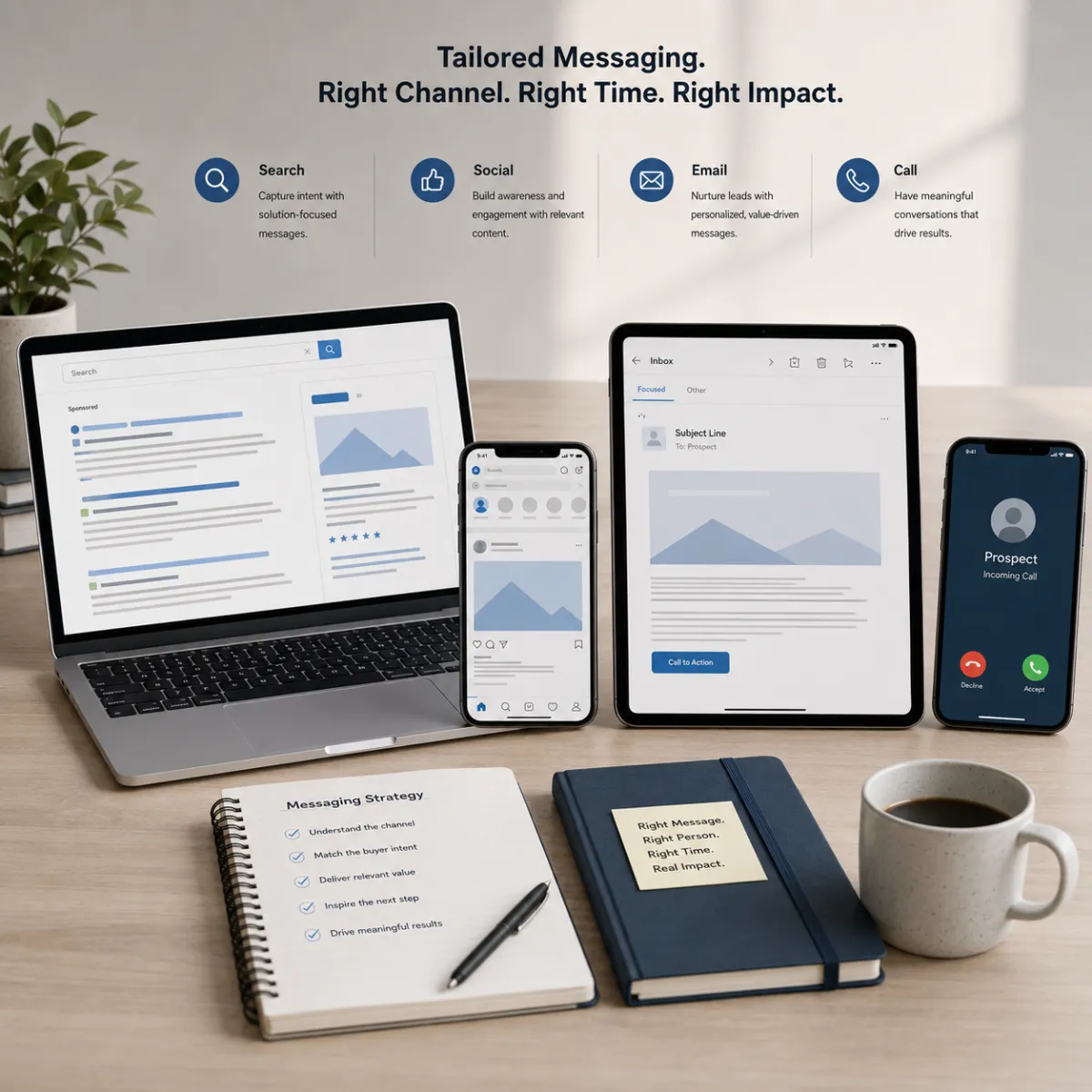
🔍 Search = high intent (warm/hot)
📱 Social = discovery (cold/warm)
✉️ Email = trust + proof (warm/hot)
📞 Calls/DMs = close + fit (hot)
Now we map each channel.
🔍 Search (Google/Bing) — “I need help now”
🧠 Why search works
Search is the buyer’s diary.
People type what they want when they think nobody is watching.
Search is great when:
the problem is urgent
the buyer is comparing
the buyer is ready to act
✅ Best content types for search
“how to” guides (cold/warm)
comparison pages (“X vs Y”) (warm)
pricing pages (hot)
“for [role]” pages (warm/hot)
problem pages (“why ___ isn’t working”) (warm)
🗣️ What to say in search (buyer persona words)
Search copy should be clear and specific:
pain: “Stop wasting money on ___.”
moment: “If you need this by Friday…”
risk: “No guessing. Clear steps.”
proof: “See examples.”
CTA: “Get the complimentary guide” (cold) / “Book a demo” (warm)
✅ Sample search headline formulas
“How to [get result] for [target audience] (simple steps)”
“Stop [pain]: A clear plan for [buyer persona]”
“[Solution] vs [Solution]: Which is right for [target audience]?”
📊 KPIs for search
impressions
CTR
bounce rate
time on page
conversions
📱 Social (Instagram/TikTok/LinkedIn/Facebook) — “Show me something”
🧠 Why social works
Social is where people discover problems and identity.
Social works when:
buyers aren’t searching yet
buyers need awareness
buyers need a quick hit of clarity
✅ Best content types for social
“3 signs” posts
“tiny wins” tips
short stories
before/after (real)
myth vs truth
quick checklists
🗣️ What to say in social (buyer persona words)
Social needs a fast hook:
pain spotting: “If you feel ___, you’re not alone.”
identity: “This is for [role] who…”
moment: “If you need this this week…”
risk reducer: “Start small.”
✅ Sample social hooks
“If you’re doing ___ and it’s not working, here’s why.”
“Stop doing ___—do this instead.”
“Most [target audience] miss this one thing…”
📊 KPIs for social
hook rate (first 3 seconds)
saves/shares
link clicks
DM replies
✉️ Email — “Convince me calmly”
🧠 Why email works
Email is the trust channel.
Email works when:
buyers need proof
buyers have doubts
buyers need repeated reminders
✅ Best email types
3-email proof sequence
objection answers
“week-one win” plan
case story
FAQ email
🗣️ What to say in email (buyer persona words)
Email should feel like a friend:
“we get it” pain mirror
simple steps
proof
one CTA
✅ 3-email sequence (copy-ready)
Email 1: “You’re not crazy—this is why ___ isn’t working.”
CTA: small step (guide)
Email 2: “Here’s what worked for people like us.”
CTA: proof page
Email 3: “What happens next (and what to expect).”
CTA: book/demo/trial
📊 KPIs for email
open rate
click rate
reply rate
unsubscribe rate (watch spikes)
📞 Calls + DMs — “Help me decide”
🧠 Why calls/DMs work
This is where high-risk buyers get safe.
Calls are best when:
price is high
fit matters
buyers need reassurance
buying teams exist (B2B)
✅ Best call/DM assets
“what happens next” script
proof pack
objections list
plan guidance
🗣️ What to say on calls (buyer persona words)
mirror the pain
confirm the moment
reduce risk
show the first win plan
📊 KPIs for calls
bookings
show rate
close rate
velocity
🧠 Step 3: Pick 2–3 channels (don’t spread thin)
Most businesses should start with:
1 discovery channel (search or social)
1 trust channel (email)
1 close channel (calls/checkout)
That’s enough to win.
Too many channels = weak everywhere.
🧩 Step 4: Write one message block you can reuse everywhere
Here’s the buyer persona block system:
✅ Universal message blocks (buyer persona)
Pain line
Dream line
Moment line (why now)
Risk reducer
Proof line
CTA (safe step)
🧾 Copy/paste block
“We’re stuck with [pain].
We want [dream].
We need this because [moment].
We worry [risk].
Show us [proof].
Start with [CTA].”
Now you can shorten or expand for any channel.
🗓️ Sample weekly calendar (simple, repeatable)
Here’s a clean calendar you can run every week.
Monday (search + email)
post 1 short blog or update
send 1 email tip
Tuesday (social)
1 “3 signs” post
1 short story post
Wednesday (proof)
1 mini-case post
1 FAQ post
Thursday (CTA day)
1 offer post with 48-hour win
1 email with “what happens next”
Friday (retarget + nurture)
1 proof reminder
1 objection answer
Weekend (light)
1 simple checklist post
1 behind-the-scenes (optional)
Keep it simple. Keep it consistent.
🧠 What to say by stage (quick cheat sheet)
❄️ Cold stage
say: “here’s the problem and a small win”
CTA: guide/checklist
proof: simple steps proof
🌤️ Warm stage
say: “here’s proof and how it works”
CTA: trial/demo/audit
proof: like-me proof near CTA
🔥 Hot stage
say: “here’s what happens next and how fast”
CTA: book/buy
proof: proof near pricing + risk reducers
📊 KPI dashboard (what to watch so you don’t guess)
Track per channel:
Search KPIs
CTR
bounce
conversions
Social KPIs
link clicks
saves/shares
DMs
Email KPIs
clicks
replies
bookings
Calls KPIs
show rate
close rate
velocity
If you want buyer clarity, you track behavior.
🧯 Troubleshooting flow (fix the first broken link)
If CTR is low
hook is weak OR channel is wrong
Fix: rewrite headline using buyer persona pain words.
If bounce is high
promise mismatch
Fix: match ad promise to hero.
If CTA clicks are low
fear at the click
Fix: add proof + micro-FAQ under CTA.
If leads are low quality
audience too broad
Fix: tighten target audience “For…” line and add “not for you if…”
🧠 Why this supports ranking for “buyer persona”
This post strengthens your “buyer persona” authority because it:
connects buyer persona to channel messaging
repeats the keyword naturally and usefully
includes templates and examples that match intent
includes AEO-friendly FAQ questions about buyer persona and target audience
This is how we build topical authority and conversions together.
❓ FAQ — Channel Strategy for Target Audience and Buyer Persona
1) How do we choose channels for a target audience?
We choose channels based on consumer behavior—where the target audience searches, scrolls, asks questions, and buys.
2) What does buyer persona change in channel strategy?
Buyer persona changes the words we use: pain, moment, risk, proof, and the safe next step CTA.
3) Which channel is best for urgent buyers?
Search and calls work best because urgent buyers show high intent and want fast answers.
4) Which channel is best for building trust?
Email works best because it lets us answer objections and show proof calmly over time.
5) What should we post on search vs social?
Search posts should match intent (how-to, compare, pricing). Social posts should spot pain, tell short stories, and create quick clarity.
6) What is a simple channel mix for beginners?
One discovery channel (search or social), one nurture channel (email), and one close channel (calls/checkout).
7) How do we know a channel is wrong for our target audience?
CTR stays low and bounce stays high. That means the audience isn’t there or the message doesn’t match.
8) What should we say in buyer persona words?
Use their pain, their dream, their “why now,” their fear, and the proof they need to feel safe.
9) What KPIs should we track by channel?
Search: CTR and conversions. Social: clicks and DMs. Email: clicks and replies. Calls: close rate and velocity.
10) How often should we review channel strategy?
Weekly small reviews are best, with a deeper review every 90 days based on consumer behavior.
11) How do we avoid spreading too thin?
Pick 2–3 channels only for 30 days. Win there first. Then expand.
12) How does this help us attract ideal clients?
The right channel brings the right people, and buyer persona words make them feel seen—so they act faster.
📌 Key Takeaways
Target audience decides WHERE to show up
Buyer persona decides WHAT to say
Use a channel matrix by stage (cold/warm/hot)
Start with 2–3 channels: discovery, trust, close
Reuse buyer persona message blocks across channels
Track KPIs by channel so behavior guides the next move
This is buyer clarity inside The Buyer Clarity System™
🎁 Complimentary Ebook
Want the channel matrix, weekly calendar, and buyer persona message blocks?
Grab our COMPLIMENTARY Buyer Clarity Guide here:
👉 Download your complimentary ebook now
🧭 Final Word
Stop yelling everywhere.
Show up where your target audience already is.
Then speak in buyer persona words that feel like a mirror.
That’s how clicks turn into calls and sales—inside The Buyer Clarity System™.
