🧠 Buyer Persona vs. Bad Ads: The Fast Test That Saves Your Budget
🧠 Buyer Persona vs. Bad Ads: The Fast Test That Saves Your Budget
When ads don’t work, it feels personal.
We spend money.
We watch the clicks.
We hope for calls.
And then… nothing.
That “nothing” hits the gut.
Because the brain hears danger words:
“We’re wasting money.”
“We’re falling behind.”
“We’re doing it wrong.”
But here’s the twist most people miss:
Sometimes the ad is fine.
The real problem is this:
✅ The buyer persona is wrong.
✅ The target audience is off.
✅ The message is aimed at the wrong brain.
So we need a fast test that tells the truth.
Not a long theory.
Not a 30-day wait.
A quick check that saves budget this week.
That’s what we’ll do here—using a simple 3-signal check:
CTR (click-through rate)
Bounce (leave fast)
Lead quality (wrong people)
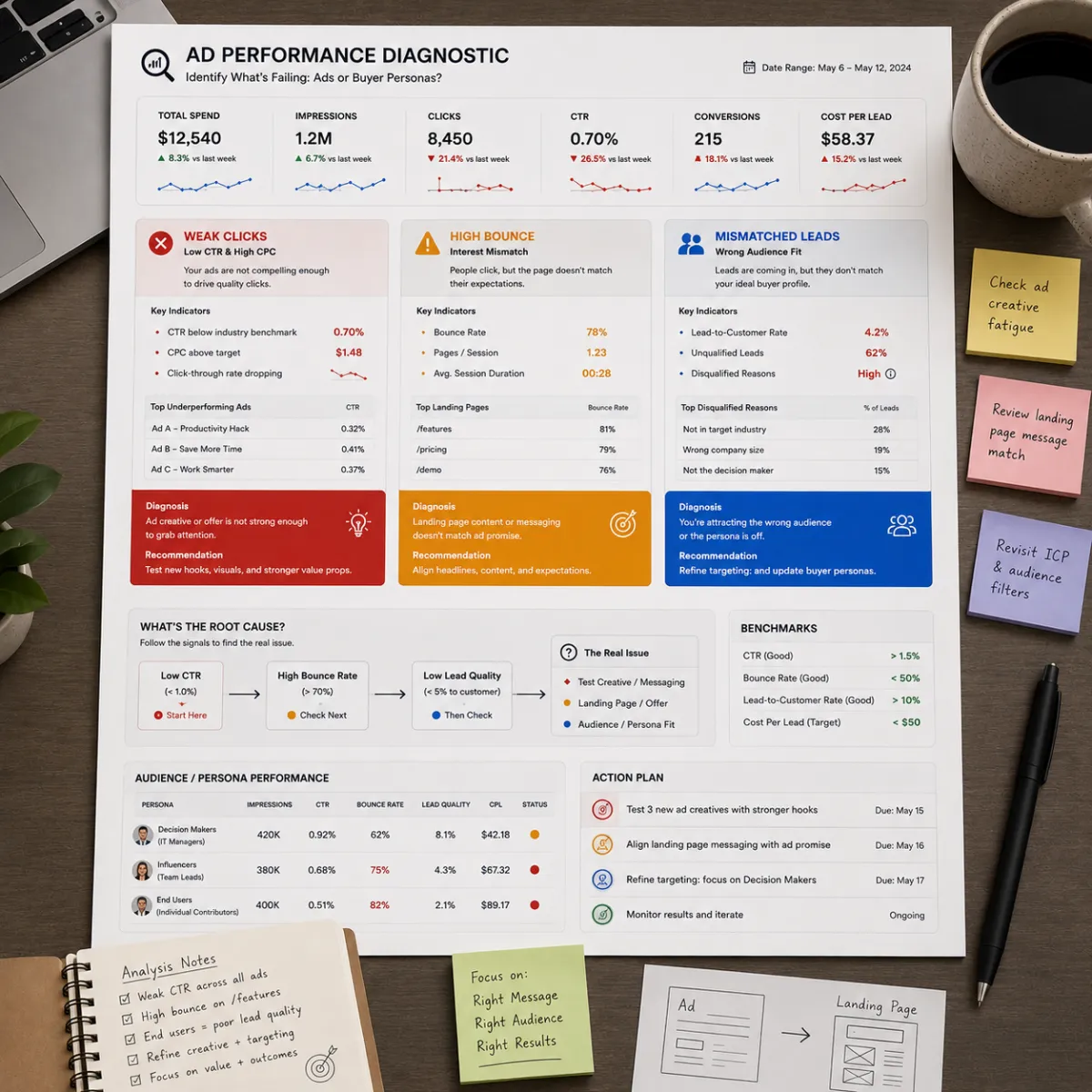
If CTR is low, your buyer persona hook is likely wrong (or your target audience is wrong). If CTR is okay but bounce is high, your promise and persona message don’t match the landing page. If leads come in but they’re the wrong fit, your target audience and buyer persona are misaligned—fix the “For…” line and filters before you touch creative.
🎯 Buyer persona basics: What “bad ads” usually isn’t
Lots of people blame:
the platform
the algorithm
the time of year
the ad format
the “creative”
Sometimes those matter.
But most of the time, ads fail because we aimed wrong.
A buyer persona is the “one person” inside the group.
A target audience is the group we aim at.
If we don’t know those clearly, ads can’t work consistently.
🧠 Buyer persona basics: What a buyer persona really is
A buyer persona is not “age + income + job title.”
A buyer persona is a decision pattern with:
pain (what hurts)
dream (what they want)
moment (why now)
risk (what they fear)
proof needed (what makes them trust)
first safe step (CTA)
Ads only work when they match those.
That match shows up as consumer behavior.
🧪 Buyer persona vs bad ads: The 3-signal check (fast test)
Here is the simple test we use:
✅ Signal 1: CTR (did the right brain click?)
CTR tells us if the hook hit the right person.
✅ Signal 2: Bounce (did they leave fast?)
Bounce tells us if the promise matched what they expected.
✅ Signal 3: Lead quality (are we attracting the right people?)
Lead quality tells us if the target audience and buyer persona are truly aligned.
Now we’ll break each one down.
📉 Buyer persona signal 1: CTR (what it means and what to do)
CTR answers one question:
Did our buyer persona feel “this is for me”?
👀 What low CTR usually means
Low CTR often means one of these:
we aimed at the wrong target audience
the buyer persona hook is weak
the ad is too generic
the pain is not specific
the “why now” is missing
Low CTR is the “they didn’t even care enough to click” signal.
🛠️ Buyer persona fixes for low CTR (quick wins)
✅ Fix 1: Swap your hook angle (pain vs proof)
Test two hooks:
Pain hook: “Stop wasting money on ___.”
Proof hook: “See how people like us fixed ___.”
Keep the rest the same.
✅ Fix 2: Tighten the “For…” line
Add this line into your ad text:
For [group] who want [result] without [pain] in [time].
That one line filters and attracts.
✅ Fix 3: Add the moment (why now)
Add a real timing line:
“If you need leads this month…”
“If ads are burning cash this week…”
This matches the buyer persona’s moment.
🚪 Buyer persona signal 2: Bounce (what it means and what to do)
Bounce answers:
Did the click feel like a trick or a mismatch?
If people click and leave fast, the ad promise and landing page promise don’t match.
That’s not “bad traffic.”
That’s bad match.
👀 What high bounce usually means
the ad says one thing, the page says another
the buyer persona expects a simple next step, but the page asks for a big leap
the page is slow or messy on mobile
proof is missing near the CTA
the page feels “for everyone,” not for the target audience
🛠️ Buyer persona fixes for high bounce (quick wins)
✅ Fix 1: Match the first 10 words
Make the first 10 words of the landing page match the ad.
If the ad says: “Stop wasting money on ads…”
The page should say that too.
This reduces bounce fast.
✅ Fix 2: Move proof next to the button
Fear spikes at the click.
So place:
a short proof block
1–3 real review lines (if you have them)
a “what happens next” box
Right next to the CTA.
✅ Fix 3: Shrink the first step (CTA)
If your buyer persona is cold, don’t ask for a call first.
Use a safe step:
complimentary guide
checklist
quick audit request
short form
Small steps beat big leaps.
🧲 Buyer persona signal 3: Lead quality (what it means and what to do)
Lead quality answers:
Are we attracting ideal buyers—or random people?
You can get leads and still lose money if they’re the wrong leads.
Bad leads create:
long calls
low close rate
refunds
stress
👀 Signs your lead quality is bad
“How much is it?” is all they ask
they don’t match your offer
they want something else
they can’t pay
they aren’t ready
they say “I thought this was ___” (big mismatch)
🛠️ Buyer persona fixes for bad lead quality (quick wins)
✅ Fix 1: Add a “not for you” line in the ad
This filters out wrong people.
Example:
“Not for people who want magic results with no steps.”
Kind, clear, and honest.
✅ Fix 2: Add a “For / Not For” box on the page
For: who it’s for
Not for: who it’s not for
This boosts close rate fast.
✅ Fix 3: Tighten targeting with market segmentation
Use simple market segmentation slices like:
pain-now (urgent)
proof-seeker
budget-starter
Aim one slice per ad set.
That keeps the message clean.
🧭 Buyer persona decision chart: Is it the persona or the ad?
Here’s the simple decision chart.
✅ If CTR is low
It’s likely:
buyer persona hook is wrong
or target audience is wrong
Fix: hook + audience first.
✅ If CTR is okay but bounce is high
It’s likely:
message match is broken (ad vs page)
proof is missing near CTA
CTA step is too big
Fix: page promise + proof + CTA step.
✅ If CTR and bounce are okay but leads are bad
It’s likely:
target audience is too broad
buyer persona is unclear
you need better filters
Fix: “For…” line + not-for + segmentation.
🧱 Buyer persona rebuild: The 15-minute “persona patch”
We don’t need a 40-page buyer persona document.
We need a usable one.
Here’s the quick patch.
✅ Buyer persona patch (copy/paste)
Target audience: For ____
Pain: We’re stuck with ____
Dream: We want ____
Moment: We need this because ____
Risk: We worry ____
Proof needed: We need to see ____
Safe CTA: ____
48-hour win: In 48 hours, we will ____
Now write your ad with these words.
That’s it.
🪧 Buyer persona ad templates (swipe-friendly)
Use these as starting points.
✅ Template 1: Pain hook (buyer persona)
“Still stuck with [pain]?
For [target audience] who want [dream] without [risk].
Start small: [CTA].”
✅ Template 2: Proof hook (buyer persona)
“People like us fixed [pain].
Here’s the simple path.
For [target audience].
Start here: [CTA].”
✅ Template 3: Moment hook (buyer persona)
“If you need [dream] this month, don’t guess.
For [target audience] who want [result] without [pain].
Start small: [CTA].”
📍 Buyer persona landing page checklist (to stop bounce)
Use this quick checklist:
Hero headline matches the ad
“For…” line is visible
Proof is near the CTA
Steps are simple (3 steps)
Micro-FAQ is under CTA
CTA is safe for the stage
Mobile is easy (big button, short text)
This is how you turn clicks into action.
🗓️ One-week rescue plan (tiny tests, big savings)
If ads are burning cash, don’t do big changes.
Do one-week rescue.
Day 1: Run the 3-signal check
CTR, bounce, lead quality.
Day 2: Fix the first broken link
low CTR → hook + audience
high bounce → promise match + proof near CTA
bad leads → filters + segmentation
Day 3: Launch one A/B test
Test only one thing:
pain vs proof headline
ORproof near CTA vs proof lower
ORguide CTA vs call CTA
Day 4–7: Read consumer behavior
Watch:
CTR
bounce
CTA clicks
conversions
lead quality
Pick one winner next week.
That’s how we stop wasting money without panic.
❓ FAQ — Buyer Persona vs Bad Ads (Fast Test)
1) How do we know if ads fail because the buyer persona is wrong?
If CTR is low, your buyer persona hook may not feel “for me.” If CTR is okay but bounce is high, the persona promise and the page don’t match. If leads are bad-fit, your persona and target audience are too broad.
2) What is the fastest test to diagnose ad failure?
Use the 3-signal check: CTR, bounce rate, and lead quality. These consumer behavior signals show where the break is.
3) What does low CTR mean for buyer persona messaging?
Low CTR often means the hook is not in buyer persona words, the pain is too vague, or the target audience is wrong.
4) What does high bounce mean after an ad click?
High bounce usually means message match is broken. The ad promise and landing page hero don’t match, or the CTA is too big for the stage.
5) What does “bad lead quality” mean?
It means the wrong people are raising their hand. Your target audience filters and buyer persona clarity are too weak.
6) Should we change the ad creative first?
Not always. If targeting and buyer persona are wrong, changing creative won’t fix the root problem. Fix audience and persona first, then polish creative.
7) Where should proof go on the landing page?
Proof should sit near the CTA and near pricing. That’s where risk spikes for the buyer persona.
8) What CTA works best for cold traffic?
A small safe step like a complimentary guide, checklist, or quick audit request usually works best for cold buyer persona traffic.
9) How does market segmentation help ads?
Market segmentation lets you aim one slice at a time (urgent, proof-seeker, budget-starter) so your message matches consumer behavior better.
10) How long should we run a test before deciding?
Run one change for one week. Don’t change targeting mid-test. Let consumer behavior show the winner.
11) How do we fix lead quality fast?
Add “for/not-for” filters in the ad and on the page, tighten the “For…” line, and aim one slice per ad set.
12) How does this help us attract ideal clients?
When your buyer persona and target audience are clear, the right people click and the wrong people self-filter. That saves budget and speeds up sales.
📌 Key Takeaways
Ads fail most often because the buyer persona or target audience is wrong, not because the ad “looks bad”
Run the 3-signal check: CTR, bounce, lead quality
Low CTR = fix hook and audience
High bounce = fix promise match, proof near CTA, and CTA step size
Bad leads = add filters and tighten market segmentation
Run one tiny test per week and let consumer behavior pick winners
This is buyer clarity inside The Buyer Clarity System™
🎁 Complimentary Ebook
Want the buyer persona patch sheet, ad templates, and the 3-signal checklist in one place?
Grab our COMPLIMENTARY Buyer Clarity Guide here:
👉 Download your complimentary ebook now
🧭 Final Word
When ads feel like fire, don’t flail.
Aim first.
Then speak.
Then prove.
Then test one small thing.
Fix the buyer persona and target audience first—and your budget stops bleeding inside The Buyer Clarity System™.
