🧭 Zero-Data Playbook: Buyer Persona Insights Without Customers
🧭 Zero-Data Playbook: Buyer Persona Insights Without Customers
No customers yet?
That can feel scary.
Because when we don’t have buyers, the brain says:
“What if we pick the wrong message?”
“What if we build the wrong offer?”
“What if we waste money on ads?”
That fear is normal.
But here’s the truth:
We do not need a huge list to build a useful buyer persona.
We need clues.
And buyers leave clues everywhere.
In reviews.
In search.
In comment threads.
In competitor pages.
In the questions people ask their friends.
That’s consumer behavior.
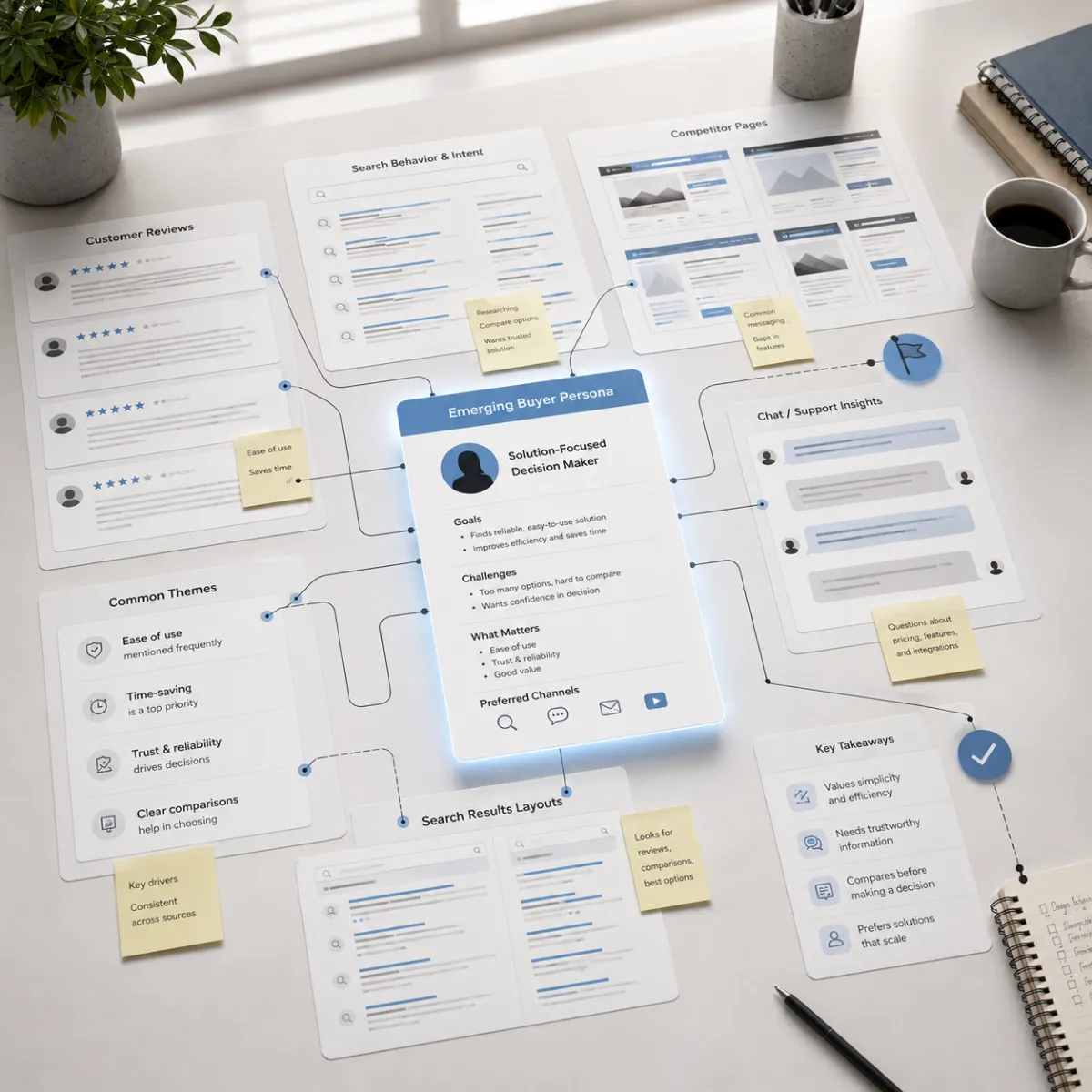
With zero data, we build a buyer persona using four sources: competitor reviews, competitor pages, search terms, and quick lookalike interviews. Then we write a one-page “first draft persona” and test it for one week.
🧠 First: what “zero data” really means
When people say “we have no data,” they usually mean:
no email list
no sales calls
no reviews
no customers
But data still exists.
Because your market is alive.
People are already talking about the problem you solve.
So we borrow data from:
competitors
communities
search engines
real conversations
We don’t invent. We observe.
That’s buyer clarity.
🧠 What a buyer persona is (simple definition)
A buyer persona is not a demographic profile.
A buyer persona is a decision pattern that includes:
pain (what hurts now)
dream (what they want next)
moment (why now)
doubts (what scares them)
proof needed (what makes them trust)
first safe step (CTA)
Even with zero customers, we can find these patterns.
🎯 Why “buyer persona first” helps you attract ideal clients
A strong buyer persona helps you:
write a clear “For…” line (target audience)
write a headline that grabs the right person
answer objections before they bounce
pick the right CTA step (guide vs call vs buy)
design a 48-hour win (fast proof)
That creates certainty for you and safety for them.
🧭 The Zero-Data Playbook (the 5-step plan)
Here’s the playbook we’ll follow:
Review mining (competitor and category reviews)
Rival page mining (headlines, FAQs, offers)
Search term mining (intent clues)
Lookalike interviews (quick calls)
One-page buyer persona draft + one-week test
Let’s do it.
⭐ Step 1: Review mining (the fastest buyer persona fuel)
Reviews are pure buyer language.
They are “what worked,” “what hurt,” and “what I feared.”
Even if you have no reviews, your competitors do.
✅ Where to mine reviews
Pick 3–5 competitors or alternatives and pull reviews from places like:
Google reviews
Yelp (local)
Amazon (products)
G2/Capterra (software)
Trustpilot (services)
Facebook business pages
We are not copying claims.
We are collecting language.
✅ What to copy from reviews
Create a doc with these headers:
What pain they had
What they wanted
What scared them
What they loved
What they hated
Words they repeat
Now copy 30–50 review lines.
🧠 What to look for (patterns)
repeated pains (“wasting money,” “no time,” “confusing”)
repeated moments (“before event,” “this week,” “deadline”)
repeated risks (“scam,” “didn’t work,” “hard to use”)
repeated wins (“saved time,” “clear steps,” “felt safe”)
These become buyer persona fields.
📄 Step 2: Rival page mining (steal the questions, not the claims)
Competitor pages show what buyers ask most.
Look at:
headline
subhead
CTA buttons
FAQ section
pricing section
“who this is for/not for” sections
guarantees and risk reducers (if any)
✅ What you’re looking for
Which promises show up everywhere? (core desire)
Which fears do they keep answering? (core risk)
Which CTAs do they use? (stage)
What do they explain first? (confusion points)
🧠 Quick page-mining worksheet
For each competitor page, write:
Main promise: ____
Main fear they answer: ____
CTA step size: guide/trial/call/buy
Proof style: reviews/cases/steps
FAQ topics repeated: ____
After 3–5 pages, patterns become obvious.
🔍 Step 3: Search term mining (the buyer persona diary)
Search terms are raw intent.
Even without analytics, you can still do search mining by observing what people search in your category.
✅ What to collect
Create a list of 30–60 phrases people type.
Focus on these buckets:
🧲 Motive searches (what they want)
“best ____ for ____”
“simple ____”
“easy ____”
“fast ____”
“how to ____”
⏰ Moment searches (why now)
“today”
“this week”
“before ____”
“urgent”
“ASAP”
🛡️ Risk searches (what they fear)
“is ____ legit”
“reviews”
“refund”
“cancel”
“safe”
“scam”
✅ How search terms help your buyer persona
Search terms tell you:
what words buyers use
what stage they are in (cold/warm/hot)
what their biggest fear is
That’s buyer persona gold.
☎️ Step 4: Lookalike interviews (10-minute calls that change everything)
If you have no customers, you interview lookalikes.
Lookalikes are people who:
have the problem
are close to your target audience
might buy something like this
You can find them in:
your network
groups
LinkedIn
local community pages
✅ Who to interview (easy list)
3 people who match the role
2 people who tried a competitor
2 people who chose “do nothing”
3 people who are actively searching
Even 5 interviews helps.
✅ The 10-question script (simple)
Ask:
What are you trying to fix right now?
Why does it matter this month?
What have you tried already?
What was frustrating about that?
What would “success” look like in 30 days?
What worries you about trying something new?
What would make you trust a solution?
What would make it feel “easy”?
If you did buy, what step would feel safe first?
What words would you use to describe this problem?
Write their exact words.
Those words become your buyer persona.
🧾 Step 5: Build the one-page first-draft buyer persona
Now we build the persona.
This is a draft. We will test it.
✅ One-page Buyer Persona Draft (copy/paste)
Target audience line: For ____ who ____
Pain (now): “We’re stuck with ____.”
Dream (next): “We want ____.”
Moment (why now): “We need this because ____.”
Past tries: “We tried ____.”
Top doubt (risk): “We worry ____.”
Proof needed: “We need to see ____.”
First safe step (CTA): ____
48-hour win: “In 48 hours, we will ____.”
Top 10 buyer words/phrases:
________________________
________________________
________________________
…
That’s enough to write real copy.
🧱 Build a mini Objection Bank (from your mined data)
Even with zero customers, objections exist.
We pull them from:
competitor FAQs
interview fears
review complaints
search “risk” phrases
✅ Mini Objection Bank (start with 8)
Will this work for someone like me?
How long will this take?
What happens first?
Is this hard to set up?
What if I tried something before and it failed?
What if I waste money?
Do I need a contract? (if relevant)
How fast will I see a win?
Now write 1–3 line answers.
Keep them calm and honest.
✍️ Turn the buyer persona into a page (simple conversion layout)
Here is the quickest page layout that works:
Headline (pain + dream)
“For…” line (target audience)
CTA (safe step)
Proof near CTA (like-me language)
Steps (3 steps + time tags)
Objections (micro-FAQ under CTA)
48-hour win block
Repeat CTA
This layout is built around consumer behavior: fear spikes at the click.
🧩 Copy templates (use these with your buyer persona)
🪧 Headline template
“Stop [pain] and get [dream] without [fear].”
🎯 For line template
“For [group] who want [result] without [pain] in [time].”
🪞 Persona mirror block
“We’re stuck with [pain].
We want [dream].
We tried [past try]. It didn’t work.
We worry [doubt].
We need [proof] to feel safe.”
🔘 CTA micro-copy
“Start small. Takes 2 minutes. No big leap.”
⏱️ 48-hour win block
“In 48 hours, you will:
____________________________________
____________________________________
____”
Keep it real and measurable.
🧪 Validate your buyer persona (one-week test)
A buyer persona is only “real” when it performs.
Here’s a simple test:
✅ One-week buyer persona validation
1 landing page
1 offer/CTA
1 channel
$10/day or one email blast or 20 DMs
Track:
CTR
bounce
time on page
CTA clicks
conversions
lead quality
Then change one thing next week.
This is how The Buyer Clarity System™ avoids guessing.
🧠 What to do if results are weak (fast fix map)
If CTR is low
tighten target audience line
change headline angle (pain vs proof)
use more buyer words
If bounce is high
match ad promise to hero
move CTA up
add proof near CTA
If CTA clicks are low
add micro-FAQ under CTA
shrink the CTA step (guide first)
add “what happens next”
If leads are low quality
add “not for you if…”
tighten the slice
clarify the promise
This is consumer behavior telling you what to fix.
🧠 Why this supports ranking for “buyer persona”
This post is built to rank for buyer persona because it:
defines buyer persona clearly
repeats the term naturally in useful sections
gives a full step-by-step method
includes buyer persona templates and a test plan
uses AEO-style FAQs that match search intent
That builds topical authority across Google and AI search.
❓ FAQ — Zero-Data Buyer Persona Playbook
1) Can we build a buyer persona with no customers?
Yes. We can build a first-draft buyer persona using consumer behavior clues from reviews, competitor pages, search terms, and quick lookalike interviews.
2) What is the fastest way to get buyer persona language with zero data?
Review mining is fastest. Copy real phrases from competitor reviews and complaints to find repeated pains, fears, and wins.
3) What should we avoid when building a buyer persona with no data?
Avoid guessing and demographics-only profiles. A buyer persona must include pain, moment, doubt, proof needed, and a safe first step.
4) How do competitor pages help buyer persona work?
Competitor pages show common questions and objections through headlines, FAQs, CTAs, and proof blocks.
5) How do search terms help a buyer persona?
Search terms show intent. “Best,” “safe,” “today,” and “reviews” reveal motive, moment, and risk in consumer behavior.
6) What is a lookalike interview?
A lookalike interview is a short call with someone who has the problem and fits your target audience, even if they are not your customer yet.
7) What is the one-page buyer persona draft?
It’s a simple card with target audience line, pain, dream, moment, doubts, proof needed, CTA step, and a 48-hour win.
8) What is an Objection Bank and why do we need it?
An Objection Bank is a list of buyer doubts in buyer words. We need it because unanswered doubts stop CTA clicks.
9) How do we test if our buyer persona is right?
Run a one-week test with one page and one CTA. Track consumer behavior: CTR, bounce, time, CTA clicks, and conversions.
10) How many buyer personas should we start with in zero data mode?
Start with one primary buyer persona. Add more only after you see a clear winning segment.
11) What is the biggest sign our buyer persona is wrong?
Low CTR and high bounce are common signs. It means the message doesn’t feel like a mirror to the right people.
12) How often should we update a buyer persona after we start getting data?
Do a light review every 90 days and a deeper refresh every 6–12 months using consumer behavior signals.
📌 Key Takeaways
You can build a buyer persona without customers by using consumer behavior clues
Mine competitor reviews, competitor pages, and search terms for real buyer words
Run 5–10 lookalike interviews to capture fears, triggers, and proof needs
Create a one-page first-draft buyer persona and a mini objection bank
Turn the persona into a page with proof and FAQs near the CTA
Validate with a one-week test and improve one thing at a time
This is buyer clarity inside The Buyer Clarity System™
🎁 Complimentary Ebook
Want the zero-data worksheets, persona draft card, and objection bank template?
Grab our COMPLIMENTARY Buyer Clarity Guide here:
👉 Download your complimentary ebook now
🧭 Final Word
Zero data doesn’t mean zero direction.
It just means we start by listening in the right places.
Borrow buyer words. Build a first-draft buyer persona. Test fast. Improve weekly.
That’s how we attract ideal clients with buyer clarity—inside The Buyer Clarity System™.
