🧱 Build a Buyer Persona From Scratch (Even With No Data)
🧱 Build a Buyer Persona From Scratch (Even With No Data)
No data feels scary.
Because it feels like walking in the dark.
But here’s the truth:
Even with “no data,” we still have clues.
We still have words. We still have patterns. We still have consumer behavior.
And we can use those clues to build a buyer persona that actually helps us sell—without guessing, without hype, and without fake stuff.
This is the zero-to-one method we use inside The Buyer Clarity System™.
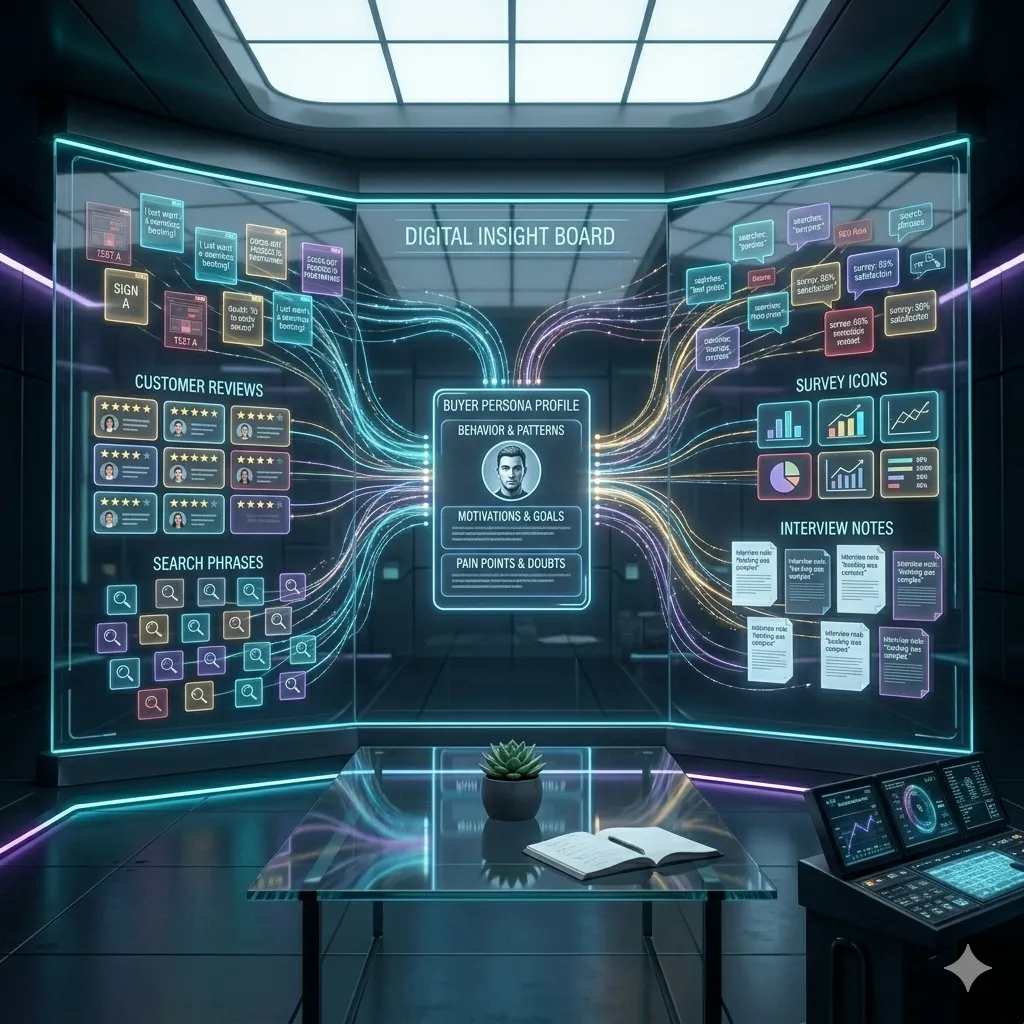
To build a buyer persona with no data, we use five simple inputs: review mining, lookalike interviews, site/search clues, a quick survey, and a first-draft persona card. Then we test it and tighten it weekly.
💡 Buyer persona: Why “no data” is not the real problem
“No data” usually means:
We don’t have many customers yet
We don’t have many reviews yet
We don’t have fancy tools yet
But we still have something better than tools:
Human words.
And words come from:
competitor reviews
public forums
our inbox
our DMs
our own brain (as long as we verify it with real people)
A buyer persona is not a report.
A buyer persona is a decision helper.
It helps us choose:
who we’re talking to (target audience)
what to say
what offer to lead with
what proof to show
what doubts to answer
That’s buyer clarity.
🔎 Buyer persona: What a buyer persona really is (simple definition)
A buyer persona is a one-page story of one real type of buyer.
Not a made-up character.
Not a cute name.
Not a list of demographics.
A strong buyer persona includes:
the pain they feel
the win they want
the moment that made them look
the fear that slows them down
what they tried before
what proof they need to feel safe
That is consumer behavior turned into a clear plan.
🧭 Buyer persona: The zero-to-one plan (what we do first)
When we have little or no data, we do this in order:
Review mining (yours + competitors)
Lookalike interviews (talk to “close enough” people)
Site/search clues (even small signals count)
Quick survey (fast answers from real humans)
First draft persona card (one page)
Weekly tightening (test, learn, improve)
We don’t wait for perfect data.
We start with a strong first draft.
⭐ Buyer persona: Step 1 — Review mining (fastest way to borrow consumer behavior)
If we don’t have reviews yet, we borrow them from the market.
We can mine:
competitor reviews
marketplace reviews (Amazon, Etsy, G2, etc.)
Google reviews for similar services
Reddit threads (careful, but useful for language)
YouTube comments under “how to” videos
We’re not stealing ideas.
We’re collecting buyer words.
🧩 Buyer persona: What to copy from reviews
Copy lines that show:
Pain: “I was tired of ___.”
Dream: “I wanted ___.”
Doubt: “I wasn’t sure ___.”
Trigger: “I started looking when ___.”
Past tries: “I tried ___ and it didn’t work.”
Proof: “This worked because ___.”
🧩 Buyer persona: Review mining mini-checklist
Copy 30 lines
Keep them raw (don’t rewrite)
Tag each line (pain/dream/doubt/trigger/past try/proof)
Circle repeats (repeats = truth)
Those repeats become the bones of your buyer persona.
🗣️ Buyer persona: Step 2 — Lookalike interviews (when you don’t have customers)
No customers? No problem.
We interview “lookalikes.”
A lookalike is someone who:
has the same problem
wants the same win
would buy something like this
even if they never heard of us
🧩 Buyer persona: Who to interview
people in your network
friends of friends
local business owners (if B2B)
people in Facebook groups
people who left reviews for competitors (if you can reach them)
past leads who didn’t buy (if any)
You only need 5–10 short calls to see patterns.
🧩 Buyer persona: 10 interview questions (simple and strong)
Ask these word-for-word:
“What problem are you trying to fix right now?”
“When did it start feeling serious?”
“What did you try already?”
“What did you hate about what you tried?”
“What would a win look like in 7 days?”
“What would a bigger win look like in 30 days?”
“What scares you about buying help?”
“What proof would you need to feel safe?”
“Where do you usually look for help?”
“What words would you type into Google?”
Those answers become your first buyer persona draft.
🔍 Buyer persona: Step 3 — Site and search clues (tiny data still counts)
Even a new site has signals.
If you have:
a few visits
a few DMs
a few emails
a few clicks
That’s consumer behavior.
🧩 Buyer persona: What to look at first
top pages people visit
what they click most
what they do before leaving
your site search terms (if you have it)
the questions they ask in DMs
If you have no analytics yet, use:
the questions people ask you on calls
the words in comments
the phrases people repeat
Small clues still build a solid buyer persona.
📝 Buyer persona: Step 4 — Quick survey (small, fast, honest)
A quick survey can give you clean language fast.
Keep it short. 5 questions max.
🧩 Buyer persona: Quick survey questions
“What are you trying to fix right now?”
“What is hardest about it?”
“What have you tried already?”
“What would make you trust a solution?”
“What would a win look like in 7 days?”
That’s it.
Send it to:
your email list (even if small)
your social followers
a Facebook group (if allowed)
friends who fit the problem
Don’t ask for essays. Ask for simple words.
🪪 Buyer persona: Step 5 — Build the first draft buyer persona card (copy/paste)
Now we build the one-page card.
This is the “usable” part.
This is what you print and keep near your desk.
🧩 Buyer persona: First draft persona card template
Buyer Persona Name (simple): “___ Buyer” (example: “Busy Parent Buyer”)
Target Audience: Who they are in one line (role + situation)
Main Pain: “I’m stuck with ___.”
Main Dream: “I want ___.”
Trigger (why now): “I started looking when ___.”
Past Tries: “I tried ___.”
Hated Thing: “I don’t want to ___.”
Top Doubt: “Will this work for me if ___?”
Proof Needed: Reviews / case / demo / steps / guarantee (only if true)
First Safe Step: guide / quiz / trial / call
Week-One Win: the small win they can feel fast
Words They Use: 5–10 exact phrases
This card is your first buyer persona.
It will not be perfect.
It doesn’t need to be perfect.
It needs to be useful.
🧠 Buyer persona: How market segmentation helps when you have no data
When you have no data, market segmentation is your flashlight.
You make a few slices based on:
pain
urgency
role
budget
past tries
Then you pick one slice first.
That slice becomes your target audience for 30 days.
That keeps your buyer persona focused.
🧩 Buyer persona: Easy 3-slice starter segmentation
Slice 1: “Urgent pain now”
Slice 2: “Burned before, needs proof”
Slice 3: “New and unsure, needs small steps”
Pick one. Build one page. Run one test.
That’s how small brands move fast.
🧱 Buyer persona: One page per persona slice (simple layout)
A persona is useless if it doesn’t change your page.
Use this rule:
One buyer persona slice = one landing page = one CTA.
🧩 Buyer persona: Simple landing page layout
headline in buyer words
3-step path with time tags
proof near the button
micro-FAQ under the button
one clear CTA (small step for cold)
This turns your buyer persona into sales.
🔁 Buyer persona: Weekly tightening (how to make it accurate fast)
The first persona is a draft.
We improve it every week using consumer behavior.
🧩 Buyer persona: Weekly tightening routine
Read 10 new buyer phrases (reviews/emails/DMs)
Check one KPI (CTR, time, clicks, conversion)
Ask: “Where did they stall?”
Update one line on the persona card
Test one change on the page
One change. One week. One winner.
That’s how buyer clarity grows.
🧪 Buyer persona: Mini examples (no data → first draft persona)
Here are clean examples you can model.
🧩 Buyer persona: Example for a local gym (busy parents)
Target Audience: parents near the gym with low time
Pain: “We have no time and we feel out of shape.”
Dream: “We want energy and strength fast.”
Trigger: “Clothes feel tight / doctor visit / kids got busy.”
Doubt: “Will we stick with it?”
Proof Needed: parent reviews + class times
First Step: tour or intro week
Week-One Win: 2 visits completed
🧩 Buyer persona: Example for SaaS (ops leads)
Target Audience: ops lead at small agency
Pain: “Late payments and chasing invoices.”
Dream: “Get paid on time without awkward chasing.”
Trigger: month-end chaos
Doubt: “Will it work with our tools?”
Proof Needed: integration list + like-me case
First Step: trial + setup help
Week-One Win: automation running
🧩 Buyer persona: Example for coaching (new coach)
Target Audience: new coach with no clients
Pain: “I don’t know what to say to get calls.”
Dream: “Book paid calls without being salesy.”
Trigger: bills / job stress
Doubt: “What if I’m shy?”
Proof Needed: scripts + simple steps
First Step: complimentary guide
Week-One Win: 10 messages sent
These examples are simple on purpose.
🧯 Buyer persona: Dos and don’ts (so you don’t build a fake persona)
✅ Buyer persona: Do
use real buyer words
use competitor reviews if you’re new
talk to 5–10 lookalikes
keep it one page
pick one target audience slice first
update weekly using consumer behavior
❌ Buyer persona: Don’t
make up stats
invent “customer stories”
rely on demographics only
build 10 personas at once
talk to “everyone” on one page
ignore repeated buyer questions
A buyer persona should make your next move clearer.
If it doesn’t, it’s not done.
❓ FAQ — buyer persona with no data
1) How do we build a buyer persona with no data?
Build a buyer persona using reviews, competitor reviews, lookalike interviews, and a quick survey. Tag pains, dreams, doubts, and triggers. Then draft a one-page persona card and test it weekly.
2) What is the fastest way to get buyer persona words?
Review mining is fastest. Pull 30 buyer lines, tag them, and circle repeats. Those repeats become your buyer persona language.
3) Can we use competitor reviews to build a buyer persona?
Yes. Competitor reviews show real consumer behavior and real buyer words. Use them to create a first draft, then verify with interviews and tests.
4) How many interviews do we need for a buyer persona?
Start with 5–10 short interviews. You will hear repeated pains and doubts fast. That’s enough to build a useful buyer persona.
5) What should a buyer persona include (minimum)?
A buyer persona should include pain, dream, trigger, past tries, top doubt, proof needed, first safe step, and week-one win.
6) How does target audience relate to a buyer persona?
Your target audience is the slice. The buyer persona is the “one person” story inside that slice. A clear target audience makes the persona stronger.
7) How does market segmentation help a buyer persona with no data?
Market segmentation helps you create 3–5 slices by pain/role/urgency, then pick one slice first. That focus makes the buyer persona easier to build and use.
8) How often should we update a buyer persona?
Update your buyer persona weekly with new buyer words and behavior signals, and do a deeper refresh every 90 days.
9) What is a week-one win in a buyer persona?
A week-one win is the first small result the buyer can feel fast. It reduces risk and increases trust, which improves conversions.
10) What is the biggest mistake when building a buyer persona?
The biggest mistake is making it up. Use real buyer words and real consumer behavior signals instead of guesses and stereotypes.
📌 Key Takeaways
Build a buyer persona even with no data by using buyer words and behavior clues
Mine competitor reviews and your inbox for real language
Interview 5–10 lookalikes to verify pains, fears, and triggers
Use market segmentation to pick 3–5 slices, then choose one target audience first
Draft a one-page persona card with pain, dream, doubt, proof, and week-one win
Build one page per slice with one CTA
Update weekly using consumer behavior and simple KPIs
This creates buyer clarity inside The Buyer Clarity System™
🎁 Complimentary Ebook
Want the persona card template and the tagging worksheet in one place?
Grab our COMPLIMENTARY Buyer Clarity Guide here:
👉 Download your complimentary ebook now
🧭 Final Word
“No data” does not mean “no direction.”
It means we start with clues.
We borrow buyer words.
We talk to lookalikes.
We draft the first buyer persona.
Then we let consumer behavior tighten it week by week.
That’s how we go from confused to clear—inside The Buyer Clarity System™.
