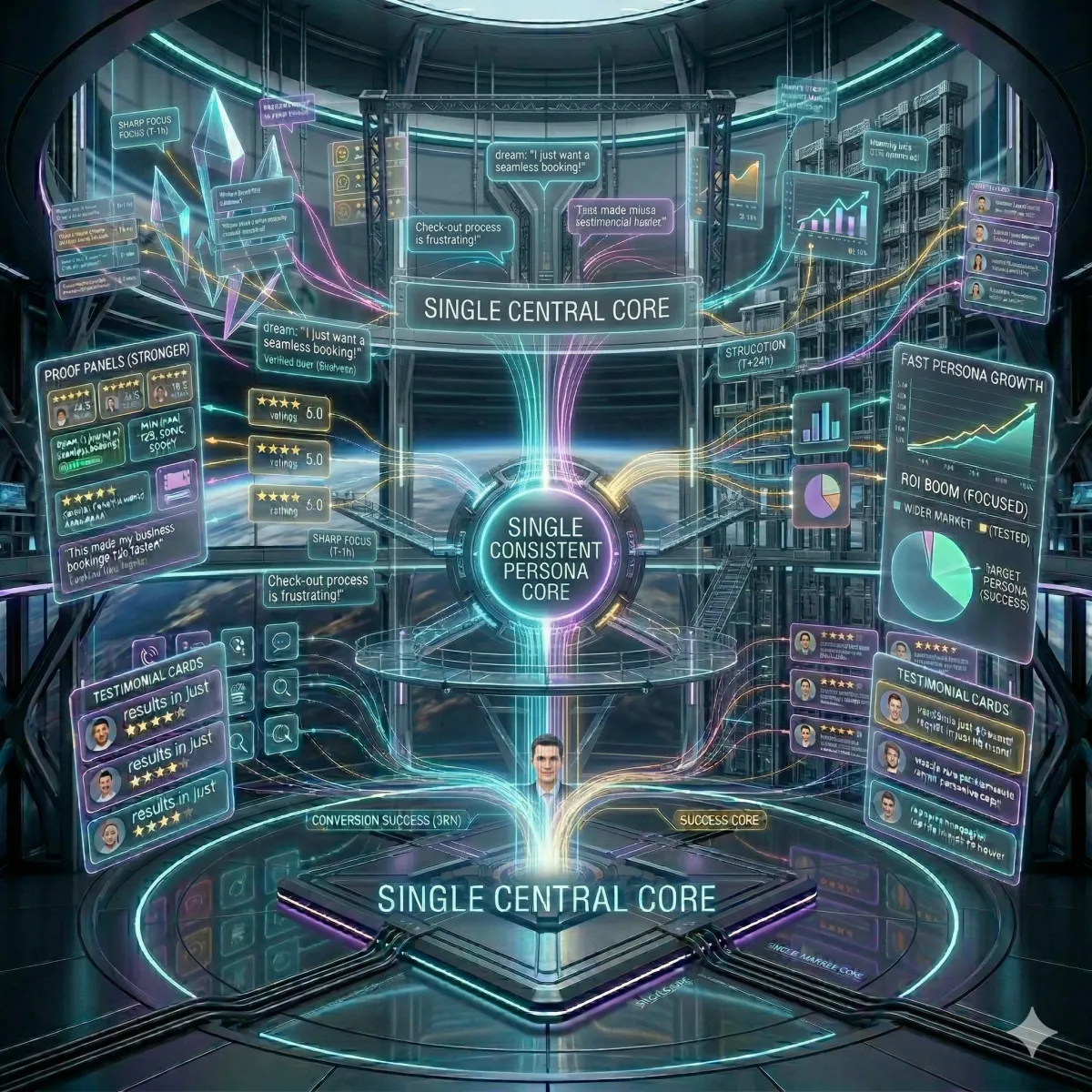
🧭 Channel Playbook: Use Your Buyer Persona in Ads, Email, and Pages
🧭 Channel Playbook: Use Your Buyer Persona in Ads, Email, and Pages
A buyer persona doesn’t change…
but the message wrapper does.
Same person. Same pain. Same dream.
Different channel. Different moment.
An ad is a tap on the shoulder.
An email is a calm conversation.
A landing page is the decision room.
If we keep the persona the same but adjust the message to match consumer behavior, things get easier:
ads get better clicks
emails get more replies
pages get more conversions
sales feels less pushy
Use one buyer persona, but shift your message by channel and stage: cold (hook + small step), warm (proof + path), hot (speed + safety). Keep your core promise consistent across ads, email, and landing pages.
💡 Buyer persona: What stays the same across channels
Your buyer persona should not change every time you post.
These parts stay the same everywhere:
pain (what hurts now)
dream (what they want)
trigger (why now)
doubts (what scares them)
proof needed (what makes them trust)
words they use (real phrases)
Those are the “truth anchors.”
🧠 Consumer behavior: What changes across channels
What changes is the moment.
Different channels show different behavior:
Ads: fast scroll, low trust, tiny attention
Email: slower pace, higher trust, more context
Landing pages: decision time, fear spikes at the CTA
So we adjust:
how long the message is
how much proof we show
how big the CTA step is
where we place objections
Same persona. Different wrapper.
🧭 The stage lens (cold, warm, hot) for every channel
Your persona also arrives in a stage:
❄️ Cold consumer behavior
Learning. Unsure. Needs safety.
🌤️ Warm consumer behavior
Comparing. Wants proof. Needs certainty.
🔥 Hot consumer behavior
Ready. Wants speed. Needs risk reduced.
Stage controls what we say in ads, email, and pages.
📣 Buyer persona in ads (fast hook, tiny step)
Ads are not where we “explain everything.”
Ads are where we win the first click.
✅ What ads should do for your buyer persona
mirror the pain in one line
promise one simple win
offer one safe next step
match the landing page headline
🪧 Ad hook templates (buyer persona)
Pain hook: “Still stuck with [pain]? Here’s the 3-step fix.”
Dream hook: “Get [dream] in [time]—without [fear].”
Proof hook: “People like you got [result]. See how.”
🔘 Ad CTAs by stage (consumer behavior)
cold: “Get the complimentary guide” / “See how it works”
warm: “Start the trial” / “See the case”
hot: “Book now” / “Start now”
🧾 Ad checklist (buyer persona)
one persona pain line
one persona dream line
one proof cue (tiny)
one CTA
one landing page match
If your ad promise and page promise don’t match, bounce rises.
✉️ Buyer persona in email (calm proof, clear path)
Email is where trust grows.
It’s not loud. It’s steady.
✅ What email should do for your buyer persona
tell a short “we get it” story
show proof and steps
answer objections
guide one next step
🧩 Email structure that converts (buyer persona)
Subject: pain or promise
Opening: “we get it”
Proof: like-me example
Steps: 3-step path
CTA: one next step
P.S.: micro-FAQ answer
🧾 Email subject swipe file (buyer persona)
“Still dealing with [pain]?”
“A simple 3-step plan for [dream]”
“What happens in week one”
“Will this work for [role]?”
“Start small this week”
🔘 Email CTAs by stage (consumer behavior)
cold: guide / checklist / “see steps”
warm: case page / trial / demo
hot: pricing page / booking link
Email works best when each email has one job.
🧱 Buyer persona on landing pages (decision room, fear at the CTA)
Landing pages are where the buyer decides.
This is where risk spikes.
✅ What landing pages should do for your buyer persona
mirror pain and dream in the hero
show proof near the CTA
show a simple 3-step path
answer top objections under the CTA
make the next step feel safe
🧩 Landing page layout (buyer persona)
Hero: pain/dream headline + CTA
Micro proof: next to CTA
Steps: 3-step path with time tags
Proof: like-me story (warm/hot)
FAQ: objections under CTA
CTA repeat: same label
📌 Proof placement rule (consumer behavior)
Proof belongs:
under headline
by CTA
near price (warm/hot)
Fear spikes there. Proof calms it.
🧊 Cold message shifts (same persona, different wrapper)
Cold stage = small, safe, simple.
📣 Ads (cold buyer persona)
1 line pain + 1 line win
CTA: complimentary guide
✉️ Email (cold buyer persona)
short tip + small win
CTA: see steps / guide
🧱 Page (cold buyer persona)
pain-first headline
micro proof + “for/not-for”
CTA: small step
Cold buyers don’t want pressure. They want safety.
🌤️ Warm message shifts (same persona, more proof)
Warm stage = proof + path.
📣 Ads (warm buyer persona)
proof hook (“people like you”)
CTA: case study or trial
✉️ Email (warm buyer persona)
case story + FAQ answer
CTA: trial/demo
🧱 Page (warm buyer persona)
proof-first block near top
micro-FAQ under CTA
week-one win checklist
Warm buyers want certainty.
🔥 Hot message shifts (same persona, less friction)
Hot stage = speed + risk reduction.
📣 Ads (hot buyer persona)
“start now” + urgency
CTA: book/buy
✉️ Email (hot buyer persona)
“what happens next”
risk reducers
CTA: booking link
🧱 Page (hot buyer persona)
plan choice clear
proof beside plan buttons
terms/support visible
shortest path to start
Hot buyers want action now.
✅ Cross-channel consistency tips (so your persona feels real everywhere)
This is where most brands break.
They run an ad that promises one thing…
then an email that talks about another…
then a page that’s generic.
Here’s how to keep it consistent:
🧩 Consistency rule: one core promise
Use the same promise everywhere, in simple words.
Example:
“Get [dream] without [pain] in [time].”
🧩 Consistency rule: same CTA label per stage
Don’t switch CTA labels every block.
Pick one main CTA per stage.
🧩 Consistency rule: same buyer words
Keep a “buyer words bank” and reuse phrases.
🧩 Consistency rule: match proof to the persona
Use “like me” proof. Not random proof.
Consistency creates trust. Trust creates conversion.
🧾 Asset checklists per channel (buyer persona ready)
📣 Ad assets checklist
3 hooks (pain/dream/proof)
2 creatives (image/video)
1 CTA per stage
1 matching landing page per stage
✉️ Email assets checklist
3-email sequence (tip → proof → next step)
1 case story
1 FAQ email
1 “week-one win” email
🧱 Landing page assets checklist
hero with persona words
proof by CTA
3-step path with time tags
micro-FAQ under CTA
for/not-for box
repeat CTA
📊 KPIs to watch across channels (consumer behavior signals)
Track by slice if you can.
📣 Ads KPIs
CTR
CPC (optional)
landing page bounce
✉️ Email KPIs
open rate
click rate
reply rate
unsubscribe rate (watch spikes)
🧱 Page KPIs
time on page
scroll-to-CTA %
CTA clicks
conversion rate
velocity
If one link breaks, fix that first.
🧪 Tiny tests that keep persona messaging sharp
One test per week.
ad hook test: pain vs proof
email subject test: pain vs curiosity
page test: proof by CTA vs lower
CTA test: “see how it works” vs “get the guide” (cold)
FAQ order test: top doubt first
Let consumer behavior choose winners.
❓ FAQ — buyer persona across channels
How do we use one buyer persona across ads, email, and landing pages?
Keep the pain, dream, and buyer words the same. Change the wrapper: ads are short hooks, email adds proof and story, landing pages add steps, FAQs, and CTAs.
How does consumer behavior stage change messaging by channel?
Cold needs safety and small steps. Warm needs proof and a clear path. Hot needs speed, risk reducers, and fewer steps.
What should ads say for a buyer persona?
One pain line, one win line, one CTA. Match the landing page headline to reduce bounce.
What should email say for a buyer persona?
A calm story, proof, steps, and one next step. Answer one objection per email.
What should landing pages include for a buyer persona?
Hero in buyer words, proof by CTA, 3-step path with time tags, micro-FAQ under CTA, and one clear CTA.
Should we use different CTAs across channels?
Use stage-matched CTAs. Keep the label consistent within the page or email. Avoid switching CTAs too often.
Where should proof go on each channel?
Ads: tiny proof hint. Email: like-me case proof. Pages: proof by CTA and near pricing/plan buttons.
How do we keep messaging consistent across channels?
Use one core promise, one buyer words bank, and matching headlines between ads and landing pages.
What KPIs show persona-channel fit?
Ads: CTR and bounce. Email: clicks and replies. Pages: CTA clicks and conversion. Watch velocity and refunds for true fit.
What is the biggest mistake using personas across channels?
Changing the promise from channel to channel. It breaks trust and raises bounce.
📌 Key Takeaways
Same buyer persona, different channel wrapper
Ads = hook + small step
Email = proof + path + objection answers
Pages = decision room with proof by CTA and micro-FAQs
Match message and CTA to consumer behavior stage (cold/warm/hot)
Keep one core promise consistent across channels
Use “buyer words” everywhere
Track KPIs per channel and test weekly
This builds buyer clarity inside The Buyer Clarity System™
🎁 Complimentary Ebook
Want the channel checklists and swipe templates?
Grab our COMPLIMENTARY Buyer Clarity Guide here:
👉 Download your complimentary ebook now
🧭 Final Word
The persona is the person.
The channel is the moment.
Keep the person the same. Match the moment with the right hook, proof, and step.
That’s how your message stays true and converts—inside The Buyer Clarity System™.
