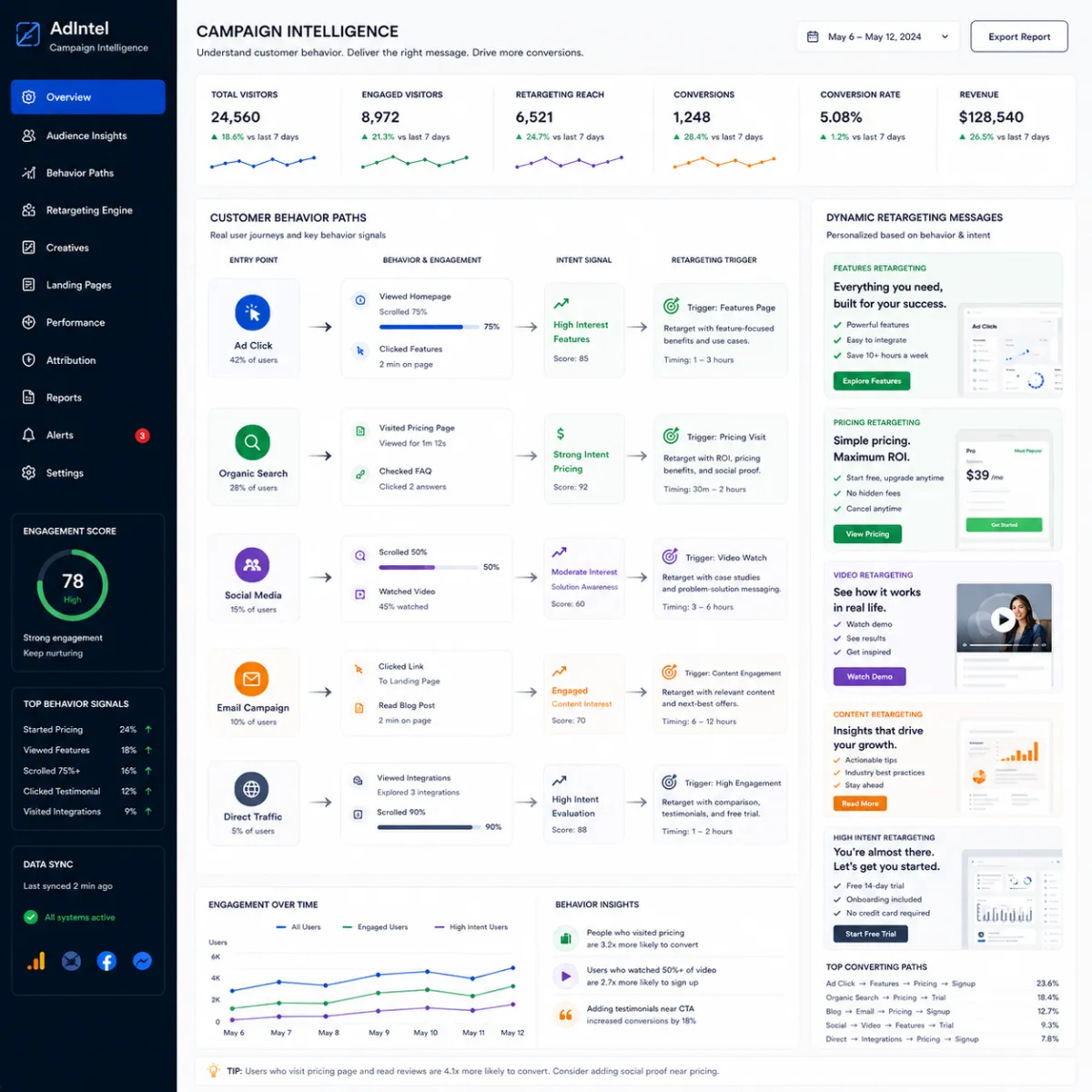
🎯 Behavior-Based Retargeting: Ads That Follow Consumer Behavior (Not Guesswork)
🎯 Behavior-Based Retargeting: Ads That Follow Consumer Behavior (Not Guesswork)
Retargeting gets a bad name.
Because most people do it like this:
“Visited page? Cool. Show the same ad again.”
So the buyer sees the same message…
with the same fear…
in the same moment…
and they still don’t act.
That’s not retargeting. That’s nagging.
Real retargeting is simple:
We follow consumer behavior.
We don’t just track where they went.
We track what they did.
Did they bounce fast?
Did they scroll deep?
Did they click pricing?
Did they read FAQs?
Did they start checkout?
Did they watch a video?
Those actions tell us the buyer persona’s state:
confused
curious
comparing
scared
ready
Then we match the right message to that state.
Behavior-based retargeting segments people by actions (bounce speed, scroll depth, pricing loops, FAQ clicks, CTA clicks, checkout starts). Each segment gets a different message that answers the buyer persona’s objection and offers the correct next step. Use frequency guardrails so you don’t annoy the audience.
🧠 Quick definitions (so we don’t mix it up)
🎯 Target audience
Your target audience is the group you aim at.
👤 Buyer persona
Your buyer persona is the “one person story” inside that group:
pain, dream, moment, risk, proof needed, safe next step.
🔁 Retargeting
Retargeting is showing ads to people who already interacted with you.
🧠 Behavior-based retargeting
Behavior-based retargeting is segmenting retargeting based on consumer behavior actions, not just “visited page.”
🎯 Why “visited page” retargeting fails
Because it ignores the real reason people didn’t buy.
A page visit does not tell you:
why they left
what they feared
what they needed to see
what stage they’re in
Behavior tells you.
That’s why this method converts better.
🧩 The big idea: Behavior = stage + objection
Most buyers don’t leave because they hate you.
They leave because of one of these:
confusion (“I don’t get it”)
doubt (“I don’t trust it”)
fear (“what if it fails”)
effort (“this feels like work”)
timing (“not right now”)
Those are buyer persona objections.
Behavior reveals which objection is active.
✅ The 6 behavior signals that matter most
We can keep it simple.
Most behavior-based retargeting can be built with these six signals:
Bounce speed (left fast)
Scroll depth (how far they went)
Time on page (how long they stayed)
Click behavior (pricing, FAQ, CTA, proof)
Repeat visits (came back again)
High-intent events (add to cart, booking, checkout start)
Now we build segments using those signals.
🧠 Segment 1: “Bounced Fast” (0–10 seconds)
What their consumer behavior means
They clicked… and their brain said “nope.”
Usually because:
wrong target audience
message match is broken
page looked confusing
they didn’t see themselves fast
Buyer persona objection behind it
“This is not for me.”
or
“This feels risky.”
Best retarget message
Make it clearer and tighter.
✅ Use a “For…” line and one simple promise.
Retarget ad template (Bounced Fast):
“For [target audience] who want [result] without [pain].
Here’s the simple first step.
Get the complimentary guide.”
Best CTA for this segment
Small step:
guide
checklist
“see the steps”
Where to send them
A simple, clear page with:
headline match
“For…” line
steps
proof near CTA
🧠 Segment 2: “Scrolled Deep” (but didn’t click)
What their consumer behavior means
They were interested enough to read.
But they didn’t feel safe enough to act.
Buyer persona objection behind it
“What if this doesn’t work?”
or
“What happens next?”
Best retarget message
Reduce risk with proof + what-next.
Retarget ad template (Scrolled Deep):
“Still thinking about it?
Here’s what happens first + proof from people like you.
See the proof pack.”
Best CTA
Proof step:
proof pack
case story
quick audit
Where to send them
A proof-first page:
mini-case
proof near CTA
micro-FAQ under CTA
🧠 Segment 3: “Pricing Loopers” (pricing page visits 2+ times)
What their consumer behavior means
They want to buy… but fear wasting money.
They are doing risk checks.
Buyer persona objection behind it
“Is it worth it?”
“What do we get?”
“Is this a contract?” (if relevant)
Best retarget message
Value clarity + risk reducer.
Retarget ad template (Pricing Loopers):
“Wondering if this is worth it?
Here’s what’s included + the safe way to start.
See pricing and the starter path.”
Best CTA
“See what’s included”
“Start with Starter”
“Get the quick audit”
Where to send them
A pricing clarity page:
“what’s included” bullets
plan guidance (“best for…”)
proof beside plan buttons
micro-FAQ under pricing
🧠 Segment 4: “FAQ Readers” (FAQ clicks or deep FAQ scroll)
What their consumer behavior means
They are high risk-sensitive.
They want answers before they act.
Buyer persona objection behind it
“Will this work for me?”
“How long does it take?”
“What if I get stuck?”
Best retarget message
Answer one big objection per ad.
Retarget ad template (FAQ Readers):
“Question: ‘Will this work for someone like me?’
Answer: yes—here’s how it works and what happens first.
See the simple steps.”
Best CTA
“See how it works”
“Get the proof pack”
“Start small”
Where to send them
A page with:
micro-FAQ under CTA
“what happens next”
proof matched to their fear
🧠 Segment 5: “CTA Clickers” (clicked CTA but didn’t finish)
What their consumer behavior means
They were ready… then the step felt too big.
This is pure friction.
Buyer persona objection behind it
“This is too much.”
“This feels like work.”
“I’m not ready for this step.”
Best retarget message
Shrink the step.
Retarget ad template (CTA Clickers):
“Want the first win without the big leap?
Start small with the complimentary guide (takes 2 minutes).”
Best CTA
Smaller than before:
guide
checklist
short form
“reply with one word” (if using DM)
Where to send them
A low-friction page:
fewer fields
one CTA
proof near CTA
mobile-first
🧠 Segment 6: “Hot Intent” (checkout start / booking page / cart)
What their consumer behavior means
They are very close.
They need certainty and next steps.
Buyer persona objection behind it
“Am I making the right choice?”
“What happens after I pay?”
“How soon do we start?”
Best retarget message
Decision support.
Retarget ad template (Hot Intent):
“Ready when you are.
Here’s what happens after you start + your first 48-hour win.
Finish your booking.”
Best CTA
“Finish booking”
“Complete checkout”
“Start now”
Where to send them
A decision page:
what-happens-next
proof near CTA
48-hour win block
last objections answered
🧭 Message menus (what to say by behavior segment)
Here are quick “menus” you can pull from.
For confusion segments (bounced fast)
“For [role] who…”
“3 steps”
“start small”
For risk segments (scrolled deep, FAQ readers)
“proof pack”
“like-me examples”
“what happens next”
For value segments (pricing loopers)
“what’s included”
“starter path”
“safe first step”
For friction segments (CTA clickers)
“takes 2 minutes”
“no big leap”
“fewer steps”
For hot segments (checkout starters)
“start date”
“week one plan”
“48-hour win”
🧱 The retargeting ladder (stage-based order)
Retargeting should move in steps:
clarity (for me?)
proof (safe?)
value (worth it?)
decision (what next?)
If you jump to “book now” too early, you create ad fatigue.
⏱️ Frequency guardrails (don’t annoy your target audience)
Retargeting works until it becomes creepy.
So we set simple guardrails:
✅ Frequency rules (simple)
Cold retargeting: 1–2 views per day max
Warm retargeting: 2–3 views per day max
Hot retargeting: can be slightly higher for a short window (1–3 days)
✅ Duration rules (simple)
Bounced fast: 3–7 days
Scrolled deep: 7–14 days
Pricing loopers: 7–14 days
FAQ readers: 7–14 days
CTA clickers: 3–7 days
Hot intent: 1–3 days (short and focused)
✅ Creative rotation rule
Change the message every 7–10 days.
Not because you “need more ads.”
Because the brain ignores repeats.
📍 What pages should each retarget segment land on?
Don’t send every segment to the same page.
Match the page to the behavior.
✅ Page routing map
Bounced fast → clarity page (tight hero + For line)
Scrolled deep → proof page (mini-cases + FAQ)
Pricing loopers → pricing clarity page (what’s included)
FAQ readers → FAQ-first page (objections answered)
CTA clickers → low-friction page (short form)
Hot intent → decision page (what next + 48-hour win)
This is market segmentation in action—built from consumer behavior.
📊 How to measure behavior-based retargeting success
Track per segment:
CTR on retarget ads
bounce on landing page
CTA clicks
conversion rate
cost per conversion
close rate (if calls)
time-to-yes (velocity)
Behavior-based retargeting is working when:
bounce drops
CTA clicks rise
conversions rise
costs stabilize
🧪 Tiny tests (one win a week)
Test only one thing at a time.
Test 1: Proof vs steps (for scrolled deep)
A: proof-first retarget
B: steps-first retarget
Test 2: Value bullets vs risk reducer (for pricing loopers)
A: “what’s included”
B: “start small + guarantee mechanic” (only if true)
Test 3: 48-hour win block (for hot intent)
A: include 48-hour win
B: no 48-hour win
Let consumer behavior pick winners.
🧠 Why this supports ranking for “buyer persona”
This post supports “buyer persona” ranking because it:
uses buyer persona as the message driver for each behavior segment
defines buyer persona and connects it to objections
includes snippet-ready FAQs about buyer persona retargeting
ties buyer persona to consumer behavior signals (time, scroll, clicks)
That’s SEO + AEO working together.
❓ FAQ — Behavior-Based Retargeting and Buyer Persona
1) What is behavior-based retargeting?
Behavior-based retargeting uses consumer behavior signals (time, scroll, clicks) to decide which retarget ad and message to show.
2) Why is “visited page” retargeting not enough?
Because page visits don’t explain intent or fear. Behavior shows if the buyer persona was confused, comparing, or ready.
3) What behaviors should we use to build retarget segments?
Bounced fast, scrolled deep, pricing loopers, FAQ readers, CTA clickers, and hot-intent actions like checkout starts.
4) What should we show people who bounced fast?
A clarity message with a tight “For…” line and a small safe CTA like a complimentary guide.
5) What should we show people who keep visiting pricing?
Value proof: what’s included, plan guidance, proof near pricing, and a safe starter path.
6) What should we show FAQ readers?
Objection answers. Use ads that answer one big fear and send them to a page with micro-FAQs under the CTA.
7) What should we show people who clicked the CTA but didn’t finish?
A smaller step with less friction. Short forms, clear what-next, and “start small” messaging.
8) What should we show checkout starters?
Decision support: what happens next, proof near the button, and a 48-hour win plan.
9) How do we prevent retargeting from annoying people?
Use frequency guardrails (1–3 views/day) and short durations (1–14 days based on segment). Rotate messages weekly.
10) How do we know behavior-based retargeting is working?
Bounce drops, time and CTA clicks rise, conversion rate rises, and cost per conversion improves.
11) How does buyer persona help retargeting?
Buyer persona tells you what fear to answer and what proof to show, so retarget ads feel helpful, not pushy.
12) What is the simplest way to start?
Start with 3 segments: bounced fast, pricing loopers, and hot intent. Add the others later.
📌 Key Takeaways
Retargeting should follow consumer behavior, not just “visited page”
Segment retargeting by actions: bounced fast, scrolled deep, pricing loopers, FAQ readers, CTA clickers, hot intent
Match each segment to the right buyer persona objection and the right CTA
Route each segment to the correct page (clarity, proof, pricing, FAQ, low-friction, decision)
Use frequency and duration guardrails to avoid ad fatigue
Test one change per week and let behavior pick winners
This is buyer clarity inside The Buyer Clarity System™
🎁 Complimentary Ebook
Want the retargeting segment map, message menus, and guardrail checklist?
Grab our COMPLIMENTARY Buyer Clarity Guide here:
👉 Download your complimentary ebook now
🧭 Final Word
Good retargeting doesn’t chase people.
It guides them.
Follow what they did. Answer what they feared. Show what they needed. Then the “yes” comes naturally—inside The Buyer Clarity System™.
