🗣️ Ad Copy That Sounds Like Your Buyer Persona (Swipe Templates)
🗣️ Ad Copy That Sounds Like Your Buyer Persona (Swipe Templates)
Most ads fail for a simple reason:
They don’t sound like the buyer.
They sound like the business.
And the buyer’s brain does not trust “business talk.”
The buyer’s brain trusts buyer talk.
It trusts the words people say when they are stressed… tired… behind… and trying to fix something.
That is consumer behavior in language form.
So if we want better ads, we don’t start with “creative.”
We start with the buyer persona.
Because a buyer persona is not a profile. It’s a voice.
It tells us:
what they say out loud
what they say in their head
what they fear losing
what proof they need
what step feels safe
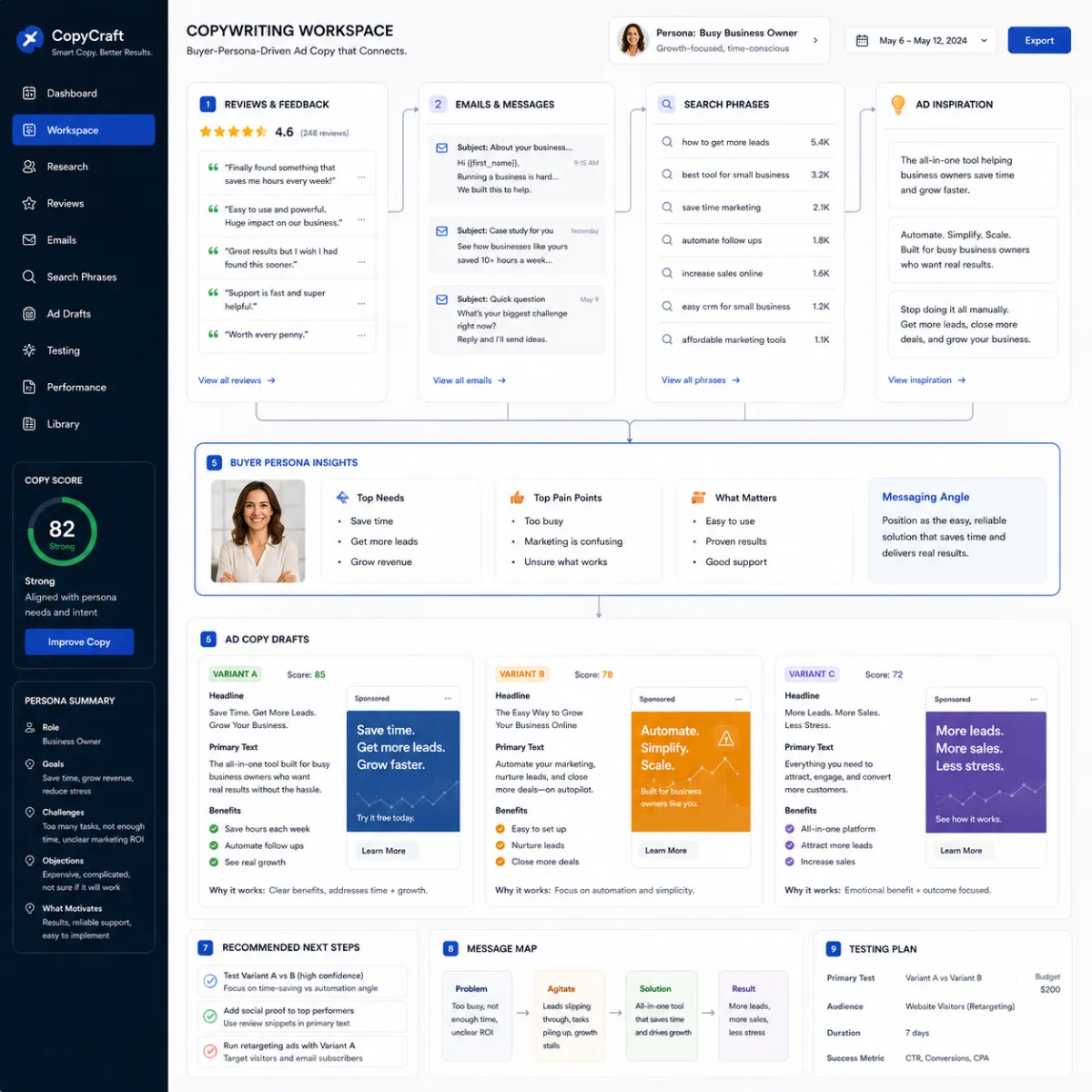
Ad copy matches a buyer persona when it uses real buyer phrases (pain, moment, risk), adds proof in the same language, and offers a safe CTA. We mine those phrases from reviews, emails, and search terms—then write using swipe templates and test one change per week.
🧠 Quick definitions (so we write the right thing)
🎯 Target audience
Your target audience is the group you aim at.
Example: “Local service owners.”
👤 Buyer persona
Your buyer persona is the “one person” story inside that group:
pain (what hurts)
dream (what they want)
moment (why now)
risk (what they fear)
proof needed (what makes them trust)
safe step (CTA)
Target audience tells us who.
Buyer persona tells us what to say.
🎯 Why “real words” beats “marketing words”
Marketing words are smooth.
Real words are sharp.
Smooth words feel like a pitch.
Sharp words feel like truth.
A buyer persona converts when your copy feels like:
“You’re inside our head.”
That is why ad copy must sound like the buyer persona—not like the brand deck.
🧭 The 3-part buyer persona voice (what we must capture)
Every converting ad is built from three persona parts:
Pain words (what hurts now)
Moment words (why now)
Risk words (what they fear)
Then we add:
Proof words (what makes them trust)
Safe step CTA (what feels low risk)
That’s the full recipe.
✅ Step 1: Voice-of-customer mining (where to get buyer persona words)
If we guess the words, the ad sounds fake.
So we mine words from places where people are honest.
⭐ Source A: Reviews (yours + competitors)
Look for repeated phrases like:
“I was tired of…”
“I didn’t have time…”
“I was scared…”
“I tried X and it didn’t work…”
What to copy from reviews:
pain phrases
“why now” lines
trust lines (“I liked that…”)
complaints (what they hate)
✉️ Source B: Emails / DMs / support chats
These are fear-rich.
People ask:
“Will this work for me?”
“What happens first?”
“How long does this take?”
“Can we cancel?” (if relevant)
Those are buyer persona objections.
🔍 Source C: Search terms
Search is the buyer’s private diary.
Collect phrases with:
“best” “near me” “safe” “reviews”
“how to” “why” “fix”
“this week” “today” “ASAP”
Those words tell you motive, moment, and risk.
💬 Source D: Comments (ads, posts, forums)
Comments show:
skepticism
confusion
“been burned before” energy
That’s risk language. It’s valuable.
🧾 The 15-minute mining worksheet (copy/paste)
Open a doc and paste this:
Buyer persona pain words (10):
__________________________________________________________________
__________________________________________________________________
…
Buyer persona moment words (5):
__________________________________________________________________
…
Buyer persona risk words (10):
__________________________________________________________________
…
Buyer persona proof words (5):
__________________________________________________________________
…
Buyer persona “safe step” words (5 CTAs):
__________________________________________________________________
…
When you fill this, ad writing becomes easy.
✅ Step 2: Turn buyer words into “message bricks”
Now we turn raw phrases into reusable bricks.
🩹 Brick 1: Pain line
“Still stuck with ___?”
“Tired of ___?”
“Sick of ___?”
⏰ Brick 2: Moment line
“If you need ___ this month…”
“Before ___ happens…”
“This week…”
🛡️ Brick 3: Risk line
“Without wasting money.”
“Without guessing.”
“Without adding more work.”
⭐ Brick 4: Proof line
“Clear steps.”
“People like you.”
“What happens first.”
🔘 Brick 5: Safe CTA
“Get the complimentary guide.”
“See the steps.”
“Get the quick audit.”
“Book a quick call.”
Now we build ads from bricks.
✅ Step 3: The 10 hook formulas (buyer persona swipe templates)
These are hooks that work because they speak to the reptilian brain:
avoid pain, reduce risk, save time, create certainty.
1) 🧨 Pain hook
“Still stuck with [pain]? Here’s the simple fix.”
2) 🧾 Proof hook
“People like you fixed [pain]. Here’s how it works.”
3) ⏰ Moment hook
“If you need [result] by [time], start here.”
4) 🛑 Stop-doing hook
“Stop doing [bad habit]. Do this instead.”
5) 😬 Burned-before hook
“Tried [past try] and it didn’t work? You’re not alone.”
6) 🧠 Confusion hook
“Feeling stuck because nothing is clear? Here’s the 3-step path.”
7) 💸 Waste hook
“Stop wasting money on [thing]. Fix this first.”
8) ⏳ Time hook
“No time? Do this in 15 minutes.”
9) 🔍 “Is it for me?” hook
“For [role] who want [result] without [pain].”
10) ✅ “What happens next?” hook
“Here’s what happens first (so it feels safe).”
Pick 1 hook per ad. Don’t mix 4 hooks at once.
⭐ Proof lines that sound human (not hypey)
Proof lines must match what buyers care about.
Here are safe proof line templates:
“Clear steps. No guessing.”
“Start small and see progress fast.”
“We show you what happens first.”
“Built for people like [role].”
“Simple plan you can follow.”
If you have real reviews, you can use short real quotes.
🔘 CTA lines that match stage (cold/warm/hot)
CTA is where most ads break.
They ask for too much too soon.
❄️ Cold stage CTAs
“Get the complimentary guide”
“See the steps”
“Grab the checklist”
🌤️ Warm stage CTAs
“Get the quick audit”
“Start the trial”
“Get the proof pack”
🔥 Hot stage CTAs
“Book now”
“Start now”
“Talk to us today”
Match CTA to readiness.
🧱 6 ad templates you can swipe (ready to paste)
Below are full templates. Replace brackets.
Template A: Cold (pain + safe step)
Hook: Still stuck with [pain]?
For: For [target audience].
Promise: Get [dream] without [risk].
CTA: Get the complimentary guide.
Template B: Cold (time + steps)
No time for [pain]?
Here’s a simple 3-step plan for [buyer persona].
Start small: see the steps.
Template C: Warm (proof + objections)
Will this work for [role]?
Here’s proof + the steps.
For [target audience].
Get the proof pack.
Template D: Warm (burned before)
Tried [past try] and it didn’t work?
We get it.
Here’s what happens first.
Start with a quick audit.
Template E: Hot (moment + next step)
If you need [result] this week, don’t guess.
For [target audience].
Book now and get your first win fast.
Template F: Value filter (protect lead quality)
For [target audience] who want [result] without [pain].
Not for people who want magic results with no steps.
Start here: [CTA].
📍 Where buyer persona language belongs in the ad (order)
A simple order that works:
Pain or moment hook
“For…” line (target audience)
Risk reducer (“without…”)
Proof line
Safe CTA
This is the rhythm of a human brain.
🧪 How to test ad copy (one-change-one-week)
Don’t test 10 things.
Test one thing.
Week 1: Pain hook vs proof hook
Keep targeting the same.
Measure:
CTR
bounce (on the landing page)
CTA clicks
Week 2: CTA step size
Guide vs call.
Measure:
conversions
lead quality
close rate
Week 3: Proof line
“Clear steps” vs “people like you.”
Measure:
CTR + CTA clicks
Small tests. Clean learning.
🧯 Do/Don’t list (so your buyer persona trusts you)
✅ Do
use buyer words (copied from real sources)
write short lines
add “what happens next” clarity
reduce risk near the CTA
keep one promise per ad
❌ Don’t
stack buzzwords (“innovative, scalable, cutting-edge”)
overpromise
talk about yourself for 5 lines
use vague claims (“guaranteed results”)
write to “everyone”
The buyer persona can smell fluff.
🧠 Why this supports ranking for “buyer persona”
This post builds authority for buyer persona because it:
defines buyer persona clearly
shows how buyer persona becomes ad copy
uses the keyword naturally in headings and templates
answers common buyer persona copy questions in the FAQ
That helps SEO and AEO together.
❓ FAQ — Ad Copy That Matches a Buyer Persona
1) What does it mean for ad copy to match a buyer persona?
It means the ad uses real buyer persona words for pain, moment, risk, and proof needs, so the target audience feels “this is for me.”
2) Where do we get real buyer persona words?
From consumer behavior sources like reviews, emails, DMs, support chats, comments, and search terms.
3) Why is buyer persona language better than marketing language?
Because buyer persona language feels true and safe. Marketing language often feels like a pitch and lowers trust.
4) What is the fastest buyer persona copy structure for ads?
Pain hook → For line → risk reducer → proof line → safe CTA.
5) What hooks work best for cold traffic?
Pain hooks, confusion hooks, and “see the steps” hooks work well because they offer a small safe first step.
6) What hooks work best for warm traffic?
Proof hooks and burned-before hooks work well because warm buyers are comparing and risk-sensitive.
7) How do we avoid attracting bad leads with ad copy?
Use a tighter “For…” line and add a simple “not for you if…” filter line.
8) What CTA should we use if the buyer persona is not ready?
Use a small CTA like a complimentary guide, checklist, or “see the steps.”
9) How do we test if buyer persona copy is working?
Run one-change-one-week tests and track CTR, bounce, CTA clicks, conversions, and lead quality.
10) What consumer behavior metrics tell us the copy is off?
Low CTR shows weak hook fit. High bounce shows promise mismatch. Low CTA clicks show risk at the click.
11) How many hooks should one ad use?
One. Pick one primary hook and keep the message clean.
12) How does this connect to target audience targeting?
Target audience decides who sees the ad. Buyer persona decides what words make them click and act.
📌 Key Takeaways
Great ads sound like the buyer persona, not the business
Mine voice-of-customer words from reviews, emails, and search terms
Build message bricks: pain, moment, risk, proof, CTA
Use the 10 hook formulas and swipe templates to write fast
Match CTAs to stage (cold/warm/hot)
Test one change per week and let consumer behavior pick winners
This is buyer clarity inside The Buyer Clarity System™
🎁 Complimentary Ebook
Want the VOC mining worksheet, 10 hook formulas, proof lines, and CTA swipe file?
Grab our COMPLIMENTARY Buyer Clarity Guide here:
👉 Download your complimentary ebook now
🧭 Final Word
Ads don’t need more hype.
They need more truth.
When your ad sounds like your buyer persona, your target audience clicks—and your budget stops bleeding inside The Buyer Clarity System™.
