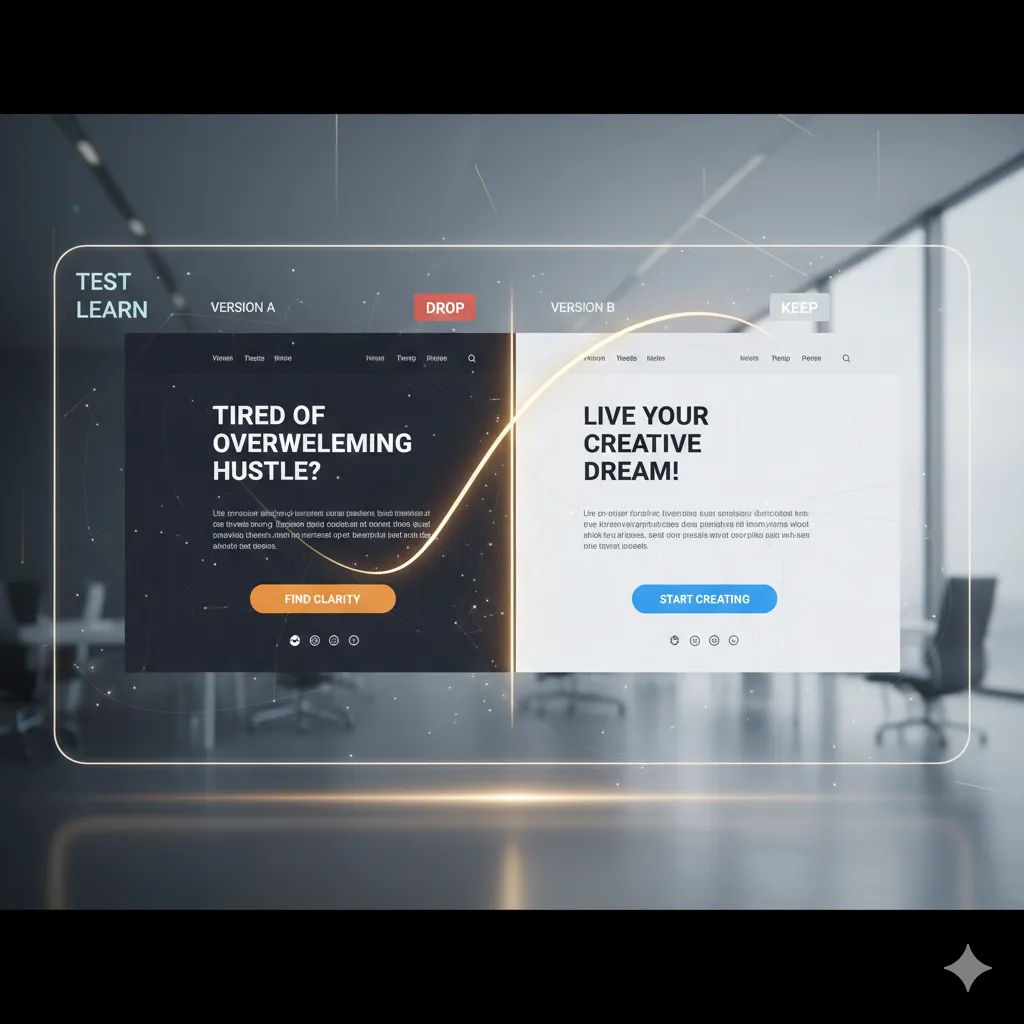
🆎 A/B Testing Headlines and CTAs for Your Target Audience (Tiny Tests, Big Wins)
🆎 A/B Testing Headlines and CTAs for Your Target Audience (Tiny Tests, Big Wins)
Safe. Seen. Sure.
That’s what people want first.
Big changes feel risky. Small tests feel safe. When we A/B test headlines and CTAs for one target audience, we learn fast. We let consumer behavior vote. We keep what works. We drop what doesn’t. That’s the calm way we grow inside The Buyer Clarity System™.
Test one thing per week for your target audience—headline (pain vs. dream vs. proof), CTA copy and placement, and proof position. Track simple numbers. Keep winners. Stack small gains into big wins.
💡 Why A/B tests for your target audience work (and wild guesses fail)
Your target audience tells you what feels safe.
Consumer behavior shows what they do, not what we hope.
One buyer persona gives the words to test.
Simple market segmentation lets you test one slice at a time.
This creates buyer clarity: clear message, safe step, more “yes.”
Small tests. Big steady lift.
🧭 Order of impact for your target audience (what to test first)
Start where a single change helps the most.
Headline-fit for your target audience (pain vs. dream vs. proof)
Hero → CTA flow for your target audience (button label + position)
Proof next to CTA for your target audience (trust at the click)
Micro-FAQ near button for your target audience (remove last doubts)
Offer size for your target audience (guide vs. mini workshop vs. trial)
Form friction for your target audience (fields and mobile keyboards)
Fix the first broken link in the chain. Then the next.
🪧 Headlines to test for your target audience (pain vs. dream vs. proof)
Use buyer words. Keep it under ~12–14 words.
💥 Pain-first headline for your target audience
“Stop [pain] and get [result] in [time]—without [hated thing].”
Examples for a target audience:
“Stop late payments and get on-time pay in 7 days—without chasing.”
“Stop night redness and calm skin in 7 nights—without harsh stuff.”
“Stop empty calendars and get 3 paid calls—without pushy sales.”
🌈 Dream-first headline for your target audience
“Get [result] in [time]—even if [big fear].”
Examples for a target audience:
“Get on-time payments in 7 days—even if clients pay slow.”
“Get calm skin in 7 nights—even if you’re sensitive.”
“Get paid calls this week—even if sales feels scary.”
📣 Proof-first headline for your target audience
“[Role] cut [pain] in [time]. See the 3 steps.”
Examples for a target audience:
“Ops leads cut chasing by 4 hrs/week. See the 3 steps.”
“Moms calmed redness in 7 nights. See the routine.”
“New coaches booked 3 paid calls. See the scripts.”
Test plan for your target audience:
Run pain vs. dream this week. Winner vs. proof next week.
🧲 CTAs that convert your target audience (copy, color, and placement)
📝 CTA copy to test for your target audience
“Start your 7-day plan”
“See how it works”
“Start free setup”
“Get the complimentary guide”
“Book your tour” / “Start free trial”
Tip: One main label across the page for your target audience. Keep it consistent.
📍 CTA placement to test for your target audience
Above the fold (primary)
Under the proof (trust then click)
After the 3 steps (path then click)
Sticky mobile bar (thumb reach)
Rule: Put the target audience CTA where eyes and thumbs go next.
🧾 Proof position for your target audience (where trust matters most)
Trust rises at the click. Place proof by the button.
Proof to test for a target audience:
Like-me mini case (same role, same pain, fast win)
Stars or a 10–15 word quote
Tool logos (what they already use)
Tiny metric (time saved, time to first win)
Placement for a target audience:
Desktop: to the right or just below the CTA
Mobile: directly above the CTA block
Move proof up. Watch clicks climb.
🧪 One-change-one-week rule for your target audience (keep it clean)
One change (headline or CTA or proof position)
One page for one target audience slice
One week (or a set traffic threshold)
One winner (no maybes)
Why: Your target audience deserves clarity. You deserve clean data.
📊 Metrics that matter for your target audience (plain and simple)
Track these per slice, not blended.
CTR (ad/email → page) → hook fit for your target audience
Time on page → message fit for your target audience
Scroll to CTA % → layout fit for your target audience
CTA clicks → action fit for your target audience
Lead → call/trial % → step fit for your target audience
Call → close % → promise fit for your target audience
Refunds/churn → expectation fit for your target audience
Time-to-Yes → speed for your target audience
Fix the first red number in the chain. Then the next.
🔁 Weekly A/B cycle for your target audience (tiny tests, big wins)
Monday (target audience): Pick the first broken link.
Tuesday (target audience): Launch one A/B (pain vs. dream headline).
Wednesday (target audience): Read 10 buyer phrases (reviews/support).
Thursday (target audience): Check midweek direction (don’t stop early).
Friday (target audience): Let it run if traffic is low.
Monday (target audience): Call the winner. Log the learning.
Next (target audience): Test winner vs. proof-first headline or CTA change.
Stack wins week by week. Calm and steady.
🧩 Test templates for your target audience (copy/paste blocks)
🪧 Headline test setup for your target audience
A: “Stop [pain] and get [result] in [time].”
B: “Get [result] in [time]—even if [fear].”
Hypothesis (target audience): Pain-first will lift CTR for cold traffic.
🔘 CTA test setup for your target audience
A: “Start your 7-day plan” (above fold)
B: “See how it works” (above fold)
Hypothesis (target audience): “See how it works” will lift clicks for cold readers.
🧾 Proof placement test for your target audience
A: Proof in footer
B: Proof next to main CTA
Hypothesis (target audience): Proof-by-CTA will lift CTA clicks.
🧰 Offer size test for your target audience
A: Trial
B: Mini workshop
C: Complimentary guide
Hypothesis (target audience): Guide wins for cold; trial wins for warm.
🧠 Using buyer words for your target audience (where to find them)
Reviews (yours + rivals) → exact phrases to test in headlines
Support emails/chats → top doubts to turn into micro-FAQ
On-site search → what your target audience can’t find
Refund notes → promises to tighten
Ad/social comments → raw pain and fear to mirror
Let consumer behavior write your tests.
🧱 Mobile-first testing for your target audience (thumb wins)
Test 16–18px body, 28–36px headline (readable)
Test full-width buttons vs. medium buttons
Test sticky CTA vs. no sticky
Test 3–5 fields vs. long forms
Use right keyboards (email / number)
Keep proof above the mobile CTA block
If mobile wins, everything wins.
🧪 Mini case studies by niche for your target audience
🧑💼 B2B SaaS (ops lead target audience)
Test 1: Pain vs. dream headline
Pain: “Stop late payments and get on-time pay in 7 days.”
Dream: “Get on-time payments in 7 days—even if clients pay slow.”
Lift: Pain won CTR.
Test 2: Proof footer vs. proof next to CTA
Lift: Proof-by-CTA won clicks.
Next: CTA “Start free setup” vs. “See how it works.”
🏋️ Local service (busy parent target audience)
Test 1: CTA “Book your tour” vs. “See class times”
Lift: “See class times” won clicks (cold).
Test 2: Add 3-step path with time tags
Lift: More scroll to CTA % and bookings.
Next: Sticky mobile CTA vs. no sticky.
🧴 Ecom skincare (sensitive-skin mom target audience)
Test 1: Proof location
Lift: UGC photo + quote above CTA lifted add-to-cart.
Test 2: Offer size
Lift: Sample kit vs. full-size won for cold nights.
Next: Dream vs. proof headline.
🎓 Coaching (new coach target audience)
Test 1: CTA copy
“Get the scripts” vs. “Start your 7-day plan.”
Lift: “Get the scripts” won cold opt-ins.
Test 2: Pain vs. dream headline
Lift: Dream won clicks; pain won bookings (warm).
Next: Micro-FAQ under button.
⚠️ Common test mistakes for your target audience (and fast fixes)
Testing too many things: One change. One week. One winner.
Talking to everyone: Test one target audience slice per page.
Proof too far from CTA: Move it next to the button.
Selling big to cold: Offer a small first step + 48-hour win.
Ignoring mobile: Make buttons big, forms short, keyboards right.
Stopping tests early: Wait for enough views or one full week.
No log: Write down test, hypothesis, winner, metric, notes.
Clarity beats chaos.
🗓️ 4-week testing plan for your target audience (simple and steady)
Week 1 (target audience): Headline A/B (pain vs. dream) → pick winner
Week 2 (target audience): Proof placement A/B (footer vs. by CTA)
Week 3 (target audience): CTA copy A/B (“Start plan” vs. “See how it works”)
Week 4 (target audience): Offer A/B (guide vs. trial for warm traffic)
Repeat with winner vs. new challenger. Track CTR → Time → Scroll → Clicks → Leads → Sales.
❓ FAQ (AEO-Ready): A/B testing for your target audience
1) How many things should we test at once for a target audience?
One. One change per week per target audience page. Clean data, clear winners.
2) What headline type should we try first for a target audience?
Test pain vs. dream first. Then test the winner vs. a proof headline.
3) Where should the CTA go for a target audience?
Above the fold and again after proof/steps. On mobile, use a sticky bar.
4) Where does proof belong for a target audience?
Right by the button. Trust matters at the click, not the footer.
5) Should we test forms for a target audience?
Yes. Try 3–5 fields vs. long forms. Use proper keyboards. Watch completion.
6) What if CTR is fine but no leads for a target audience?
Ad→page mismatch or step too big. Mirror the promise and offer a smaller step.
7) How long should tests run for a target audience?
At least a week or until you hit your view goal for significance.
8) What metrics matter most for a target audience?
CTR, time on page, scroll-to-CTA %, CTA clicks, lead→call/trial %, call→close %, refunds, time-to-Yes.
9) How do we use market segmentation with a target audience?
Test one slice at a time. Each target audience slice gets its own page and tests.
10) Where do headline words come from for a target audience?
Consumer behavior: reviews, support, on-site search, ad comments. Copy phrases exactly.
11) What is the fastest rescue move for a target audience page?
Move proof to the CTA, change headline (pain vs. dream), cut 1–2 form fields.
12) Do we need fancy tools to A/B test a target audience?
No. Simple split tools + a spreadsheet log work great. Let behavior vote.
📌 Key Takeaways: A/B tests for your target audience
Test one thing per week for your target audience
Start with pain vs. dream vs. proof headlines
Keep one main CTA label and test placements
Put proof by the button for instant trust
Offer smaller steps for cold target audience readers
Track simple numbers per slice, not blended
Log every test; keep winners; grow steady
Use consumer behavior to write what you test
Build buyer clarity with clean tests inside The Buyer Clarity System™
🎁 Complimentary Guide
Want the templates and test log from this post?
Grab our COMPLIMENTARY Buyer Clarity Guide and learn how to:
Write and test headlines for one target audience
Choose CTAs that feel safe and clear
Place proof where clicks happen
Run tiny tests that stack wins each week
👉 Download your complimentary ebook now
🧭 Final Word
Right words. Right button. Right place.
Let consumer behavior choose winners for your target audience.
Promise a fast win. Keep steps small. Put proof by the button.
Test weekly. Grow steady—inside The Buyer Clarity System™.
